
1950 - 2023年204个国家和地区以及660个次国家级地区的全球特定年龄和性别的全因死亡率及预期寿命估计:《2023年全球疾病负担研究》的人口分析
Global age-sex-specific all-cause mortality and life expectancy estimates for 204 countries and territories and 660 subnational locations, 1950-2023: a demographic analysis for the Global Burden of Disease Study 2023.
出版信息
Lancet. 2025 Oct 18;406(10513):1731-1810. doi: 10.1016/S0140-6736(25)01330-3. Epub 2025 Oct 12.
BACKGROUND
Comprehensive, comparable, and timely estimates of demographic metrics-including life expectancy and age-specific mortality-are essential for evaluating, understanding, and addressing trends in population health. The COVID-19 pandemic highlighted the importance of timely and all-cause mortality estimates for being able to respond to changing trends in health outcomes, showing a strong need for demographic analysis tools that can produce all-cause mortality estimates more rapidly with more readily available all-age vital registration (VR) data. The Global Burden of Diseases, Injuries, and Risk Factors Study (GBD) is an ongoing research effort that quantifies human health by estimating a range of epidemiological quantities of interest across time, age, sex, location, cause, and risk. This study-part of the latest GBD release, GBD 2023-aims to provide new and updated estimates of all-cause mortality and life expectancy for 1950 to 2023 using a novel statistical model that accounts for complex correlation structures in demographic data across age and time.
METHODS
We used 24 025 data sources from VR, sample registration, surveys, censuses, and other sources to estimate all-cause mortality for males, females, and all sexes combined across 25 age groups in 204 countries and territories as well as 660 subnational units in 20 countries and territories, for the years 1950-2023. For the first time, we used complete birth history data for ages 5-14 years, age-specific sibling history data for ages 15-49 years, and age-specific mortality data from Health and Demographic Surveillance Systems. We developed a single statistical model that incorporates both parametric and non-parametric methods, referred to as OneMod, to produce estimates of all-cause mortality for each age-sex-location group. OneMod includes two main steps: a detailed regression analysis with a generalised linear modelling tool that accounts for age-specific covariate effects such as the Socio-demographic Index (SDI) and a population attributable fraction (PAF) for all risk factors combined; and a non-parametric analysis of residuals using a multivariate kernel regression model that smooths across age and time to adaptably follow trends in the data without overfitting. We calibrated asymptotic uncertainty estimates using Pearson residuals to produce 95% uncertainty intervals (UIs) and corresponding 1000 draws. Life expectancy was calculated from age-specific mortality rates with standard demographic methods. For each measure, 95% UIs were calculated with the 25th and 975th ordered values from a 1000-draw posterior distribution.
FINDINGS
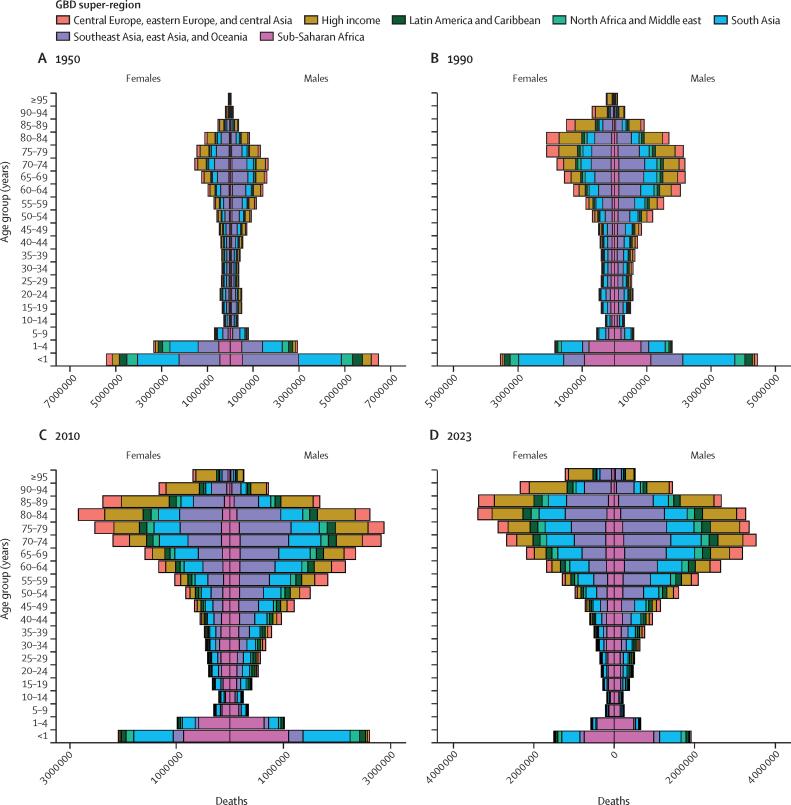
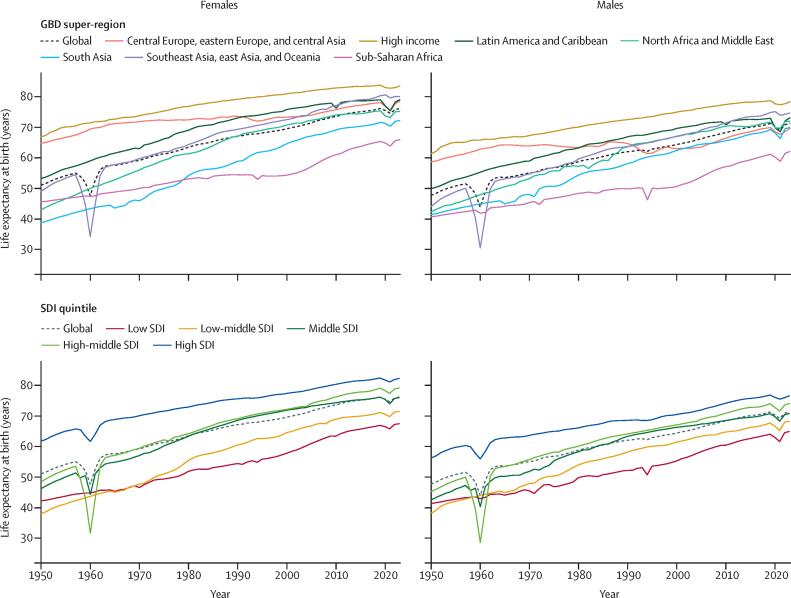
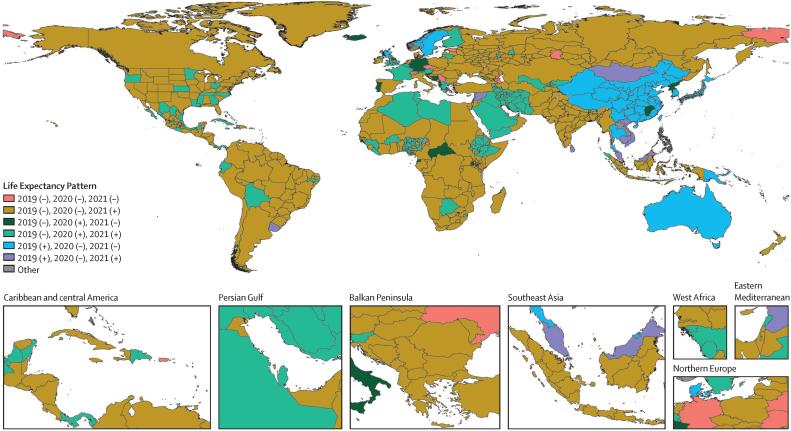
In 2023, 60·1 million (95% UI 59·0-61·1) deaths occurred globally, of which 4·67 million (4·59-4·75) were in children younger than 5 years. Due to considerable population growth and ageing since 1950, the number of annual deaths globally increased by 35·2% (32·2-38·4) over the 1950-2023 study period, during which the global age-standardised all-cause mortality rate declined by 66·6% (65·8-67·3). Trends in age-specific mortality rates between 2011 and 2023 varied by age group and location, with the largest decline in under-5 mortality occurring in east Asia (67·7% decrease); the largest increases in mortality for those aged 5-14 years, 25-29 years, and 30-39 years occurring in high-income North America (11·5%, 31·7%, and 49·9%, respectively); and the largest increases in mortality for those aged 15-19 years and 20-24 years occurring in Eastern Europe (53·9% and 40·1%, respectively). We also identified higher than previously estimated mortality rates in sub-Saharan Africa for all sexes combined aged 5-14 years (87·3% higher in GBD 2023 than GBD 2021 on average across countries and territories over the 1950-2021 period) and for females aged 15-29 years (61·2% higher), as well as lower than previously estimated mortality rates in sub-Saharan Africa for all sexes combined aged 50 years and older (13·2% lower), reflecting advances in our modelling approach. Global life expectancy followed three distinct trends over the study period. First, between 1950 and 2019, there were considerable improvements, from 51·2 (50·6-51·7) years for females and 47·9 (47·4-48·4) years for males in 1950 to 76·3 (76·2-76·4) years for females and 71·4 (71·3-71·5) years for males in 2019. Second, this period was followed by a decrease in life expectancy during the COVID-19 pandemic, to 74·7 (74·6-74·8) years for females and 69·3 (69·2-69·4) years for males in 2021. Finally, the world experienced a period of post-pandemic recovery in 2022 and 2023, wherein life expectancy generally returned to pre-pandemic (2019) levels in 2023 (76·3 [76·0-76·6] years for females and 71·5 [71·2-71·8] years for males). 194 (95·1%) of 204 countries and territories experienced at least partial post-pandemic recovery in age-standardised mortality rates by 2023, with 61·8% (126 of 204) recovering to or falling below pre-pandemic levels. There were several mortality trajectories during and following the pandemic across countries and territories. Long-term mortality trends also varied considerably between age groups and locations, demonstrating the diverse landscape of health outcomes globally.
INTERPRETATION
This analysis identified several key differences in mortality trends from previous estimates, including higher rates of adolescent mortality, higher rates of young adult mortality in females, and lower rates of mortality in older age groups in much of sub-Saharan Africa. The findings also highlight stark differences across countries and territories in the timing and scale of changes in all-cause mortality trends during and following the COVID-19 pandemic (2020-23). Our estimates of evolving trends in mortality and life expectancy across locations, ages, sexes, and SDI levels in recent years as well as over the entire 1950-2023 study period provide crucial information for governments, policy makers, and the public to ensure that health-care systems, economies, and societies are prepared to address the world's health needs, particularly in populations with higher rates of mortality than previously known. The estimates from this study provide a robust framework for GBD and a valuable foundation for policy development, implementation, and evaluation around the world.
FUNDING
Gates Foundation.
背景
对人口统计学指标(包括预期寿命和特定年龄死亡率)进行全面、可比且及时的估计,对于评估、理解和应对人口健康趋势至关重要。2019年冠状病毒病(COVID-19)大流行凸显了及时进行全因死亡率估计对于应对健康结果变化趋势的重要性,这表明迫切需要能够利用更易获取的全年龄生命登记(VR)数据更快地生成全因死亡率估计值的人口分析工具。全球疾病、伤害和风险因素负担研究(GBD)是一项正在进行的研究工作,通过估计一系列随时间、年龄、性别、地点、病因和风险而变化的流行病学相关数量来量化人类健康状况。本研究是最新的GBD发布版本GBD 2023的一部分,旨在使用一种新的统计模型,对1950年至2023年的全因死亡率和预期寿命提供新的更新估计,该模型考虑了年龄和时间维度上人口数据中的复杂相关结构。
方法
我们使用了来自VR、抽样登记、调查、人口普查和其他来源的24025个数据源,来估计204个国家和地区以及20个国家和地区的660个次国家单位中25个年龄组的男性、女性以及所有性别的全因死亡率,时间跨度为1950年至2023年。我们首次使用了5至14岁的完整出生史数据、15至49岁的特定年龄兄弟姐妹史数据以及卫生和人口监测系统的特定年龄死亡率数据。我们开发了一个结合参数和非参数方法的单一统计模型,称为OneMod,以生成每个年龄-性别-地点组的全因死亡率估计值。OneMod包括两个主要步骤:使用广义线性建模工具进行详细回归分析,该工具考虑特定年龄的协变量效应,如社会人口指数(SDI)以及所有风险因素综合的人群归因分数(PAF);使用多元核回归模型对残差进行非参数分析,该模型在年龄和时间上进行平滑处理,以适应性地跟踪数据趋势而不过度拟合。我们使用Pearson残差校准渐近不确定性估计值,以生成95%的不确定性区间(UI)和相应的1000次抽样。预期寿命采用标准人口统计学方法根据特定年龄死亡率计算得出。对于每个指标,95%的UI是根据1000次抽样后验分布中的第25和第975个排序值计算得出的。
结果
2023年,全球发生了6010万例(95% UI 5900 - 6110万例)死亡,其中5岁以下儿童死亡467万例(459 - 475万例)。由于自1950年以来人口的显著增长和老龄化,在1950 - 2023年的研究期间,全球年度死亡人数增加了35.2%(32.2 - 38.4%),在此期间,全球年龄标准化全因死亡率下降了66.6%(65.8 - 67.3%)。2011年至2023年期间,特定年龄死亡率趋势因年龄组和地点而异,5岁以下死亡率下降幅度最大的是东亚(下降67.7%);5至14岁、25至29岁和30至39岁人群死亡率上升幅度最大的是高收入的北美洲(分别上升11.5%、31.7%和49.9%);15至19岁和20至24岁人群死亡率上升幅度最大的是东欧(分别上升53.9%和40.1%)。我们还发现,撒哈拉以南非洲5至14岁所有性别人群的死亡率高于先前估计(在1950 - 2021年期间,各国和地区平均而言,GBD 2023比GBD 2021高87.3%),15至29岁女性的死亡率也高于先前估计(高61.2%),而撒哈拉以南非洲50岁及以上所有性别人群的死亡率低于先前估计(低13.2%),这反映了我们建模方法的进步。在研究期间,全球预期寿命呈现出三个不同的趋势。首先,1950年至2019年期间有显著改善,女性预期寿命从1950年的51.2岁(50.6 - 51.7岁)和男性的47.9岁(47.4 - 48.4岁)提高到2019年的76.3岁(76.2 - 76.4岁)和71.4岁(71.3 - 71.5岁)。其次,在此期间之后,COVID-19大流行期间预期寿命下降,2021年女性降至74.7岁(74.6 - 74.8岁),男性降至69.3岁(69.2 - 69.4岁)。最后,2022年和2023年世界经历了大流行后的恢复期,2023年预期寿命总体恢复到了大流行前(2019年)的水平(女性为76.3岁[76.0 - 76.6岁],男性为71.5岁[71.2 - 71.8岁])。到2023年,204个国家和地区中的194个(95.1%)在年龄标准化死亡率方面至少经历了部分大流行后的恢复,其中61.8%(204个中的126个)恢复到或低于大流行前水平。在大流行期间及之后,各国和地区存在多种死亡率轨迹。长期死亡率趋势在年龄组和地点之间也有很大差异,显示出全球健康结果的多样性。
解读
该分析确定了与先前估计相比死亡率趋势的几个关键差异,包括青少年死亡率较高、成年女性死亡率较高以及撒哈拉以南非洲大部分地区老年人群死亡率较低。研究结果还突出了各国和地区在COVID-19大流行期间及之后(2020 - 23年)全因死亡率趋势变化的时间和规模上的显著差异。我们对近年来以及整个1950 - 2023年研究期间不同地点、年龄、性别和SDI水平的死亡率和预期寿命演变趋势的估计,为政府、政策制定者和公众提供了关键信息,以确保医疗保健系统、经济和社会做好准备,满足全球的健康需求,特别是在死亡率高于先前已知水平的人群中。本研究的估计为GBD提供了一个强大的框架,并为全球政策制定、实施和评估提供了宝贵的基础。
资金来源
盖茨基金会




 Zotero 插件