
1990 - 2023年204个国家和地区以及660个次国家级地区292种死因的全球负担:全球疾病负担研究2023的系统分析
Global burden of 292 causes of death in 204 countries and territories and 660 subnational locations, 1990-2023: a systematic analysis for the Global Burden of Disease Study 2023.
出版信息
Lancet. 2025 Oct 18;406(10513):1811-1872. doi: 10.1016/S0140-6736(25)01917-8. Epub 2025 Oct 12.
BACKGROUND
Timely and comprehensive analyses of causes of death stratified by age, sex, and location are essential for shaping effective health policies aimed at reducing global mortality. The Global Burden of Diseases, Injuries, and Risk Factors Study (GBD) 2023 provides cause-specific mortality estimates measured in counts, rates, and years of life lost (YLLs). GBD 2023 aimed to enhance our understanding of the relationship between age and cause of death by quantifying the probability of dying before age 70 years (70q0) and the mean age at death by cause and sex. This study enables comparisons of the impact of causes of death over time, offering a deeper understanding of how these causes affect global populations.
METHODS
GBD 2023 produced estimates for 292 causes of death disaggregated by age-sex-location-year in 204 countries and territories and 660 subnational locations for each year from 1990 until 2023. We used a modelling tool developed for GBD, the Cause of Death Ensemble model (CODEm), to estimate cause-specific death rates for most causes. We computed YLLs as the product of the number of deaths for each cause-age-sex-location-year and the standard life expectancy at each age. Probability of death was calculated as the chance of dying from a given cause in a specific age period, for a specific population. Mean age at death was calculated by first assigning the midpoint age of each age group for every death, followed by computing the mean of all midpoint ages across all deaths attributed to a given cause. We used GBD death estimates to calculate the observed mean age at death and to model the expected mean age across causes, sexes, years, and locations. The expected mean age reflects the expected mean age at death for individuals within a population, based on global mortality rates and the population's age structure. Comparatively, the observed mean age represents the actual mean age at death, influenced by all factors unique to a location-specific population, including its age structure. As part of the modelling process, uncertainty intervals (UIs) were generated using the 2·5th and 97·5th percentiles from a 250-draw distribution for each metric. Findings are reported as counts and age-standardised rates. Methodological improvements for cause-of-death estimates in GBD 2023 include a correction for the misclassification of deaths due to COVID-19, updates to the method used to estimate COVID-19, and updates to the CODEm modelling framework. This analysis used 55 761 data sources, including vital registration and verbal autopsy data as well as data from surveys, censuses, surveillance systems, and cancer registries, among others. For GBD 2023, there were 312 new country-years of vital registration cause-of-death data, 3 country-years of surveillance data, 51 country-years of verbal autopsy data, and 144 country-years of other data types that were added to those used in previous GBD rounds.
FINDINGS
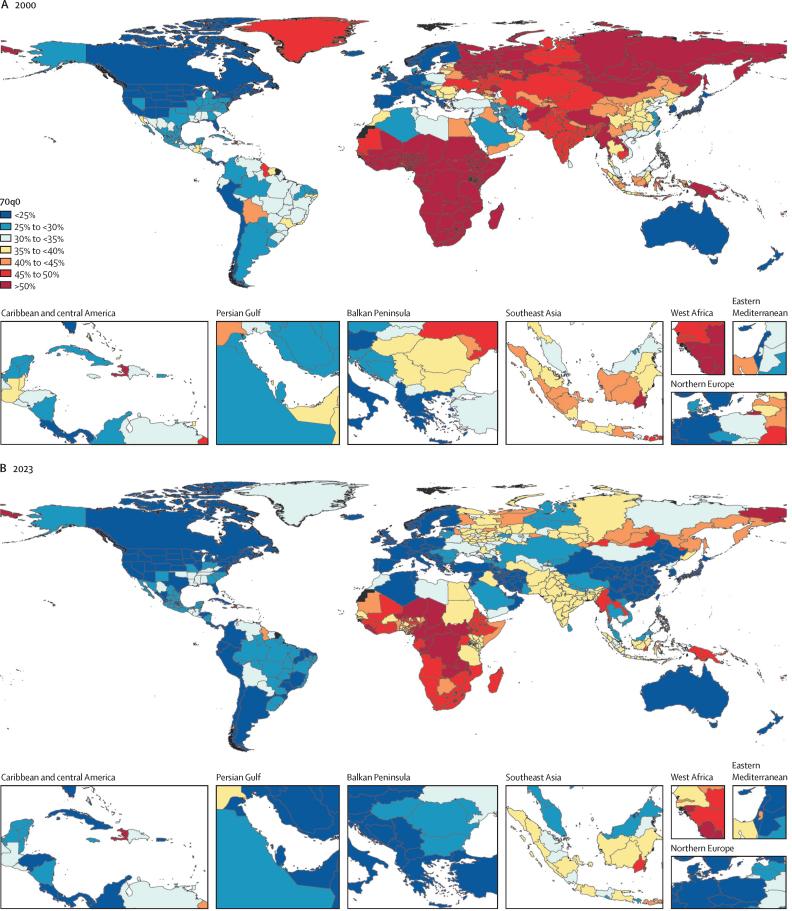
The initial years of the COVID-19 pandemic caused shifts in long-standing rankings of the leading causes of global deaths: it ranked as the number one age-standardised cause of death at Level 3 of the GBD cause classification hierarchy in 2021. By 2023, COVID-19 dropped to the 20th place among the leading global causes, returning the rankings of the leading two causes to those typical across the time series (ie, ischaemic heart disease and stroke). While ischaemic heart disease and stroke persist as leading causes of death, there has been progress in reducing their age-standardised mortality rates globally. Four other leading causes have also shown large declines in global age-standardised mortality rates across the study period: diarrhoeal diseases, tuberculosis, stomach cancer, and measles. Other causes of death showed disparate patterns between sexes, notably for deaths from conflict and terrorism in some locations. A large reduction in age-standardised rates of YLLs occurred for neonatal disorders. Despite this, neonatal disorders remained the leading cause of global YLLs over the period studied, except in 2021, when COVID-19 was temporarily the leading cause. Compared to 1990, there has been a considerable reduction in total YLLs in many vaccine-preventable diseases, most notably diphtheria, pertussis, tetanus, and measles. In addition, this study quantified the mean age at death for all-cause mortality and cause-specific mortality and found noticeable variation by sex and location. The global all-cause mean age at death increased from 46·8 years (95% UI 46·6-47·0) in 1990 to 63·4 years (63·1-63·7) in 2023. For males, mean age increased from 45·4 years (45·1-45·7) to 61·2 years (60·7-61·6), and for females it increased from 48·5 years (48·1-48·8) to 65·9 years (65·5-66·3), from 1990 to 2023. The highest all-cause mean age at death in 2023 was found in the high-income super-region, where the mean age for females reached 80·9 years (80·9-81·0) and for males 74·8 years (74·8-74·9). By comparison, the lowest all-cause mean age at death occurred in sub-Saharan Africa, where it was 38·0 years (37·5-38·4) for females and 35·6 years (35·2-35·9) for males in 2023. Lastly, our study found that all-cause 70q0 decreased across each GBD super-region and region from 2000 to 2023, although with large variability between them. For females, we found that 70q0 notably increased from drug use disorders and conflict and terrorism. Leading causes that increased 70q0 for males also included drug use disorders, as well as diabetes. In sub-Saharan Africa, there was an increase in 70q0 for many non-communicable diseases (NCDs). Additionally, the mean age at death from NCDs was lower than the expected mean age at death for this super-region. By comparison, there was an increase in 70q0 for drug use disorders in the high-income super-region, which also had an observed mean age at death lower than the expected value.
INTERPRETATION
We examined global mortality patterns over the past three decades, highlighting-with enhanced estimation methods-the impacts of major events such as the COVID-19 pandemic, in addition to broader trends such as increasing NCDs in low-income regions that reflect ongoing shifts in the global epidemiological transition. This study also delves into premature mortality patterns, exploring the interplay between age and causes of death and deepening our understanding of where targeted resources could be applied to further reduce preventable sources of mortality. We provide essential insights into global and regional health disparities, identifying locations in need of targeted interventions to address both communicable and non-communicable diseases. There is an ever-present need for strengthened health-care systems that are resilient to future pandemics and the shifting burden of disease, particularly among ageing populations in regions with high mortality rates. Robust estimates of causes of death are increasingly essential to inform health priorities and guide efforts toward achieving global health equity. The need for global collaboration to reduce preventable mortality is more important than ever, as shifting burdens of disease are affecting all nations, albeit at different paces and scales.
FUNDING
Gates Foundation.
背景
按年龄、性别和地点对死亡原因进行及时、全面的分析,对于制定旨在降低全球死亡率的有效卫生政策至关重要。《2023年全球疾病、伤害和风险因素负担研究》(GBD 2023)提供了以计数、比率和生命损失年数(YLLs)衡量的特定病因死亡率估计值。GBD 2023旨在通过量化70岁前死亡概率(70q0)以及按病因和性别划分的平均死亡年龄,加强我们对年龄与死亡原因之间关系的理解。这项研究能够比较不同时间死亡原因的影响,更深入地了解这些原因如何影响全球人口。
方法
GBD 2023对1990年至2023年期间204个国家和地区以及660个次国家地区按年龄 - 性别 - 地点 - 年份分类的292种死亡原因进行了估计。我们使用为GBD开发的建模工具——死因综合模型(CODEm),来估计大多数病因的特定死因死亡率。我们将YLLs计算为每个病因 - 年龄 - 性别 - 地点 - 年份的死亡人数与各年龄标准预期寿命的乘积。死亡概率计算为特定人群在特定年龄期间死于特定病因的几率。平均死亡年龄的计算方法是,首先为每例死亡指定每个年龄组的中点年龄,然后计算归因于给定病因的所有死亡的所有中点年龄的平均值。我们使用GBD死亡估计值来计算观察到的平均死亡年龄,并对各病因、性别、年份和地点的预期平均年龄进行建模。预期平均年龄反映了基于全球死亡率和人群年龄结构的人群中个体的预期平均死亡年龄。相比之下,观察到的平均年龄代表了实际平均死亡年龄,受特定地点人群特有的所有因素影响,包括其年龄结构。作为建模过程的一部分,使用每个指标250次抽样分布的第2.5百分位数和第97.5百分位数生成不确定性区间(UIs)。研究结果以计数和年龄标准化率报告。GBD 2023中死因估计的方法改进包括对因COVID - 19导致的死亡误分类进行校正、更新用于估计COVID - 19的方法以及更新CODEm建模框架。该分析使用了55761个数据源,包括生命登记和口头尸检数据以及来自调查、人口普查、监测系统和癌症登记处等的数据。对于GBD 2023,新增了312个国家年份的生命登记死因数据、3个国家年份的监测数据、51个国家年份的口头尸检数据以及144个国家年份的其他数据类型,这些数据被添加到先前GBD轮次使用的数据中。
结果
COVID - 19大流行的最初几年导致全球主要死因的长期排名发生变化:在2021年,它在GBD病因分类层次结构的第3级中排名为年龄标准化的首要死因。到2023年,COVID - 19降至全球主要死因的第20位,前两位死因的排名恢复到整个时间序列中的典型排名(即缺血性心脏病和中风)。虽然缺血性心脏病和中风仍然是主要死因,但全球范围内其年龄标准化死亡率有所下降。在整个研究期间,其他四个主要死因的全球年龄标准化死亡率也大幅下降:腹泻病、结核病、胃癌和麻疹。其他死因在性别之间表现出不同模式,特别是在某些地区因冲突和恐怖主义导致的死亡。新生儿疾病的年龄标准化YLLs率大幅下降。尽管如此,在所研究的时期内,新生儿疾病仍然是全球YLLs的主要原因,2021年除外,当时COVID - 19暂时是主要原因。与1990年相比,许多疫苗可预防疾病的总YLLs大幅减少,最显著的是白喉、百日咳、破伤风和麻疹。此外,本研究对全死因死亡率和特定病因死亡率的平均死亡年龄进行了量化,并发现了按性别和地点的显著差异。全球全死因平均死亡年龄从1990年的46.8岁(95% UI 46.6 - 47.0)增加到2023年的63.4岁(63.1 - 63.7)。男性平均年龄从45.4岁(45.1 - 45.7)增加到61.2岁(60.7 - 61.6),女性从48.5岁(48.1 - 48.8)增加到65.9岁(65.5 - 66.3),从1990年到2023年。2023年全死因平均死亡年龄最高的是高收入超级地区,该地区女性平均年龄达到80.9岁(80.9 - 81.0),男性为74.8岁(74.8 - 74.9)。相比之下,全死因平均死亡年龄最低的是撒哈拉以南非洲,2023年女性为38.0岁(37.5 - 38.4),男性为35.6岁(35.2 - 35.9)。最后,我们的研究发现,从2000年到2023年,每个GBD超级地区和地区的全死因70q0都有所下降,尽管它们之间存在很大差异。对于女性,我们发现药物使用障碍以及冲突和恐怖主义导致70q0显著增加。导致男性70q0增加的主要原因还包括药物使用障碍以及糖尿病。在撒哈拉以南非洲,许多非传染性疾病(NCDs)的70q0有所增加。此外,该超级地区NCDs的平均死亡年龄低于预期平均死亡年龄。相比之下,高收入超级地区药物使用障碍的70q0有所增加,其观察到的平均死亡年龄也低于预期值。
解读
我们研究了过去三十年的全球死亡模式,除了低收入地区非传染性疾病增加等更广泛趋势(反映了全球流行病学转变的持续变化)外,还通过改进估计方法突出了COVID - 19大流行等重大事件的影响。本研究还深入探讨了过早死亡模式,探索年龄与死亡原因之间的相互作用,并加深了我们对可将目标资源应用于何处以进一步减少可预防死亡来源的理解。我们提供了关于全球和区域卫生差距的重要见解,确定了需要针对性干预以应对传染病和非传染病的地点。对于能够抵御未来大流行和疾病负担变化的强化卫生保健系统的需求一直存在,特别是在高死亡率地区的老年人口中。对死因的可靠估计对于为卫生优先事项提供信息和指导实现全球卫生公平的努力越来越重要。全球合作以减少可预防死亡率的需求比以往任何时候都更加重要,因为疾病负担的变化正在影响所有国家,尽管速度和规模不同。
资金来源
盖茨基金会



 Zotero 插件