
将代谢数量性状基因座与控制生物合成途径的网络和顺式表达数量性状基因座相联系。
Linking metabolic QTLs with network and cis-eQTLs controlling biosynthetic pathways.
作者信息
Wentzell Adam M, Rowe Heather C, Hansen Bjarne Gram, Ticconi Carla, Halkier Barbara Ann, Kliebenstein Daniel J
机构信息
Department of Plant Sciences, University of California Davis, Davis, California, USA.
出版信息
PLoS Genet. 2007 Sep;3(9):1687-701. doi: 10.1371/journal.pgen.0030162. Epub 2007 Aug 1.
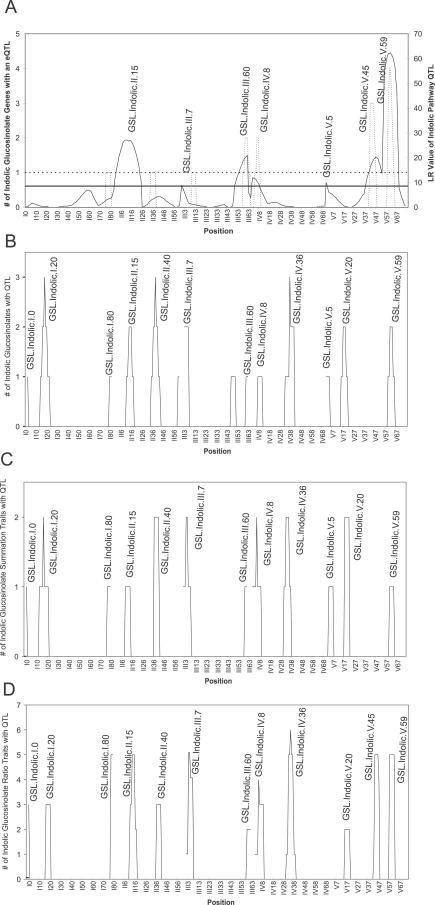
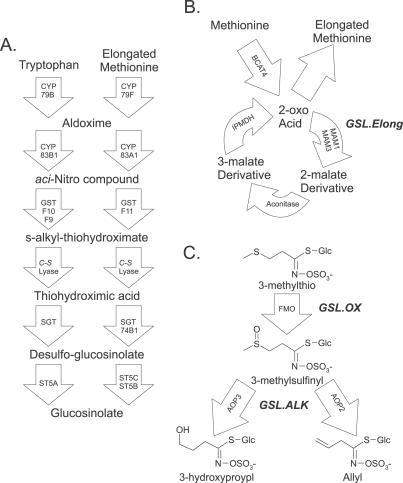
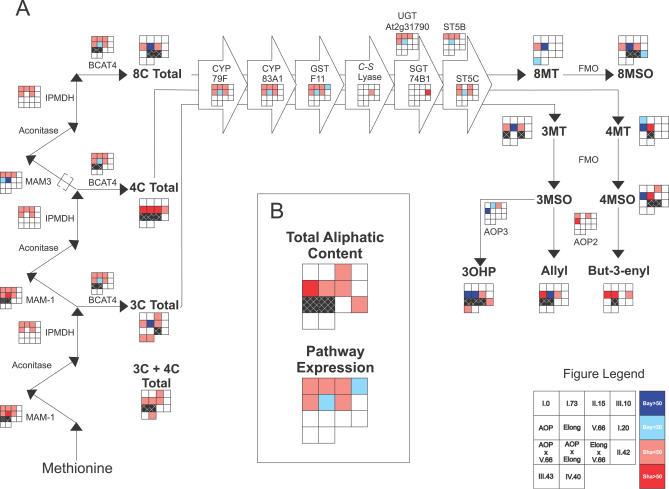
Phenotypic variation between individuals of a species is often under quantitative genetic control. Genomic analysis of gene expression polymorphisms between individuals is rapidly gaining popularity as a way to query the underlying mechanistic causes of variation between individuals. However, there is little direct evidence of a linkage between global gene expression polymorphisms and phenotypic consequences. In this report, we have mapped quantitative trait loci (QTLs)-controlling glucosinolate content in a population of 403 Arabidopsis Bay x Sha recombinant inbred lines, 211 of which were previously used to identify expression QTLs controlling the transcript levels of biosynthetic genes. In a comparative study, we have directly tested two plant biosynthetic pathways for association between polymorphisms controlling biosynthetic gene transcripts and the resulting metabolites within the Arabidopsis Bay x Sha recombinant inbred line population. In this analysis, all loci controlling expression variation also affected the accumulation of the resulting metabolites. In addition, epistasis was detected more frequently for metabolic traits compared to transcript traits, even when both traits showed similar distributions. An analysis of candidate genes for QTL-controlling networks of transcripts and metabolites suggested that the controlling factors are a mix of enzymes and regulatory factors. This analysis showed that regulatory connections can feedback from metabolism to transcripts. Surprisingly, the most likely major regulator of both transcript level for nearly the entire pathway and aliphatic glucosinolate accumulation is variation in the last enzyme in the biosynthetic pathway, AOP2. This suggests that natural variation in transcripts may significantly impact phenotypic variation, but that natural variation in metabolites or their enzymatic loci can feed back to affect the transcripts.
一个物种个体间的表型变异通常受数量遗传控制。作为一种探究个体间变异潜在机制原因的方法,对个体间基因表达多态性进行基因组分析正迅速受到欢迎。然而,几乎没有直接证据表明全球基因表达多态性与表型后果之间存在联系。在本报告中,我们在由403个拟南芥Bay×Sha重组自交系组成的群体中定位了控制芥子油苷含量的数量性状基因座(QTL),其中211个先前已用于鉴定控制生物合成基因转录水平的表达QTL。在一项比较研究中,我们在拟南芥Bay×Sha重组自交系群体内,直接测试了两条植物生物合成途径中控制生物合成基因转录本的多态性与所产生代谢物之间的关联。在该分析中,所有控制表达变异的基因座也影响了所产生代谢物的积累。此外,即使转录本性状和代谢性状都显示出相似的分布,但与转录本性状相比,代谢性状检测到上位性的频率更高。对转录本和代谢物的QTL控制网络的候选基因分析表明,控制因子是酶和调节因子的混合体。该分析表明调节连接可以从代谢反馈到转录本。令人惊讶的是,几乎整个途径的转录本水平和脂肪族芥子油苷积累的最可能主要调节因子是生物合成途径中最后一种酶AOP2的变异。这表明转录本中的自然变异可能会显著影响表型变异,但代谢物或其酶基因座中的自然变异可以反馈影响转录本。




 Zotero 插件