
流感病毒的传播取决于相对湿度和温度。
Influenza virus transmission is dependent on relative humidity and temperature.
作者信息
Lowen Anice C, Mubareka Samira, Steel John, Palese Peter
机构信息
Department of Microbiology, Mount Sinai School of Medicine, New York, New York, USA.
出版信息
PLoS Pathog. 2007 Oct 19;3(10):1470-6. doi: 10.1371/journal.ppat.0030151.
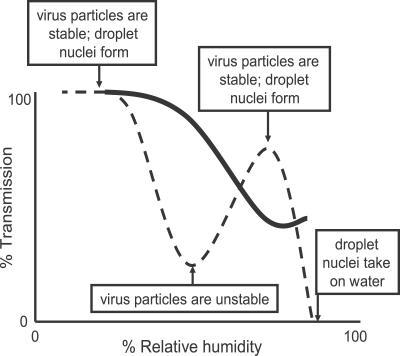
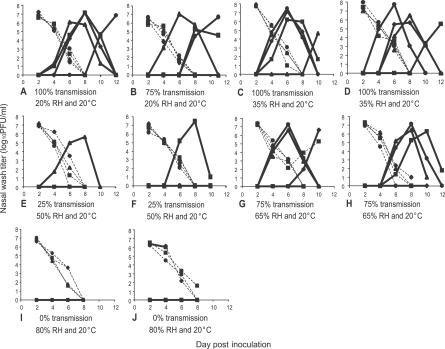
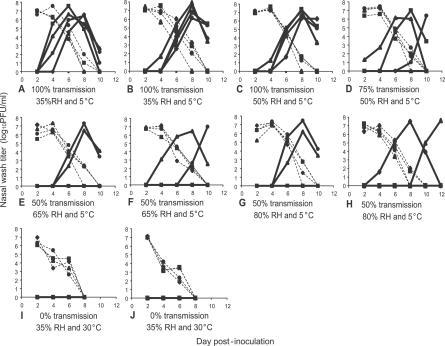
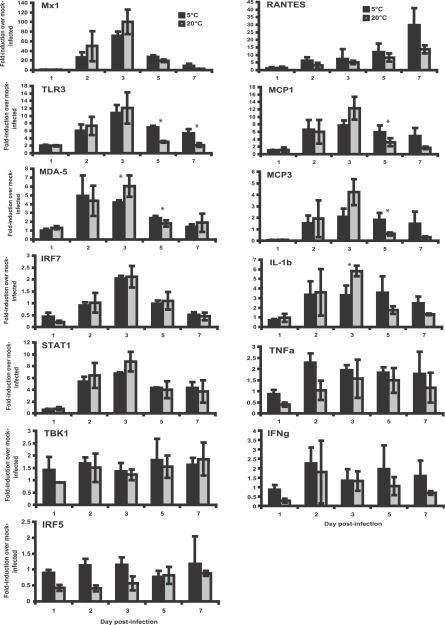
Using the guinea pig as a model host, we show that aerosol spread of influenza virus is dependent upon both ambient relative humidity and temperature. Twenty experiments performed at relative humidities from 20% to 80% and 5 degrees C, 20 degrees C, or 30 degrees C indicated that both cold and dry conditions favor transmission. The relationship between transmission via aerosols and relative humidity at 20 degrees C is similar to that previously reported for the stability of influenza viruses (except at high relative humidity, 80%), implying that the effects of humidity act largely at the level of the virus particle. For infected guinea pigs housed at 5 degrees C, the duration of peak shedding was approximately 40 h longer than that of animals housed at 20 degrees C; this increased shedding likely accounts for the enhanced transmission seen at 5 degrees C. To investigate the mechanism permitting prolonged viral growth, expression levels in the upper respiratory tract of several innate immune mediators were determined. Innate responses proved to be comparable between animals housed at 5 degrees C and 20 degrees C, suggesting that cold temperature (5 degrees C) does not impair the innate immune response in this system. Although the seasonal epidemiology of influenza is well characterized, the underlying reasons for predominant wintertime spread are not clear. We provide direct, experimental evidence to support the role of weather conditions in the dynamics of influenza and thereby address a long-standing question fundamental to the understanding of influenza epidemiology and evolution.
以豚鼠作为模型宿主,我们发现流感病毒的气溶胶传播取决于环境相对湿度和温度。在20%至80%的相对湿度以及5摄氏度、20摄氏度或30摄氏度条件下进行的20项实验表明,寒冷和干燥的条件都有利于传播。在20摄氏度时,通过气溶胶传播与相对湿度之间的关系与先前报道的流感病毒稳定性关系相似(80%的高相对湿度情况除外),这意味着湿度的影响主要作用于病毒颗粒水平。对于饲养在5摄氏度环境中的感染豚鼠,病毒峰值排出持续时间比饲养在20摄氏度环境中的动物长约40小时;这种排出增加可能是5摄氏度时传播增强的原因。为了研究允许病毒长时间生长的机制,我们测定了几种先天免疫介质在上呼吸道中的表达水平。结果证明,饲养在5摄氏度和20摄氏度环境中的动物的先天反应相当,这表明低温(5摄氏度)不会损害该系统中的先天免疫反应。虽然流感的季节性流行病学特征已很明确,但冬季传播占主导的根本原因尚不清楚。我们提供了直接的实验证据来支持天气条件在流感动态变化中的作用,从而解决了一个长期存在的、对于理解流感流行病学和进化至关重要的基本问题。


 Zotero 插件