
脯氨酸脱氢酶(ProDH)在拟南芥过敏反应中的作用背景。
Context of action of proline dehydrogenase (ProDH) in the Hypersensitive Response of Arabidopsis.
机构信息
Centro de Investigaciones en Química Biológica de Córdoba CIQUIBIC, UNC-CONICET, Departamento de Química Biológica, Facultad de Ciencias Químicas, Universidad Nacional de Córdoba, Haya de la Torre y Medina Allende, Ciudad Universitaria, X5000HUA Córdoba, Argentina.
出版信息
BMC Plant Biol. 2014 Jan 13;14:21. doi: 10.1186/1471-2229-14-21.
BACKGROUND
Proline (Pro) dehydrogenase (ProDH) potentiates the oxidative burst and cell death of the plant Hypersensitive Response (HR) by mechanisms not yet elucidated. ProDH converts Pro into ∆1 pyrroline-5-carboxylate (P5C) and can act together with P5C dehydrogenase (P5CDH) to produce Glu, or with P5C reductase (P5CR) to regenerate Pro and thus stimulate the Pro/P5C cycle. To better understand the effects of ProDH in HR, we studied the enzyme at three stages of the defense response differing in their ROS and cell death levels. In addition, we tested if ProDH requires P5CDH to potentiate HR.
RESULTS
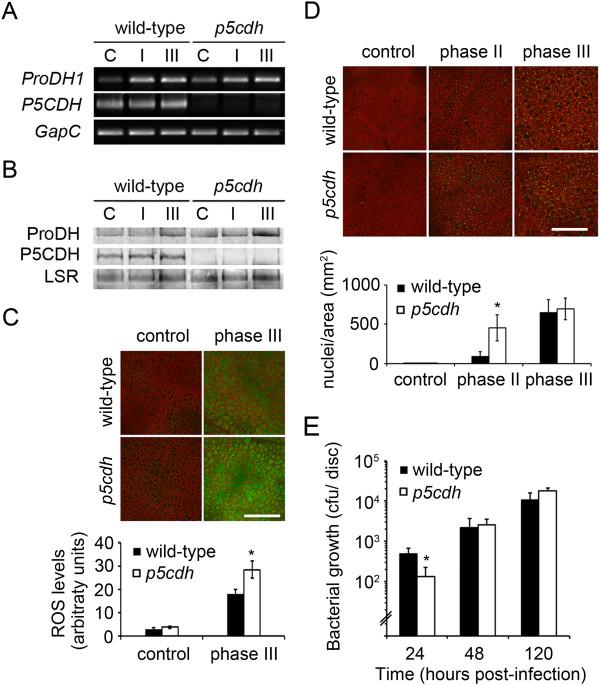
Control and infected leaves of wild type and p5cdh plants were used to monitor ProDH activity, in vivo Pro catabolism, amino acid content, and gene expression. Wild type plants activated ProDH at all HR stages. They did not consume Pro during maximal ROS accumulation, and maintained almost basal P5C levels at all conditions. p5cdh mutants activated ProDH as wild type plants. They achieved maximum oxidative burst and cell death levels producing normal HR lesions, but evidenced premature defense activation.
CONCLUSION
ProDH activation has different effects on HR. Before the oxidative burst it leads to Pro consumption involving the action of P5CDH. During the oxidative burst, ProDH becomes functionally uncoupled to P5CDH and apparently works with P5CR. The absence of P5CDH does not reduce ROS, cell death, or pathogen resistance, indicating this enzyme is not accompanying ProDH in the potentiation of these defense responses. In contrast, p5cdh infected plants displayed increased ROS burst and earlier initiation of HR cell death. In turn, our results suggest that ProDH may sustain HR by participating in the Pro/P5C cycle, whose action on HR must be formally evaluated in a future.
背景
脯氨酸(Pro)脱氢酶(ProDH)通过尚未阐明的机制增强植物过敏反应(HR)的氧化爆发和细胞死亡。ProDH 将 Pro 转化为 ∆1 吡咯啉-5-羧酸(P5C),并可以与 P5C 脱氢酶(P5CDH)一起产生 Glu,或与 P5C 还原酶(P5CR)一起再生 Pro 并刺激 Pro/P5C 循环。为了更好地理解 ProDH 在 HR 中的作用,我们在防御反应的三个阶段研究了该酶,这些阶段在 ROS 和细胞死亡水平上有所不同。此外,我们还测试了 ProDH 是否需要 P5CDH 来增强 HR。
结果
使用野生型和 p5cdh 植物的对照和感染叶片来监测 ProDH 活性、体内 Pro 分解代谢、氨基酸含量和基因表达。野生型植物在所有 HR 阶段都激活了 ProDH。它们在最大 ROS 积累期间不消耗 Pro,并在所有条件下保持几乎基础的 P5C 水平。p5cdh 突变体像野生型植物一样激活 ProDH。它们达到最大氧化爆发和细胞死亡水平,产生正常的 HR 损伤,但表现出过早的防御激活。
结论
ProDH 的激活对 HR 有不同的影响。在氧化爆发之前,它会导致 Pro 的消耗,涉及到 P5CDH 的作用。在氧化爆发期间,ProDH 与 P5CDH 功能上解偶联,显然与 P5CR 一起工作。缺乏 P5CDH 不会减少 ROS、细胞死亡或病原体抗性,表明该酶在增强这些防御反应中不伴随 ProDH。相比之下,p5cdh 感染的植物表现出更强的 ROS 爆发和更早的 HR 细胞死亡的启动。反过来,我们的结果表明,ProDH 可能通过参与 Pro/P5C 循环来维持 HR,其在 HR 中的作用需要在未来进行正式评估。


 Zotero 插件