
慢性阻塞性肺疾病患者的上身阻力训练与自我效能增强
Upper-Body Resistance Training and Self-Efficacy Enhancement in COPD.
作者信息
Covey Margaret K, McAuley Edward, Kapella Mary C, Collins Eileen G, Alex Charles G, Berbaum Michael L, Larson Janet L
机构信息
Department of Biobehavioral Health Science, College of Nursing, University of Illinois at Chicago, USA.
Department of Kinesiology and Community Health, College of Applied Health Sciences, University of Illinois at Urbana-Champaign, USA.
出版信息
J Pulm Respir Med. 2012 Apr 20;Suppl 9:001. doi: 10.4172/2161-105X.S9-001.
PURPOSE
Loss of skeletal muscle strength is commonly seen with chronic obstructive pulmonary disease (COPD). The study aim was to determine the effects of comprehensive upper-body resistance training (8 different lifts) and a self-efficacy enhancing intervention in COPD with respect to muscle strength, symptoms, functional status and exercise adherence.
METHODS
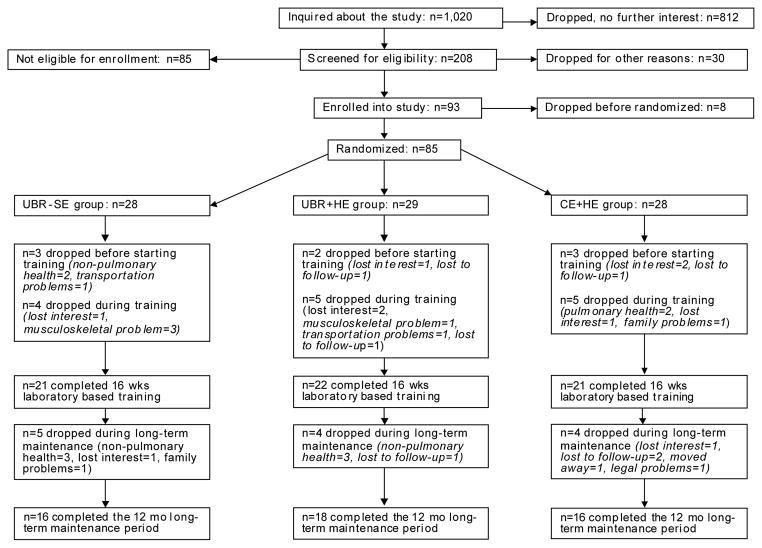
This randomized trial had 3 groups: upper-body resistance training with an intervention to enhance self-efficacy (UBR + SE), upper-body resistance training and health education (UBR + HE), gentle chair exercises and health education (CE + HE). Subjects performed 16 weeks of supervised training, then 12 months of long-term maintenance at home. Outcomes were: muscle strength, dyspnea, functional status, self-efficacy, and adherence.
RESULTS
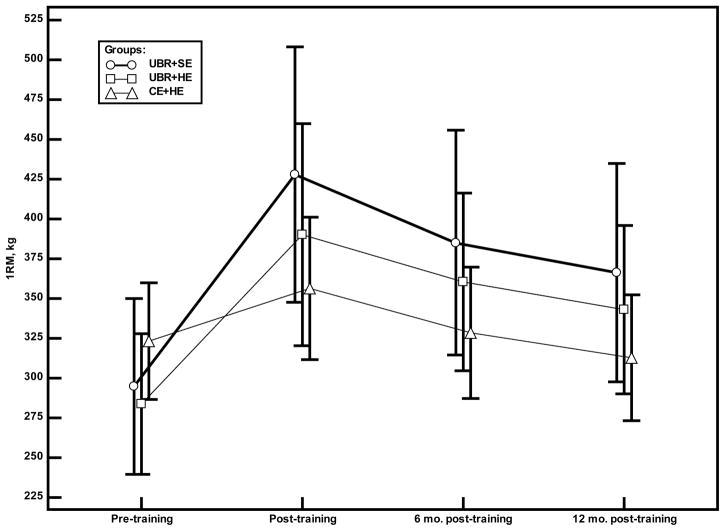
Sixty-four subjects completed 16 wks of training: age 71 ± 8 yr, fat-free mass index 19 ± 3 kg/m, forced expiratory volume in one second 58 ± 18 percent predicted. The UBR + SE intervention produced a 46% increase in strength compared to a 36% increase in the UBR + HE group ( = 0.054). The combined UBR + SE and UBR + HE groups produced a 41% increase in strength compared to an 11% increase in the CE+HE ( < 0.001). The combined UBR groups also demonstrated increases in lean arm mass ( = 0.003) and a trend toward decreased dyspnea ( = 0.053). There were no group differences in attrition, attendance and training progression. Fifty subjects completed long-term maintenance and the UBR + SE and UBR + HE groups retained some gains in muscle strength, 24% and 21% respectively, and the CE + HE group lost 3% of muscle strength from baseline.
CONCLUSION
The study provides strong evidence that comprehensive resistance training increased strength and lean arm mass and that strength can be partially maintained through a simple home program using hand weights. It provides limited evidence that upper-body resistance training improved dyspnea and that the exercise-specific self-efficacy enhancing intervention was beneficial.
目的
骨骼肌力量下降在慢性阻塞性肺疾病(COPD)中很常见。本研究旨在确定综合上身阻力训练(8种不同的举重动作)和自我效能增强干预对COPD患者肌肉力量、症状、功能状态和运动依从性的影响。
方法
这项随机试验有3组:进行上身阻力训练并辅以自我效能增强干预(UBR + SE)、进行上身阻力训练并接受健康教育(UBR + HE)、进行温和的椅子运动并接受健康教育(CE + HE)。受试者进行16周的监督训练,然后在家中进行12个月的长期维持训练。观察指标包括:肌肉力量、呼吸困难、功能状态、自我效能和依从性。
结果
64名受试者完成了16周的训练:年龄71±8岁,去脂体重指数19±3 kg/m,一秒用力呼气量为预测值的58±18%。与UBR + HE组力量增加36%相比,UBR + SE干预使力量增加了46%(P = 0.054)。与CE + HE组力量增加11%相比,UBR + SE组和UBR + HE组合计使力量增加了41%(P < 0.001)。联合UBR组还显示瘦手臂质量增加(P = 0.003),呼吸困难有减轻趋势(P = 0.053)。在损耗、出勤和训练进展方面,各小组之间没有差异。50名受试者完成了长期维持训练,UBR + SE组和UBR + HE组分别保持了24%和21%的肌肉力量增长,而CE + HE组的肌肉力量从基线水平下降了3%。
结论
该研究提供了有力证据,表明综合阻力训练可增加力量和瘦手臂质量,且通过使用哑铃的简单家庭训练计划可部分维持力量。它提供了有限的证据,表明上身阻力训练可改善呼吸困难,且特定运动的自我效能增强干预是有益的。

 Zotero 插件