
中国糖尿病性周围神经病理性疼痛患者的治疗:度洛西汀与安慰剂的双盲随机试验
Treatment of patients with diabetic peripheral neuropathic pain in China: a double-blind randomised trial of duloxetine vs. placebo.
作者信息
Gao Y, Guo X, Han P, Li Q, Yang G, Qu S, Yue L, Wang C-N, Skljarevski V, Dueñas H, Raskin J, Gu L
机构信息
Peking University First Hospital, Beijing, China.
Shengjing Hospital of China Medical University, Shengyang, China.
出版信息
Int J Clin Pract. 2015 Sep;69(9):957-66. doi: 10.1111/ijcp.12641. Epub 2015 May 4.
BACKGROUND
Duloxetine has been approved in the United States, European Union and some Asian countries for the treatment of diabetic peripheral neuropathic pain (DPNP). We assessed the efficacy and safety of duloxetine (60 mg once daily) compared with placebo in Chinese patients suffering from DPNP.
METHODS
This was a phase 3, multicenter, randomised, double-blind, parallel, placebo-controlled, 12-week trial of the treatment of DPNP with duloxetine. Subjects were male and female outpatients ≥ 18 years of age with DPNP, as assessed by the Michigan Neuropathy Screening Instrument, and had a rating of ≥ 4 on the Brief Pain Inventory-Modified Short Form-Severity weekly average pain item. The primary efficacy measure was the reduction in pain severity from baseline to 12 weeks, as measured by the weekly mean of 24-h average pain ratings recorded in the patient's diary. Mean changes from baseline in efficacy measures were analysed by a restricted maximum likelihood-based, mixed-effects model repeated measures approach and by analysis of covariance.
RESULTS
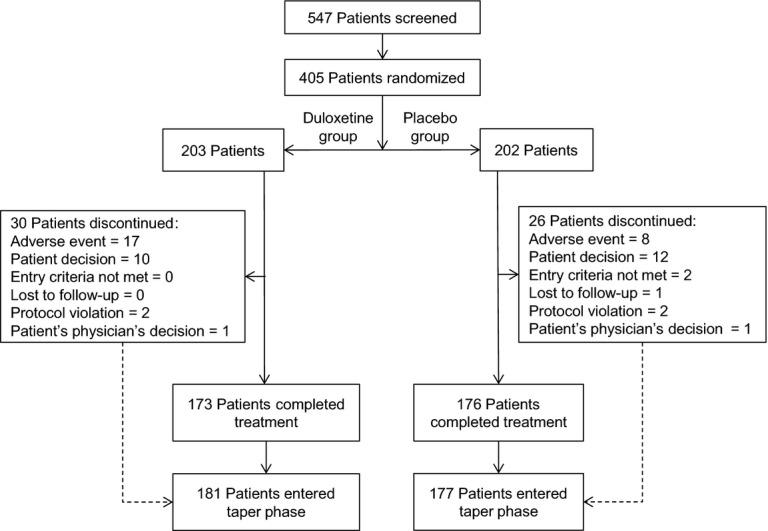
Of the 405 patients randomised, 203 patients were assigned to duloxetine 60 mg once daily and 202 patients were assigned to placebo. Duloxetine-treated patients showed significantly greater pain relief on 24-h average pain ratings compared with placebo-treated patients each week of the 12-week study period [week 12: least squares (LS) mean change duloxetine: -2.40, placebo: -1.97; LS mean change difference (95% confidence interval) = -0.43 (-0.82, -0.04), p = 0.030]. Compared with placebo, patients treated with duloxetine experienced higher rates of nausea (p = 0.010), somnolence (p < 0.001) and asthenia (p = 0.002).
CONCLUSIONS
Duloxetine-treated patients showed significantly greater pain relief compared with placebo-treated patients over the 12-week study period. Duloxetine was shown in Chinese patients to have a safety profile similar to that found in previous duloxetine trials.
背景
度洛西汀已在美国、欧盟和一些亚洲国家获批用于治疗糖尿病性周围神经病变性疼痛(DPNP)。我们评估了度洛西汀(每日一次,60毫克)与安慰剂相比,对中国DPNP患者的疗效和安全性。
方法
这是一项为期12周的3期、多中心、随机、双盲、平行、安慰剂对照试验,旨在研究度洛西汀治疗DPNP的效果。受试者为年龄≥18岁的DPNP门诊患者,男女不限,通过密歇根神经病变筛查工具评估,且在简明疼痛量表-修订简表-严重程度每周平均疼痛项目上的评分≥4分。主要疗效指标是从基线到12周时疼痛严重程度的降低,通过患者日记中记录的24小时平均疼痛评分的每周平均值来衡量。疗效指标相对于基线的平均变化通过基于限制最大似然法的混合效应模型重复测量方法和协方差分析进行分析。
结果
在405名随机分组的患者中,203名患者被分配至每日一次服用60毫克度洛西汀组,202名患者被分配至安慰剂组。在为期12周的研究期间,与安慰剂治疗组患者相比,度洛西汀治疗组患者在每周24小时平均疼痛评分上的疼痛缓解程度显著更大[第12周:最小二乘法(LS)平均变化度洛西汀:-2.40,安慰剂:-1.97;LS平均变化差异(95%置信区间)=-0.43(-0.82,-0.04),p = 0.030]。与安慰剂相比,度洛西汀治疗的患者出现恶心(p = 0.010)、嗜睡(p < 0.001)和乏力(p = 0.002)的发生率更高。
结论
在为期12周的研究期间,与安慰剂治疗组患者相比,度洛西汀治疗组患者的疼痛缓解程度显著更大。在中国患者中,度洛西汀的安全性与之前度洛西汀试验中的情况相似。



 Zotero 插件