
大豆(Glycine max)SWEET基因家族:通过比较基因组学、转录组分析和全基因组重测序分析获得的见解
Soybean (Glycine max) SWEET gene family: insights through comparative genomics, transcriptome profiling and whole genome re-sequence analysis.
作者信息
Patil Gunvant, Valliyodan Babu, Deshmukh Rupesh, Prince Silvas, Nicander Bjorn, Zhao Mingzhe, Sonah Humira, Song Li, Lin Li, Chaudhary Juhi, Liu Yang, Joshi Trupti, Xu Dong, Nguyen Henry T
机构信息
National Center for Soybean Biotechnology and Division of Plant Sciences, University of Missouri, Columbia, MO, 65211, USA.
Department of Plant Biology and Forest Genetics and Linnean Center for Plant Biology, Swedish University of Agricultural Sciences, Uppsala, Sweden.
出版信息
BMC Genomics. 2015 Jul 11;16(1):520. doi: 10.1186/s12864-015-1730-y.
BACKGROUND
SWEET (MtN3_saliva) domain proteins, a recently identified group of efflux transporters, play an indispensable role in sugar efflux, phloem loading, plant-pathogen interaction and reproductive tissue development. The SWEET gene family is predominantly studied in Arabidopsis and members of the family are being investigated in rice. To date, no transcriptome or genomics analysis of soybean SWEET genes has been reported.
RESULTS
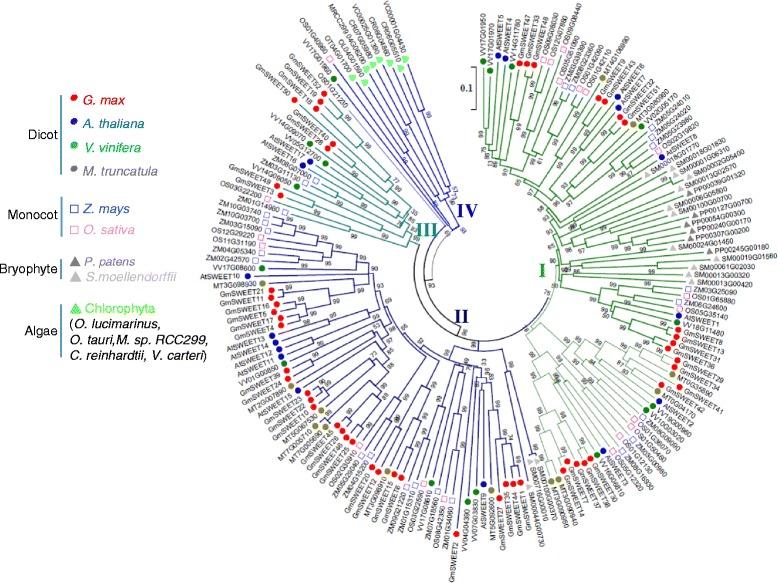
In the present investigation, we explored the evolutionary aspect of the SWEET gene family in diverse plant species including primitive single cell algae to angiosperms with a major emphasis on Glycine max. Evolutionary features showed expansion and duplication of the SWEET gene family in land plants. Homology searches with BLAST tools and Hidden Markov Model-directed sequence alignments identified 52 SWEET genes that were mapped to 15 chromosomes in the soybean genome as tandem duplication events. Soybean SWEET (GmSWEET) genes showed a wide range of expression profiles in different tissues and developmental stages. Analysis of public transcriptome data and expression profiling using quantitative real time PCR (qRT-PCR) showed that a majority of the GmSWEET genes were confined to reproductive tissue development. Several natural genetic variants (non-synonymous SNPs, premature stop codons and haplotype) were identified in the GmSWEET genes using whole genome re-sequencing data analysis of 106 soybean genotypes. A significant association was observed between SNP-haplogroup and seed sucrose content in three gene clusters on chromosome 6.
CONCLUSION
Present investigation utilized comparative genomics, transcriptome profiling and whole genome re-sequencing approaches and provided a systematic description of soybean SWEET genes and identified putative candidates with probable roles in the reproductive tissue development. Gene expression profiling at different developmental stages and genomic variation data will aid as an important resource for the soybean research community and can be extremely valuable for understanding sink unloading and enhancing carbohydrate delivery to developing seeds for improving yield.
背景
SWEET(MtN3_saliva)结构域蛋白是最近发现的一组转运蛋白,在糖分外排、韧皮部装载、植物与病原体相互作用以及生殖组织发育中发挥着不可或缺的作用。SWEET基因家族主要在拟南芥中进行研究,该家族成员也正在水稻中进行研究。迄今为止,尚未有关于大豆SWEET基因的转录组或基因组分析报道。
结果
在本研究中,我们探索了SWEET基因家族在从原始单细胞藻类到被子植物等多种植物物种中的进化情况,重点是大豆。进化特征表明陆地植物中SWEET基因家族发生了扩增和重复。使用BLAST工具进行同源性搜索以及基于隐马尔可夫模型的序列比对,在大豆基因组中鉴定出52个SWEET基因,这些基因通过串联重复事件定位到15条染色体上。大豆SWEET(GmSWEET)基因在不同组织和发育阶段表现出广泛的表达谱。对公共转录组数据的分析以及使用定量实时PCR(qRT-PCR)进行的表达谱分析表明,大多数GmSWEET基因局限于生殖组织发育。通过对106个大豆基因型的全基因组重测序数据分析,在GmSWEET基因中鉴定出了几个自然遗传变异(非同义单核苷酸多态性、提前终止密码子和单倍型)。在6号染色体上的三个基因簇中,观察到单核苷酸多态性单倍型组与种子蔗糖含量之间存在显著关联。
结论
本研究利用比较基因组学、转录组分析和全基因组重测序方法,对大豆SWEET基因进行了系统描述,并鉴定出在生殖组织发育中可能发挥作用的候选基因。不同发育阶段的基因表达谱和基因组变异数据将成为大豆研究群体的重要资源,对于理解库卸载以及增强向发育中的种子输送碳水化合物以提高产量具有极高的价值。




 Zotero 插件