
热量限制作为一种延缓衰老的干预措施。
Calorie restriction as an intervention in ageing.
作者信息
López-Lluch Guillermo, Navas Plácido
机构信息
Universidad Pablo de Olavide, Centro Andaluz de Biología del Desarrollo, CABD-CSIC, CIBERER, Instituto de Salud Carlos III, Carretera de Utrera km. 1, 41013, Sevilla, Spain.
出版信息
J Physiol. 2016 Apr 15;594(8):2043-60. doi: 10.1113/JP270543. Epub 2016 Jan 3.
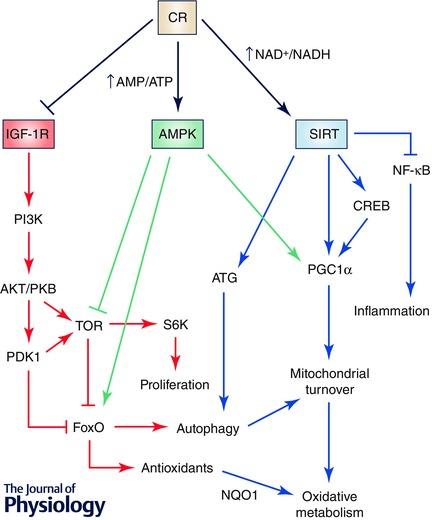
Ageing causes loss of function in tissues and organs, is accompanied by a chronic inflammatory process and affects life- and healthspan. Calorie restriction (CR) is a non-genetic intervention that prevents age-associated diseases and extends longevity in most of the animal models studied so far. CR produces a pleiotropic effect and improves multiple metabolic pathways, generating benefits to the whole organism. Among the effects of CR, modulation of mitochondrial activity and a decrease in oxidative damage are two of the hallmarks. Oxidative damage is reduced by the induction of endogenous antioxidant systems and modulation of the peroxidability index in cell membranes. Mitochondrial activity changes are regulated by inhibition of IGF-1 and Target of Rapamycin (TOR)-dependent activities and activation of AMP-dependent kinase (AMPK) and the sirtuin family of proteins. The activity of PGC-1α and FoxO is regulated by these systems and is involved in mitochondria biogenesis, oxidative metabolism activity and mitochondrial turnover. The use of mimetics and the regulation of common factors have demonstrated that these molecular pathways are essential to explain the effect of CR in the organism. Finally, the anti-inflammatory effect of CR is an interesting emerging factor to be taken into consideration. In the present revision we focus on the general effect of CR and other mimetics in longevity, focusing especially on the cardiovascular system and skeletal muscle.
衰老会导致组织和器官功能丧失,伴有慢性炎症过程,并影响寿命和健康跨度。热量限制(CR)是一种非基因干预措施,在目前研究的大多数动物模型中,它能预防与年龄相关的疾病并延长寿命。CR产生多效性作用,改善多种代谢途径,对整个机体产生益处。在CR的作用中,线粒体活性的调节和氧化损伤的减少是两个标志。通过诱导内源性抗氧化系统和调节细胞膜的过氧化指数可减少氧化损伤。线粒体活性的变化通过抑制胰岛素样生长因子1(IGF-1)和雷帕霉素靶蛋白(TOR)依赖性活性以及激活腺苷酸活化蛋白激酶(AMPK)和沉默调节蛋白家族来调节。PGC-1α和FoxO的活性受这些系统调节,并参与线粒体生物发生、氧化代谢活性和线粒体更新。模拟物的使用和共同因子的调节表明,这些分子途径对于解释CR在机体中的作用至关重要。最后,CR的抗炎作用是一个值得考虑的有趣的新因素。在本综述中,我们重点关注CR和其他模拟物对寿命的总体影响,尤其关注心血管系统和骨骼肌。



 Zotero 插件