
过氧化氢诱导的杂合性缺失与酵母中的复制寿命和有丝分裂不对称性相关。 (注:原文中“in”后面缺少具体内容,根据语境推测补充了“酵母”,以使句子完整通顺)
Hydrogen peroxide induced loss of heterozygosity correlates with replicative lifespan and mitotic asymmetry in .
作者信息
Güven Emine, Parnell Lindsay A, Jackson Erin D, Parker Meighan C, Gupta Nilin, Rodrigues Jenny, Qin Hong
机构信息
Department of Biology, Spelman College, Atlanta, Georgia, United States.
Current affiliation: Department of Computer Science and Engineering, University of Tennessee at Chattanooga, Chattanooga, Tennessee, United States.
出版信息
PeerJ. 2016 Nov 3;4:e2671. doi: 10.7717/peerj.2671. eCollection 2016.
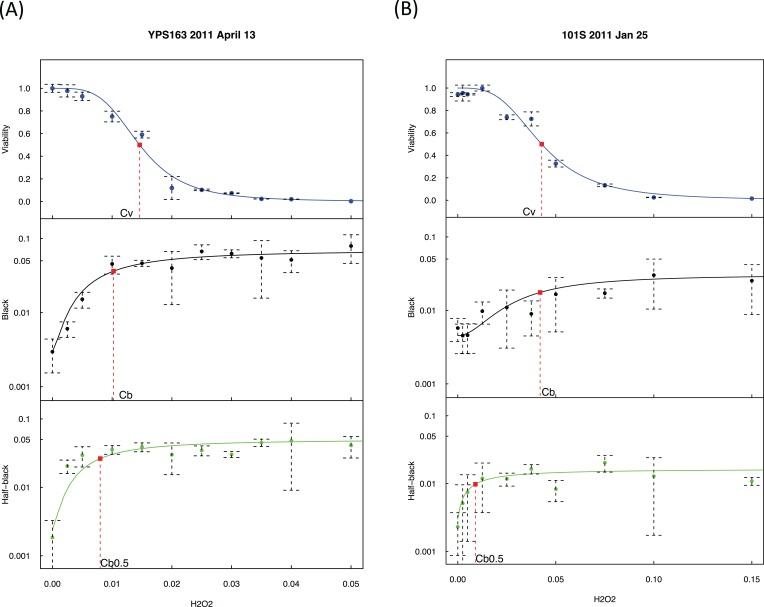
Cellular aging in can lead to genomic instability and impaired mitotic asymmetry. To investigate the role of oxidative stress in cellular aging, we examined the effect of exogenous hydrogen peroxide on genomic instability and mitotic asymmetry in a collection of yeast strains with diverse backgrounds. We treated yeast cells with hydrogen peroxide and monitored the changes of viability and the frequencies of loss of heterozygosity (LOH) in response to hydrogen peroxide doses. The mid-transition points of viability and LOH were quantified using sigmoid mathematical functions. We found that the increase of hydrogen peroxide dependent genomic instability often occurs before a drop in viability. We previously observed that elevation of genomic instability generally lags behind the drop in viability during chronological aging. Hence, onset of genomic instability induced by exogenous hydrogen peroxide treatment is opposite to that induced by endogenous oxidative stress during chronological aging, with regards to the midpoint of viability. This contrast argues that the effect of endogenous oxidative stress on genome integrity is well suppressed up to the dying-off phase during chronological aging. We found that the leadoff of exogenous hydrogen peroxide induced genomic instability to viability significantly correlated with replicative lifespan (RLS), indicating that yeast cells' ability to counter oxidative stress contributes to their replicative longevity. Surprisingly, this leadoff is positively correlated with an inverse measure of endogenous mitotic asymmetry, indicating a trade-off between mitotic asymmetry and cell's ability to fend off hydrogen peroxide induced oxidative stress. Overall, our results demonstrate strong associations of oxidative stress to genomic instability and mitotic asymmetry at the population level of budding yeast.
细胞衰老会导致基因组不稳定和有丝分裂不对称受损。为了研究氧化应激在细胞衰老中的作用,我们检测了外源性过氧化氢对一系列具有不同背景的酵母菌株基因组不稳定和有丝分裂不对称的影响。我们用过氧化氢处理酵母细胞,并监测其活力变化以及杂合性缺失(LOH)频率对过氧化氢剂量的响应。使用S形数学函数对活力和LOH的中期转变点进行量化。我们发现,过氧化氢依赖性基因组不稳定的增加通常发生在活力下降之前。我们之前观察到,在时序衰老过程中,基因组不稳定的升高通常滞后于活力下降。因此,就活力的中点而言,外源性过氧化氢处理诱导的基因组不稳定的起始与内源性氧化应激在时序衰老过程中诱导的情况相反。这种对比表明,在时序衰老过程中,直到细胞死亡阶段,内源性氧化应激对基因组完整性的影响都得到了很好的抑制。我们发现,外源性过氧化氢诱导的基因组不稳定与活力之间的起始显著与复制寿命(RLS)相关,这表明酵母细胞对抗氧化应激的能力有助于其复制寿命。令人惊讶的是,这种起始与内源性有丝分裂不对称的反向测量呈正相关,表明有丝分裂不对称与细胞抵御过氧化氢诱导的氧化应激的能力之间存在权衡。总体而言,我们的结果表明,在芽殖酵母的群体水平上,氧化应激与基因组不稳定和有丝分裂不对称之间存在很强的关联。




 Zotero 插件