
蛋白激酶R通过上调血管内皮生长因子表达中的磷脂酰肌醇-3-激酶/蛋白激酶B信号通路来促进脉络膜新生血管形成。
PKR promotes choroidal neovascularization via upregulating the PI3K/Akt signaling pathway in VEGF expression.
作者信息
Zhu Manhui, Liu Xiaojuan, Wang Shengcun, Miao Jin, Wu Liucheng, Yang Xiaowei, Wang Ying, Kang Lihua, Li Wendie, Cui Chen, Chen Hui, Sang Aimin
机构信息
Department of Ophthalmology, Affiliated Hospital of Nantong University, Nantong, Jiangsu, China; Jiangsu Province Key Laboratory for Inflammation and Molecular Drug Target, Medical College, Nantong University, Nantong, Jiangsu, PR China.
Department of Pathogen Biology, Medical College, Nantong University, Nantong, Jiangsu, China; Jiangsu Province Key Laboratory for Inflammation and Molecular Drug Target, Medical College, Nantong University, Nantong, Jiangsu, PR China.
出版信息
Mol Vis. 2016 Dec 2;22:1361-1374. eCollection 2016.
PURPOSE
The aim of this study was to investigate the functions of dsRNA-activated protein kinase (PKR) in choroidal neovascularization (CNV) and related signaling pathways in the production of vascular endothelial growth factor (VEGF).
METHODS
A chemical hypoxia model of in vitro RF/6A cells, a rhesus choroid-retinal endothelial cell line, was established by adding cobalt chloride (CoCl) to the culture medium. PKR, phosphophosphatidylinositol 3-kinase (p-PI3K), phosphoprotein kinase B (p-Akt), and VEGF protein levels in RF/6A cells were detected with western blotting. PKR siRNA and the PI3K inhibitor LY294002 were used to evaluate the roles of the PKR and PI3K signaling pathways in VEGF expression with western blotting. In an ARPE-19 (RPE cell line) and RF/6A cell coculture system, proliferation, migration, and tube formation of RF/6A cells under hypoxic conditions were measured with 3-(4,5-dimethylthiazol-2-yl)-2,5-diphenyl tetrazolium bromide (MTT), Transwell, and Matrigel Transwell assays, respectively. In vivo CNV lesions were induced in C57BL/6J mice using laser photocoagulation. The mice were euthanized in a timely manner, and the eyecups were dissected from enucleated eyes. PKR, p-PI3K, p-Akt, and VEGF protein levels in tissues were detected with western blotting. To evaluate the leakage area, fundus fluorescein angiography and choroidal flat mount were performed on day 7 after intravitreal injection of an anti-PKR monoclonal antibody.
RESULTS
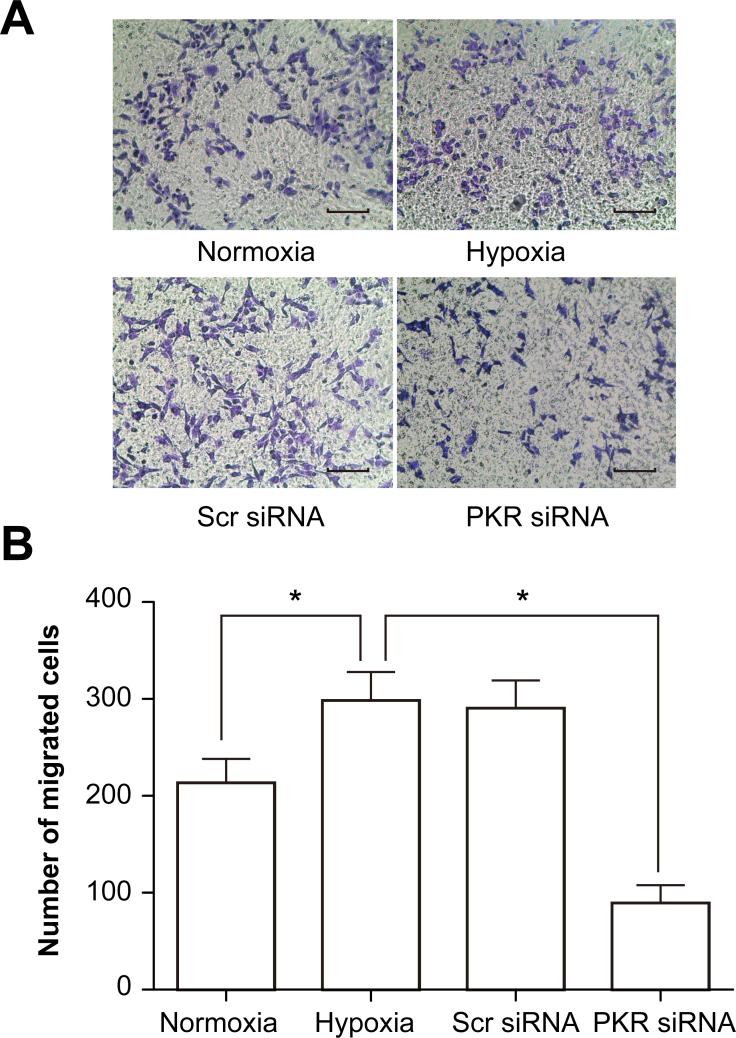
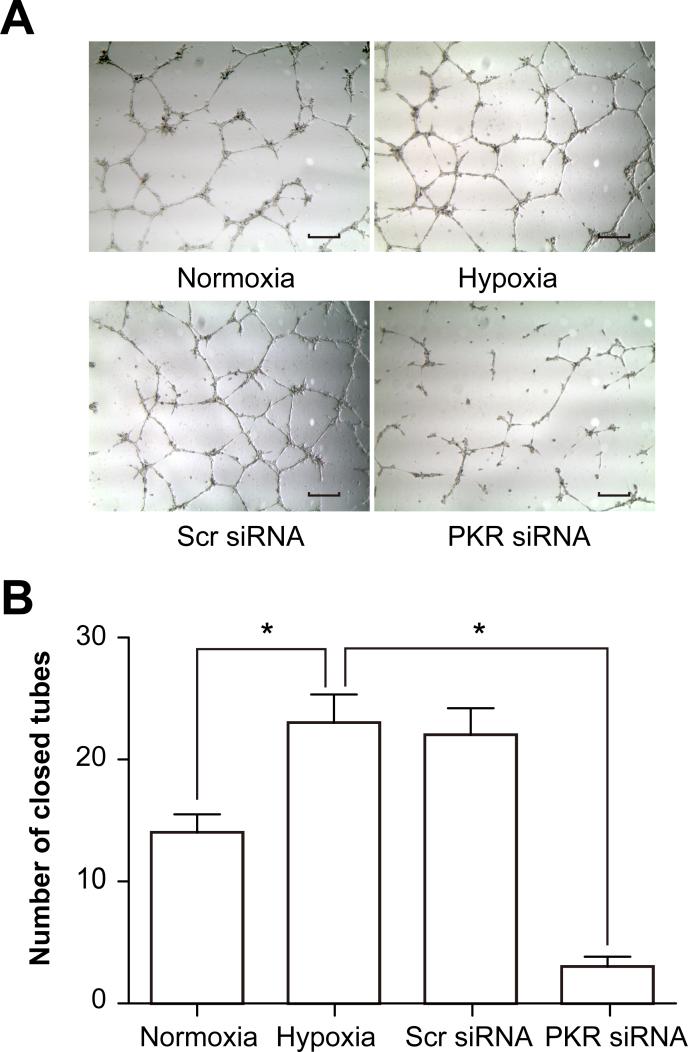
The in vitro RF/6A cell chemical hypoxia model showed that PKR expression was upregulated in parallel with p-PI3K, p-Akt, and VEGF expression, peaking at 12 h. PKR siRNA downregulated PKR, p-PI3K, p-Akt, and VEGF expression. In addition, the PI3K inhibitor LY294002 greatly decreased the p-PI3K, p-Akt, and VEGF protein levels, but PKR expression was unaffected, indicating that Akt was a downstream molecule of PKR that upregulated VEGF expression. In the ARPE-19 (RPE cell line) and RF/6A cell coculture system, PKR siRNA reduced the migration and tube formation of the RF/6A cells. In vivo, PKR, p-PI3K, p-Akt, and VEGF expression increased and peaked at 7 days in the mouse CNV model induced by laser photocoagulation. Furthermore, on the RPE and choroid cryosections, PKR colocalized with CD31, suggesting that PKR was expressed by the vascular endothelium. The intravitreal injection of an anti-PKR monoclonal antibody decreased the progression and leakage area of CNV in mice.
CONCLUSIONS
PKR promotes CNV formation via the PI3K/Akt signaling pathway in VEGF expression. Additionally, the anti-PKR monoclonal antibody significantly decreased CNV in a mouse model, showing the antibody may have therapeutic potential in human CNV.
目的
本研究旨在探讨双链RNA激活蛋白激酶(PKR)在脉络膜新生血管(CNV)中的作用以及在血管内皮生长因子(VEGF)产生过程中的相关信号通路。
方法
通过向培养基中添加氯化钴(CoCl)建立恒河猴脉络膜视网膜内皮细胞系RF/6A细胞的化学缺氧体外模型。采用蛋白质免疫印迹法检测RF/6A细胞中PKR、磷酸化磷脂酰肌醇3激酶(p-PI3K)、磷酸化蛋白激酶B(p-Akt)和VEGF蛋白水平。使用PKR小干扰RNA(siRNA)和PI3K抑制剂LY294002,通过蛋白质免疫印迹法评估PKR和PI3K信号通路在VEGF表达中的作用。在ARPE-19(视网膜色素上皮细胞系)和RF/6A细胞共培养体系中,分别采用3-(4,5-二甲基噻唑-2)-2,5-二苯基四氮唑溴盐(MTT)法、Transwell法和基质胶Transwell法检测缺氧条件下RF/6A细胞的增殖、迁移和管腔形成情况。利用激光光凝在C57BL/6J小鼠体内诱导CNV病变。及时对小鼠实施安乐死,从摘除的眼球中分离出眼杯。采用蛋白质免疫印迹法检测组织中PKR、p-PI3K、p-Akt和VEGF蛋白水平。为评估渗漏面积,在玻璃体腔内注射抗PKR单克隆抗体后第7天进行眼底荧光血管造影和脉络膜铺片检查。
结果
体外RF/6A细胞化学缺氧模型显示,PKR表达与p-PI3K、p-Akt和VEGF表达同步上调,在12小时达到峰值。PKR siRNA下调了PKR、p-PI3K,、p-Akt和VEGF表达。此外,PI3K抑制剂LY294002显著降低了p-PI3K、p-Akt和VEGF蛋白水平,但PKR表达未受影响,表明Akt是PKR的下游分子,可上调VEGF表达。在ARPE-19(视网膜色素上皮细胞系)和RF/6A细胞共培养体系中,PKR siRNA减少了RF/6A细胞的迁移和管腔形成。在体内,激光光凝诱导的小鼠CNV模型中,PKR、p-PI3K、p-Akt和VEGF表达在第7天增加并达到峰值。此外,在视网膜色素上皮和脉络膜冰冻切片上,PKR与CD31共定位,提示PKR由血管内皮细胞表达。玻璃体腔内注射抗PKR单克隆抗体可减少小鼠CNV的进展和渗漏面积。
结论
PKR通过PI3K/Akt信号通路促进VEGF表达从而促进CNV形成。此外,抗PKR单克隆抗体在小鼠模型中显著减少了CNV,表明该抗体可能对人类CNV具有治疗潜力。




 Zotero 插件