
端粒驱动的疾病与端粒靶向治疗
Telomere-driven diseases and telomere-targeting therapies.
作者信息
Martínez Paula, Blasco Maria A
机构信息
Telomeres and Telomerase Group, Molecular Oncology Program, Spanish National Cancer Centre, Madrid E-28029, Spain.
Telomeres and Telomerase Group, Molecular Oncology Program, Spanish National Cancer Centre, Madrid E-28029, Spain
出版信息
J Cell Biol. 2017 Apr 3;216(4):875-887. doi: 10.1083/jcb.201610111. Epub 2017 Mar 2.
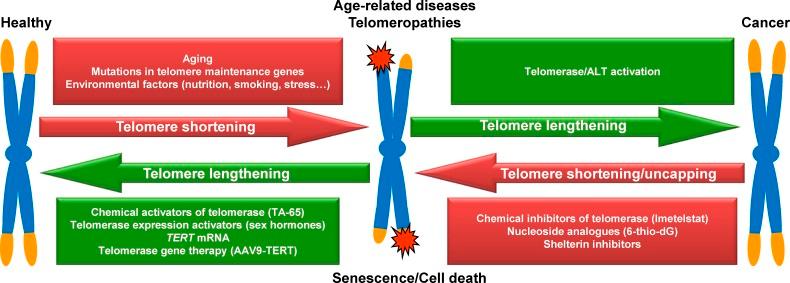
Telomeres, the protective ends of linear chromosomes, shorten throughout an individual's lifetime. Telomere shortening is proposed to be a primary molecular cause of aging. Short telomeres block the proliferative capacity of stem cells, affecting their potential to regenerate tissues, and trigger the development of age-associated diseases. Mutations in telomere maintenance genes are associated with pathologies referred to as telomere syndromes, including Hoyeraal-Hreidarsson syndrome, dyskeratosis congenita, pulmonary fibrosis, aplastic anemia, and liver fibrosis. Telomere shortening induces chromosomal instability that, in the absence of functional tumor suppressor genes, can contribute to tumorigenesis. In addition, mutations in telomere length maintenance genes and in shelterin components, the protein complex that protects telomeres, have been found to be associated with different types of cancer. These observations have encouraged the development of therapeutic strategies to treat and prevent telomere-associated diseases, namely aging-related diseases, including cancer. Here we review the molecular mechanisms underlying telomere-driven diseases and highlight recent advances in the preclinical development of telomere-targeted therapies using mouse models.
端粒是线性染色体的保护末端,在个体的一生中会逐渐缩短。端粒缩短被认为是衰老的主要分子原因。短端粒会阻碍干细胞的增殖能力,影响其再生组织的潜力,并引发与年龄相关疾病的发展。端粒维持基因的突变与被称为端粒综合征的病理状况相关,包括霍耶拉尔 - 赫雷达尔松综合征、先天性角化不良、肺纤维化、再生障碍性贫血和肝纤维化。端粒缩短会诱导染色体不稳定,在缺乏功能性肿瘤抑制基因的情况下,可能导致肿瘤发生。此外,已发现端粒长度维持基因和保护端粒的蛋白质复合物 shelterin 成分的突变与不同类型的癌症有关。这些观察结果促使人们开发治疗和预防端粒相关疾病(即包括癌症在内的与衰老相关疾病)的治疗策略。在此,我们综述了端粒驱动疾病的分子机制,并重点介绍了使用小鼠模型进行端粒靶向治疗临床前开发的最新进展。


 Zotero 插件