
γδ T 细胞:癌症发展中的朋友还是敌人?
Gamma-delta (γδ) T cells: friend or foe in cancer development?
机构信息
Cancer Center, The First Hospital of Jilin University, Changchun, 130021, People's Republic of China.
出版信息
J Transl Med. 2018 Jan 10;16(1):3. doi: 10.1186/s12967-017-1378-2.
BACKGROUND
γδ T cells are a distinct subgroup of T cells containing T cell receptors (TCRs) γ and TCR δ chains with diverse structural and functional heterogeneity. As a bridge between the innate and adaptive immune systems, γδ T cells participate in various immune responses during cancer progression. Because of their direct/indirect antitumor cytotoxicity and strong cytokine production ability, the use of γδ T cells in cancer immunotherapy has received a lot of attention over the past decade.
MAIN TEXT
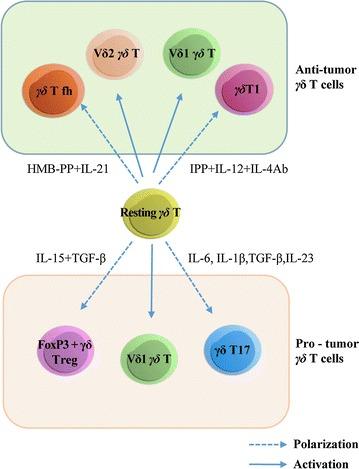
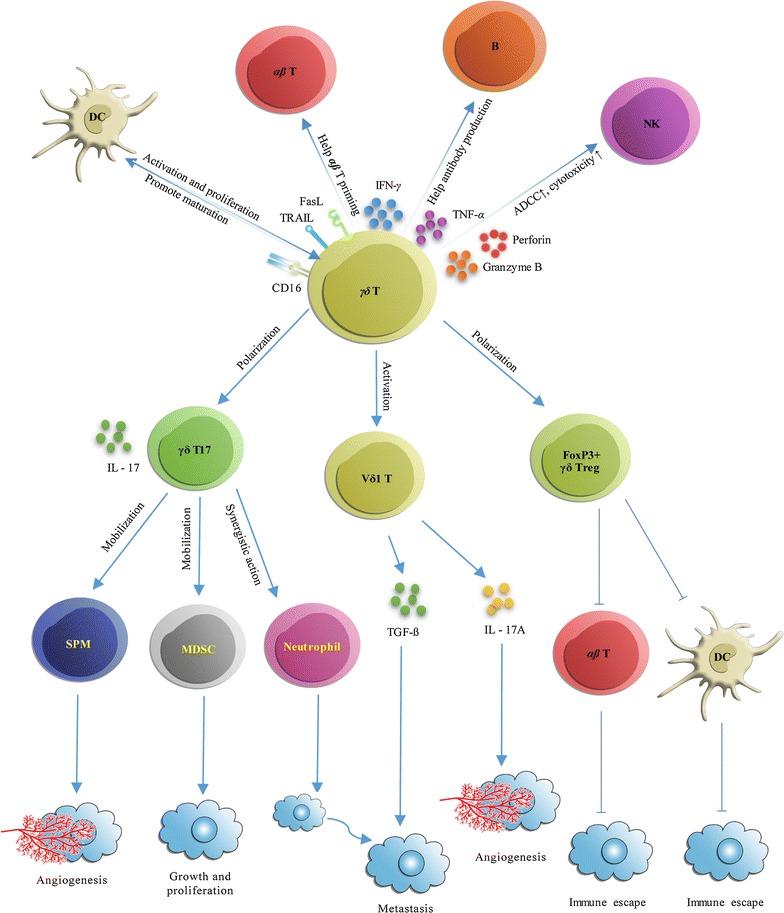
Despite the promising potential of γδ T cells, the efficacy of γδ T cell immunotherapy is limited, with an average response ratio of only 21%. In addition, research over the past 2 years has shown that γδ T cells could also promote cancer progression by inhibiting antitumor responses, and enhancing cancer angiogenesis. As a result, γδ T cells have a dual effect and can therefore be considered as being both "friends" and "foes" of cancer. In order to solve the sub-optimal efficiency problem of γδ T cell immunotherapy, we review recent observations regarding the antitumor and protumor activities of major structural and functional subsets of human γδ T cells, describing how these subsets are activated and polarized, and how these events relate to subsequent effects in cancer immunity. A mixture of both antitumor or protumor γδ T cells used in adoptive immunotherapy, coupled with the fact that γδ T cells can be polarized from antitumor cells to protumor cells appear to be the likely reasons for the mild efficacy seen with γδ T cells.
CONCLUSION
The future holds the promise of depleting the specific protumor γδ T cell subgroup before therapy, choosing multi-immunocyte adoptive therapy, modifying the cytokine balance in the cancer microenvironment, and using a combination of γδ T cells adoptive immunotherapy with immune checkpoint inhibitors.
背景
γδ T 细胞是 T 细胞的一个独特亚群,包含 T 细胞受体(TCR)γ和 TCR δ 链,具有不同的结构和功能异质性。作为先天免疫和适应性免疫系统之间的桥梁,γδ T 细胞在癌症进展过程中参与各种免疫反应。由于其直接/间接抗肿瘤细胞毒性和强大的细胞因子产生能力,γδ T 细胞在癌症免疫治疗中的应用在过去十年中受到了广泛关注。
主要文本
尽管 γδ T 细胞具有很大的应用潜力,但 γδ T 细胞免疫治疗的疗效有限,平均反应率仅为 21%。此外,过去 2 年来的研究表明,γδ T 细胞也可以通过抑制抗肿瘤反应和增强癌症血管生成来促进癌症进展。因此,γδ T 细胞具有双重作用,可以被视为癌症的“朋友”和“敌人”。为了解决 γδ T 细胞免疫治疗效率低下的问题,我们回顾了最近关于人类 γδ T 细胞主要结构和功能亚群的抗肿瘤和促肿瘤活性的观察结果,描述了这些亚群如何被激活和极化,以及这些事件如何与随后的癌症免疫效应相关。在过继免疫治疗中使用混合的抗肿瘤或促肿瘤 γδ T 细胞,再加上 γδ T 细胞可以从抗肿瘤细胞向促肿瘤细胞极化,这似乎是 γδ T 细胞疗效轻微的可能原因。
结论
未来有望在治疗前耗竭特定的促肿瘤 γδ T 细胞亚群,选择多免疫细胞过继治疗,改变肿瘤微环境中的细胞因子平衡,并将 γδ T 细胞过继免疫治疗与免疫检查点抑制剂联合使用。

 Zotero 插件