
RNA-Seq 分析验证了培养的布氏锥虫的使用,并为哺乳动物和昆虫生活史阶段提供了新的标记物。
RNA-Seq analysis validates the use of culture-derived Trypanosoma brucei and provides new markers for mammalian and insect life-cycle stages.
机构信息
Institute of Cell Biology, University of Bern, Baltzerstrasse 4, CH-3012, Bern, Switzerland.
出版信息
BMC Genomics. 2018 Apr 2;19(1):227. doi: 10.1186/s12864-018-4600-6.
BACKGROUND
Trypanosoma brucei brucei, the parasite causing Nagana in domestic animals, is closely related to the parasites causing sleeping sickness, but does not infect humans. In addition to its importance as a pathogen, the relative ease of genetic manipulation and an innate capacity for RNAi extend its use as a model organism in cell and infection biology. During its development in its mammalian and insect (tsetse fly) hosts, T. b. brucei passes through several different life-cycle stages. There are currently four life-cycle stages that can be cultured: slender forms and stumpy forms, which are equivalent to forms found in the mammal, and early and late procyclic forms, which are equivalent to forms in the tsetse midgut. Early procyclic forms show coordinated group movement (social motility) on semi-solid surfaces, whereas late procyclic forms do not.
RESULTS
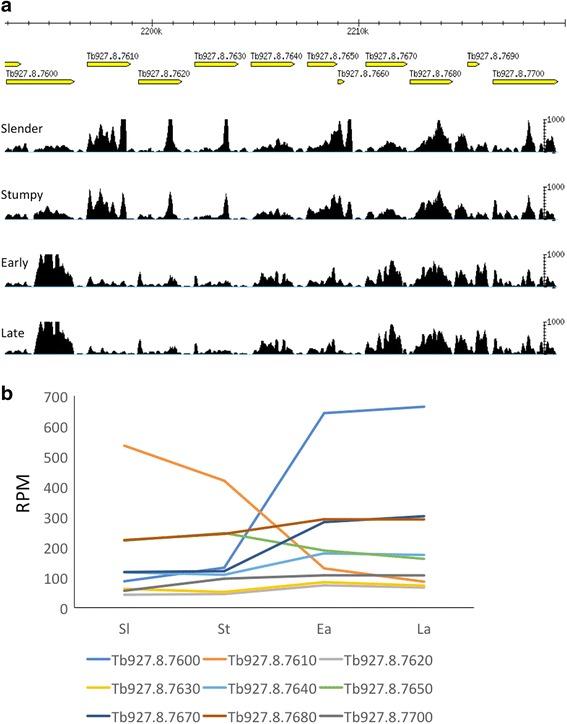
RNA-Seq was performed on biological replicates of each life-cycle stage. These constitute the first datasets for culture-derived slender and stumpy bloodstream forms and early and late procyclic forms. Expression profiles confirmed that genes known to be stage-regulated in the animal and insect hosts were also regulated in culture. Sequence reads of 100-125 bases provided sufficient precision to uncover differential expression of closely related genes. More than 100 transcripts showed peak expression in stumpy forms, including adenylate cyclases and several components of inositol metabolism. Early and late procyclic forms showed differential expression of 73 transcripts, a number of which encoded proteins that were previously shown to be stage-regulated. Moreover, two adenylate cyclases previously shown to reduce social motility are up-regulated in late procyclic forms.
CONCLUSIONS
This study validates the use of cultured bloodstream forms as alternatives to animal-derived parasites and yields new markers for all four stages. In addition to underpinning recent findings that early and late procyclic forms are distinct life-cycle stages, it could provide insights into the reasons for their different biological properties.
背景
导致家畜纳格纳病的寄生虫布氏锥虫与引起昏睡病的寄生虫密切相关,但不感染人类。除了作为病原体的重要性外,相对容易的遗传操作和内在的 RNAi 能力使其成为细胞和感染生物学的模型生物。在其在哺乳动物和昆虫(采采蝇)宿主中的发育过程中,T. b. brucei 经历了几个不同的生命周期阶段。目前有四个可培养的生命周期阶段:细长形式和粗短形式,相当于在哺乳动物中发现的形式,以及早期和晚期前环形式,相当于在采采蝇中肠中的形式。早期前环形式在半固体表面上表现出协调的群体运动(社会运动),而晚期前环形式则没有。
结果
对每个生命周期阶段的生物重复进行了 RNA-Seq 分析。这些构成了培养的细长和粗短血流形式以及早期和晚期前环形式的第一个数据集。表达谱证实,在动物和昆虫宿主中已知受阶段调节的基因也在培养中受到调节。100-125 个碱基的序列读数提供了足够的精度来发现密切相关基因的差异表达。超过 100 个转录本在前环形式中表现出峰值表达,包括腺苷酸环化酶和几种肌醇代谢成分。早期和晚期前环形式表现出 73 个转录本的差异表达,其中一些编码的蛋白质以前被证明是受阶段调节的。此外,以前显示降低社会运动性的两个腺苷酸环化酶在前环形式中上调。
结论
本研究验证了培养的血流形式可替代动物来源的寄生虫,并为所有四个阶段提供了新的标记。除了支持早期和晚期前环形式是不同的生命周期阶段的最近发现外,它还可以为它们不同的生物学特性提供一些见解。


 Zotero 插件