
预期寿命与寿命重叠之间关系的复杂性。
Complexity of the relationship between life expectancy and overlap of lifespans.
机构信息
Max-Planck Odense Center on the Biodemography of Aging, University of Southern Denmark, Odense, Denmark.
Department of Public Health, University of Southern Denmark, Odense, Denmark.
出版信息
PLoS One. 2018 Jul 12;13(7):e0197985. doi: 10.1371/journal.pone.0197985. eCollection 2018.
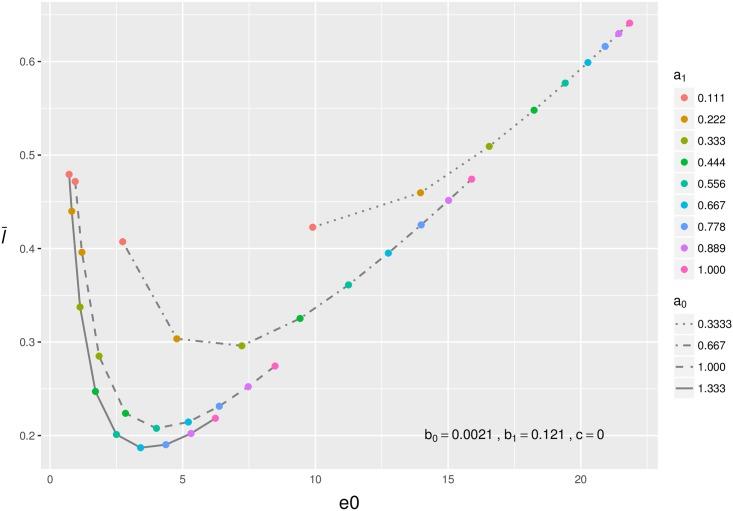
Longevity has long been recognised as a key facilitator of reciprocal altruism because repeated cooperation of partners hinges on mutual survival. Although demographic tools can be used to quantify mutual survival and expected overlapping lifespans, studies on the evolutionary theory of cooperation take only limited advantage of demography. Overlap of lifespans depends on variation in survival across ages and can be high or low independently of high or low life expectancies. Here we develop formal demographic measures to study the complex relationships between shared life expectancy of two birth cohort peers, the proportion of their lives that they can expect to overlap, and longevity. We simulate age-specific mortality schedules using a Siler model to reveal how infant and senescent mortality, along with age-independent mortality, affect the relationship between the proportion of life shared and life expectancy. We find that while the proportion of life shared can vary vastly for similar life expectancies, almost all changes to mortality schedules that result in higher life expectancies also result in higher proportions of life shared. A distinct exception occurs if life expectancy increases due to lowering the rate of senescence. In this case the proportion of life shared decreases. Our work shows that almost all selective pressures that result in higher life expectancies also result in a larger proportion of life shared. Therefore, selective forces that extend life also improve the chances that a cooperative system would be stable in terms of reciprocal interactions. Since reciprocal interactions may also reduce mortality and result in a feedback loop with the evolution of longevity, our measures and findings can be used for future cross-species comparisons that aim to disentangle predecessor and successor in the evolution of longevity and cooperation.
长寿一直被认为是互惠利他主义的关键促进因素,因为合作伙伴的反复合作取决于相互生存。虽然人口统计学工具可用于量化相互生存和预期重叠的寿命,但合作的进化理论研究仅在有限程度上利用了人口统计学。寿命的重叠取决于各年龄段的存活率差异,并且可以独立于高或低的预期寿命而高低不同。在这里,我们开发了正式的人口统计学指标来研究两个出生队列同龄人的共同预期寿命、他们可以预期重叠的生命比例以及长寿之间的复杂关系。我们使用 Siler 模型模拟特定年龄的死亡率表,以揭示婴儿死亡率和衰老死亡率以及独立于年龄的死亡率如何影响共同寿命比例与预期寿命之间的关系。我们发现,尽管预期寿命相似的情况下,共同寿命比例可能会有很大差异,但几乎所有导致预期寿命增加的死亡率表变化也会导致共同寿命比例增加。如果由于降低衰老速度而导致预期寿命增加,则会出现明显的例外。在这种情况下,共同寿命比例会降低。我们的工作表明,几乎所有导致预期寿命增加的选择压力也会导致共同寿命比例增加。因此,延长寿命的选择压力也会增加合作系统在互惠互动方面稳定的机会。由于互惠互动也可能降低死亡率,并导致与长寿进化的反馈循环,因此我们的指标和发现可用于未来的跨物种比较,旨在理清长寿和合作进化中的前辈和后继者。


 Zotero 插件