
人口学视角下的长寿崛起。
Demographic perspectives on the rise of longevity.
机构信息
Danish Centre for Demographic Research, University of Southern Denmark, 5230 Odense, Denmark;
Interdisciplinary Center on Population Dynamics, University of Southern Denmark, 5230 Odense, Denmark.
出版信息
Proc Natl Acad Sci U S A. 2021 Mar 2;118(9). doi: 10.1073/pnas.2019536118.
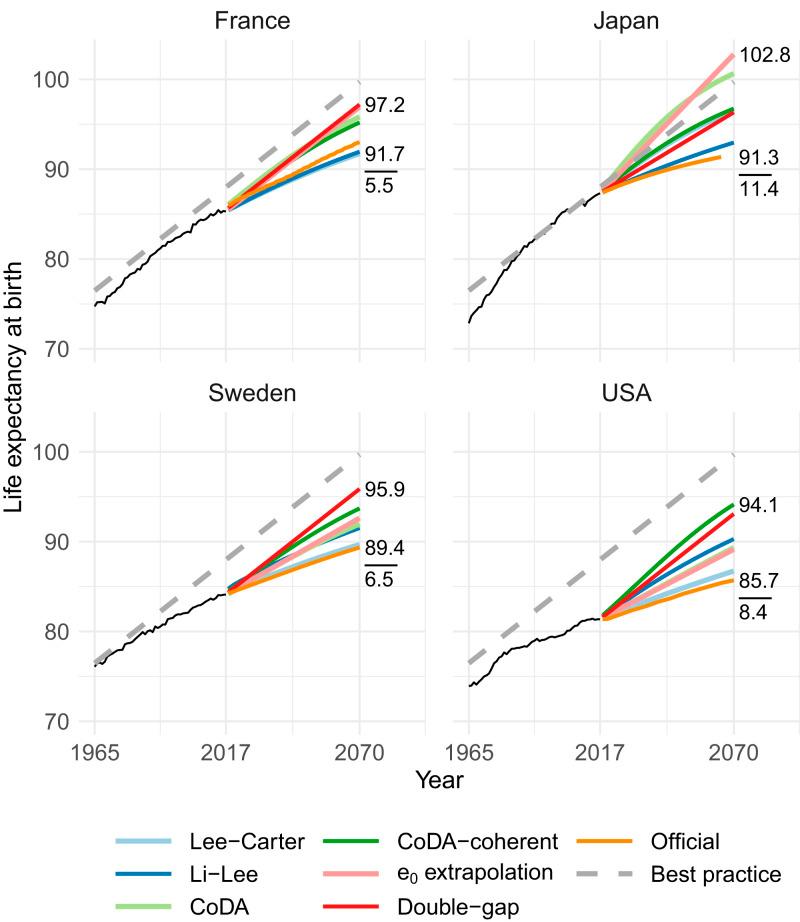
This article reviews some key strands of demographic research on past trends in human longevity and explores possible future trends in life expectancy at birth. Demographic data on age-specific mortality are used to estimate life expectancy, and validated data on exceptional life spans are used to study the maximum length of life. In the countries doing best each year, life expectancy started to increase around 1840 at a pace of almost 2.5 y per decade. This trend has continued until the present. Contrary to classical evolutionary theories of senescence and contrary to the predictions of many experts, the frontier of survival is advancing to higher ages. Furthermore, individual life spans are becoming more equal, reducing inequalities, with octogenarians and nonagenarians accounting for most deaths in countries with the highest life expectancy. If the current pace of progress in life expectancy continues, most children born this millennium will celebrate their 100th birthday. Considerable uncertainty, however, clouds forecasts: Life expectancy and maximum life span might increase very little if at all, or longevity might rise much faster than in the past. Substantial progress has been made over the past three decades in deepening understanding of how long humans have lived and how long they might live. The social, economic, health, cultural, and political consequences of further increases in longevity are so significant that the development of more powerful methods of forecasting is a priority.
这篇文章回顾了一些关于过去人类长寿趋势的人口统计学研究的关键线索,并探讨了出生时预期寿命可能的未来趋势。人口统计学数据用于估计特定年龄死亡率的预期寿命,并且使用经过验证的异常寿命数据来研究最长寿命。在每年表现最好的国家中,预期寿命从 1840 年左右开始以每十年近 2.5 年的速度增长。这种趋势一直持续到现在。与衰老的经典进化理论相反,也与许多专家的预测相反,生存的前沿正在向更高的年龄推进。此外,个体的寿命变得更加平等,减少了不平等,在预期寿命最高的国家中,八十多岁和九十多岁的人占大多数死亡人数。如果目前预期寿命的增长速度持续下去,本世纪出生的大多数孩子将庆祝他们的 100 岁生日。然而,预测存在很大的不确定性:预期寿命和最长寿命可能几乎不会增加,或者长寿可能会比过去增长得更快。在过去的三十年中,人们在深入了解人类的寿命以及他们可能的寿命方面取得了相当大的进展。预期寿命进一步增加所带来的社会、经济、健康、文化和政治后果非常重大,因此开发更强大的预测方法是当务之急。


 Zotero 插件