
度洛西汀用于日本骨关节炎慢性膝关节疼痛患者的安全性和有效性:一项开放标签、长期、III期扩展研究。
Safety and efficacy of duloxetine in Japanese patients with chronic knee pain due to osteoarthritis: an open-label, long-term, Phase III extension study.
作者信息
Uchio Yuji, Enomoto Hiroyuki, Ishida Mitsuhiro, Tsuji Toshinaga, Ochiai Toshimitsu, Konno Shinichi
机构信息
Department of Orthopaedic Surgery, Shimane University School of Medicine, Shimane, Japan,
Bio-medicine, Medicines Development Unit, Eli Lilly Japan K.K., Kobe, Japan.
出版信息
J Pain Res. 2018 Jul 31;11:1391-1403. doi: 10.2147/JPR.S171395. eCollection 2018.
PURPOSE
To assess long-term safety, tolerability, and efficacy of duloxetine in Japanese patients with chronic knee pain due to osteoarthritis.
METHODS
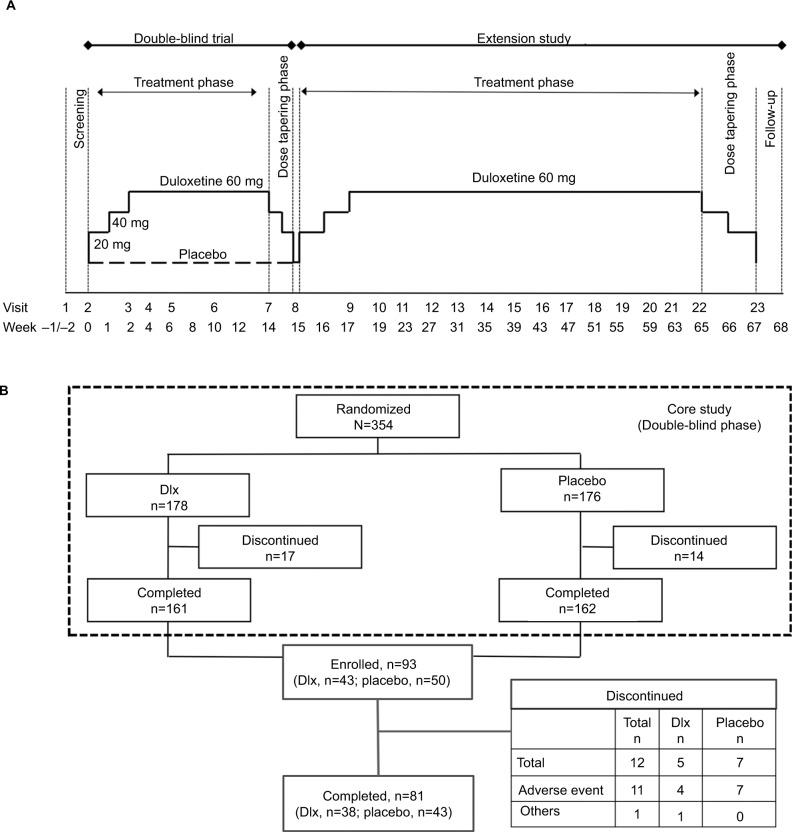
In this open-label extension study (NCT02335346), Japanese patients with knee osteoarthritis and pain (Brief Pain Inventory [BPI] - Severity average pain score ≥4 at start of randomized trial) who had previously received duloxetine 60 mg/day or placebo for 14 weeks in a double-blind randomized trial entered the extension and received duloxetine 60 mg/day for 48 weeks. The primary outcome was safety/tolerability, secondary outcomes were change in BPI-Severity (BPI-S) average pain, BPI-Interference (BPI-I), Patient Global Impression-Improvement (PGI-I), Clinical Global Impression-Improvement (CGI-I), 36-item Short-Form Health Survey (SF36), and Western Ontario and McMaster Universities Osteoarthritis Index (WOMAC), and exploratory outcomes were knee range of motion (efficacy outcome) and Kellgren-Lawrence grade (safety outcome).
RESULTS
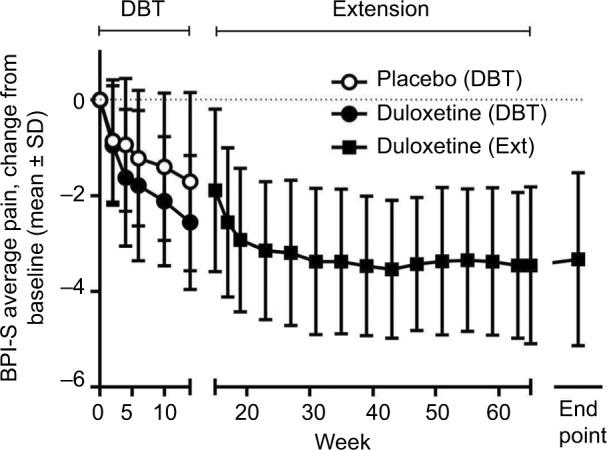
Of 323 patients who completed the randomized trial, 93 (50 placebo, 43 duloxetine) entered the extension. Most patients (85, 91.4%) experienced an adverse event, most commonly constipation, nasopharyngitis, somnolence, and dry mouth (≥10% of patients). There were eight serious adverse events in seven patients and no deaths. No obvious duloxetine-related changes were observed in laboratory tests, vital signs, or electrocardiograms. The change from baseline in BPI-S average pain score was significant throughout the extension. Significant reductions in BPI-I, PGI-I, CGI-I, WOMAC, and SF36 scores were also maintained through 52 weeks. There were no substantial changes in range of motion or Kellgren-Lawrence grade.
CONCLUSION
In Japanese patients with chronic knee pain due to osteoarthritis, long-term treatment with duloxetine was well tolerated and associated with sustained improvements in pain and health-related quality of life without radiographic deterioration.
目的
评估度洛西汀对日本骨关节炎所致慢性膝关节疼痛患者的长期安全性、耐受性及疗效。
方法
在这项开放标签扩展研究(NCT02335346)中,曾在一项双盲随机试验中接受度洛西汀60毫克/天或安慰剂治疗14周的日本膝关节骨关节炎及疼痛患者(随机试验开始时简明疼痛量表[BPI]-严重程度平均疼痛评分≥4)进入扩展期,并接受度洛西汀60毫克/天治疗48周。主要结局为安全性/耐受性,次要结局为BPI-严重程度(BPI-S)平均疼痛、BPI-干扰(BPI-I)、患者整体印象改善(PGI-I)、临床整体印象改善(CGI-I)、36项简短健康调查(SF36)及西安大略和麦克马斯特大学骨关节炎指数(WOMAC)的变化,探索性结局为膝关节活动范围(疗效结局)和凯尔格伦-劳伦斯分级(安全性结局)。
结果
在完成随机试验的323例患者中,93例(50例安慰剂组,43例度洛西汀组)进入扩展期。大多数患者(85例,91.4%)发生不良事件,最常见的是便秘、鼻咽炎、嗜睡和口干(≥10%的患者)。7例患者发生8起严重不良事件,无死亡病例。在实验室检查、生命体征或心电图方面未观察到明显的与度洛西汀相关的变化。在整个扩展期,BPI-S平均疼痛评分较基线的变化具有显著性。BPI-I、PGI-I、CGI-I、WOMAC和SF36评分在52周内也保持显著降低。膝关节活动范围或凯尔格伦-劳伦斯分级无实质性变化。
结论
对于日本骨关节炎所致慢性膝关节疼痛患者,度洛西汀长期治疗耐受性良好,与疼痛及健康相关生活质量持续改善相关,且无影像学恶化。

 Zotero 插件