
一项随机对照研究显示,耐力训练、间歇训练和抗阻训练对端粒酶活性和端粒长度的影响存在差异。
Differential effects of endurance, interval, and resistance training on telomerase activity and telomere length in a randomized, controlled study.
机构信息
Klinik für Innere Medizin III, Kardiologie, Angiologie und Internistische Intensivmedizin, Universität und Universitätsklinikum des Saarlandes, Geb. 41.1/IMED, Homburg/Saar, Germany.
Institut für Sport und Präventivmedizin, Universität des Saarlandes, Campus, B8 2, Saarbrücken, Germany.
出版信息
Eur Heart J. 2019 Jan 1;40(1):34-46. doi: 10.1093/eurheartj/ehy585.
AIMS
It is unknown whether different training modalities exert differential cellular effects. Telomeres and telomere-associated proteins play a major role in cellular aging with implications for global health. This prospective training study examines the effects of endurance training, interval training (IT), and resistance training (RT) on telomerase activity and telomere length (TL).
METHODS AND RESULTS
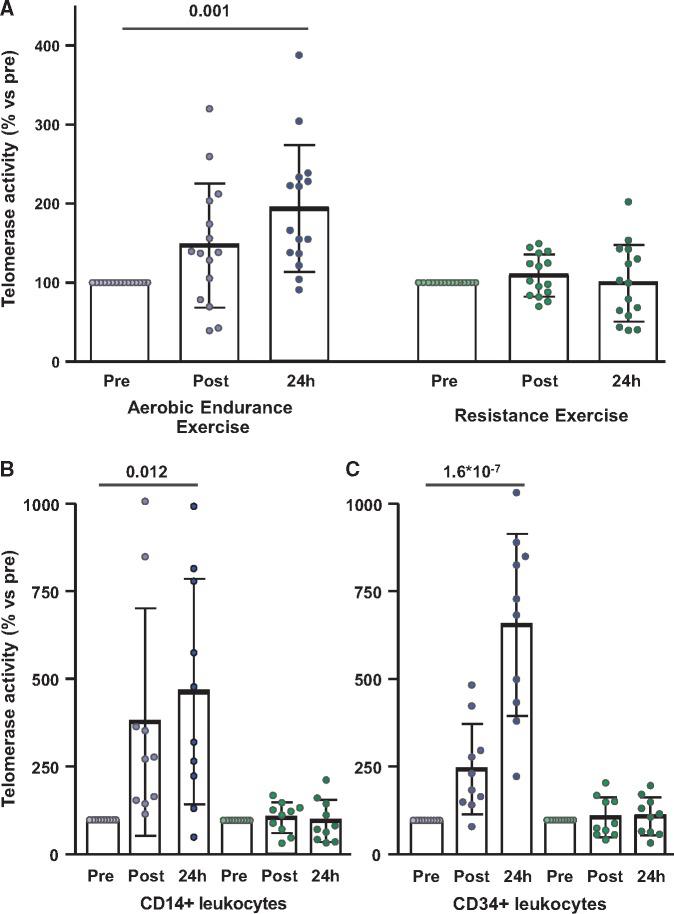
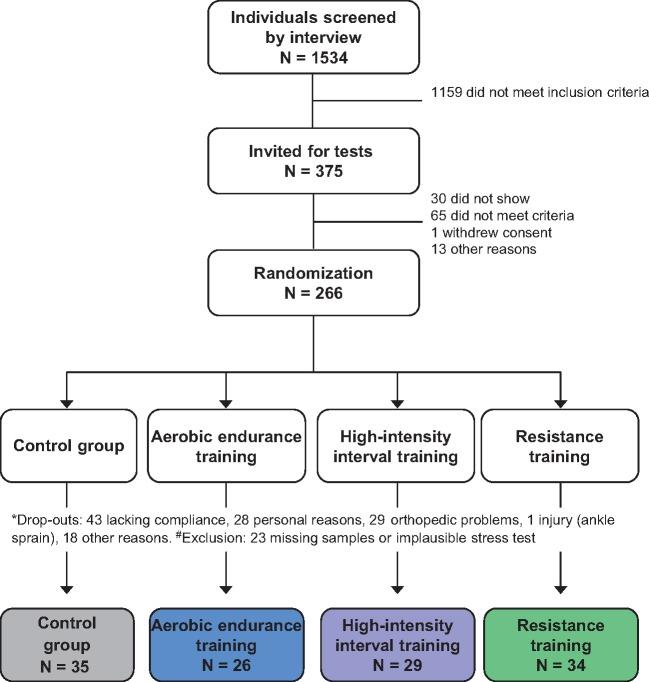
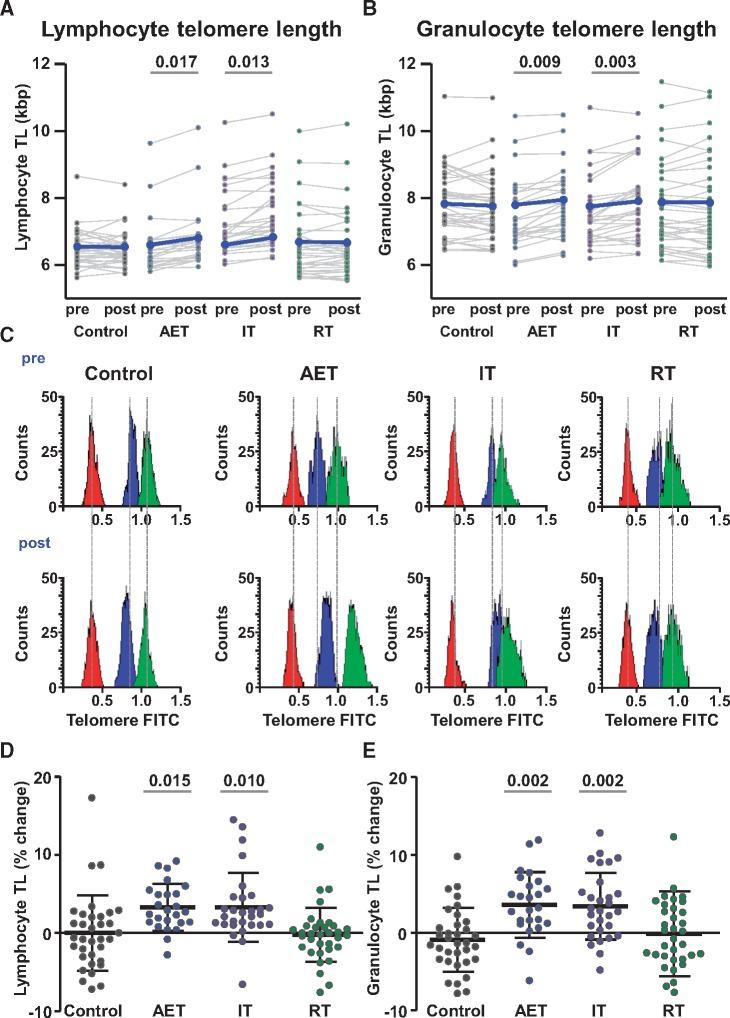
One hundred and twenty-four healthy previously inactive individuals completed the 6 months study. Participants were randomized to three different interventions or the control condition (no change in lifestyle): aerobic endurance training (AET, continuous running), high-intensive IT (4 × 4 method), or RT (circle training on 8 devices), each intervention consisting of three 45 min training sessions per week. Maximum oxygen uptake (VO2max) was increased by all three training modalities. Telomerase activity in blood mononuclear cells was up-regulated by two- to three-fold in both endurance exercise groups (AET, IT), but not with RT. In parallel, lymphocyte, granulocyte, and leucocyte TL increased in the endurance-trained groups but not in the RT group. Magnet-activated cell sorting with telomerase repeat-ampliflication protocol (MACS-TRAP) assays revealed that a single bout of endurance training-but not RT-acutely increased telomerase activity in CD14+ and in CD34+ leucocytes.
CONCLUSION
This randomized controlled trial shows that endurance training, IT, and RT protocols induce specific cellular pathways in circulating leucocytes. Endurance training and IT, but not RT, increased telomerase activity and TL which are important for cellular senescence, regenerative capacity, and thus, healthy aging.
目的
目前尚不清楚不同的训练方式是否会产生不同的细胞效应。端粒和端粒相关蛋白在细胞衰老中起着重要作用,这对全球健康有影响。这项前瞻性训练研究探讨了耐力训练、间歇训练(IT)和抗阻训练(RT)对端粒酶活性和端粒长度(TL)的影响。
方法和结果
124 名健康的既往不活跃个体完成了 6 个月的研究。参与者被随机分为三组不同的干预组或对照组(生活方式无变化):有氧耐力训练(AET,连续跑步)、高强度 IT(4×4 方法)或 RT(8 个设备上的循环训练),每组干预包括每周 3 次,每次 45 分钟的训练。三种训练方式均使最大摄氧量(VO2max)增加。两种耐力运动组(AET、IT)的血液单核细胞中端粒酶活性增加了两到三倍,但 RT 组没有。同时,淋巴细胞、粒细胞和白细胞的 TL 在耐力训练组中增加,但在 RT 组中没有增加。端粒酶重复扩增协议的磁激活细胞分选(MACS-TRAP)检测显示,单次耐力训练而不是 RT 急性增加了 CD14+和 CD34+白细胞中的端粒酶活性。
结论
这项随机对照试验表明,耐力训练、IT 和 RT 方案诱导循环白细胞中特定的细胞途径。耐力训练和 IT 而非 RT 增加了端粒酶活性和 TL,这对细胞衰老、再生能力以及健康衰老很重要。



 Zotero 插件