
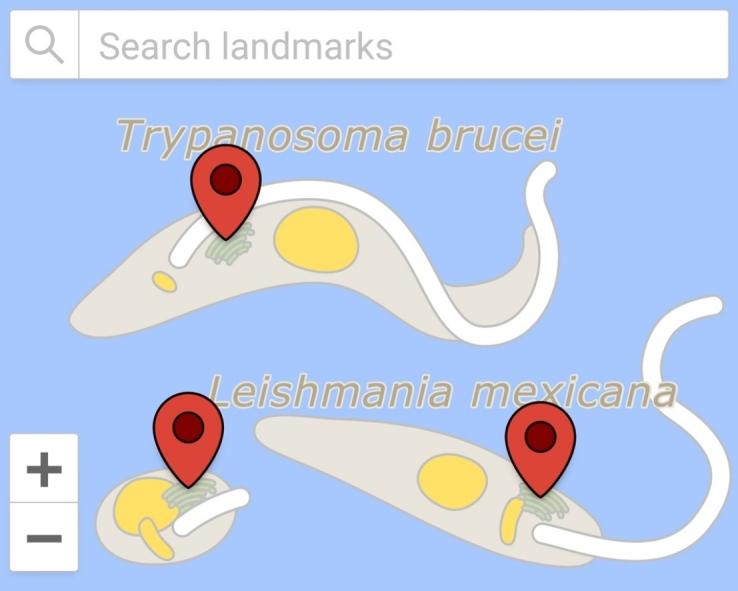
布氏锥虫和墨西哥利什曼原虫的细胞标志物
Cellular landmarks of Trypanosoma brucei and Leishmania mexicana.
作者信息
Halliday Clare, Billington Karen, Wang Ziyin, Madden Ross, Dean Samuel, Sunter Jack Daniel, Wheeler Richard John
机构信息
Sir William Dunn School of Pathology, University of Oxford, South Parks Road, Oxford, OX1 3RE, UK; Department of Biological and Medical Sciences, Oxford Brookes University, Gipsy Lane, Oxford, OX3 0BP, UK.
Sir William Dunn School of Pathology, University of Oxford, South Parks Road, Oxford, OX1 3RE, UK.
出版信息
Mol Biochem Parasitol. 2019 Jun;230:24-36. doi: 10.1016/j.molbiopara.2018.12.003. Epub 2018 Dec 11.
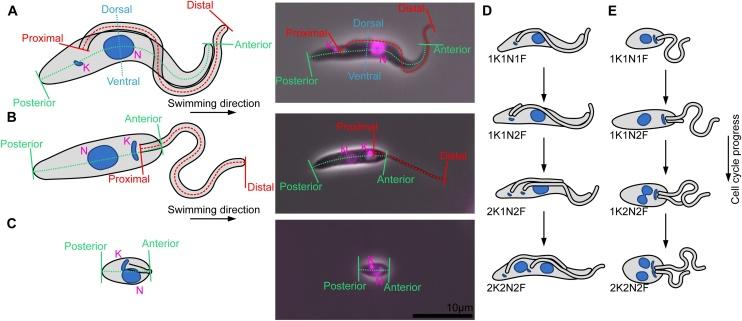
The kinetoplastids Trypanosoma brucei and Leishmania mexicana are eukaryotes with a highly structured cellular organisation that is reproduced with great fidelity in each generation. The pattern of signal from a fluorescently tagged protein can define the specific structure/organelle that this protein localises to, and can be extremely informative in phenotype analysis in experimental perturbations, life cycle tracking, post-genomic assays and functional analysis of organelles. Using the vast coverage of protein subcellular localisations provided by the TrypTag project, an ongoing project to determine the localisation of every protein encoded in the T. brucei genome, we have generated an inventory of reliable reference organelle markers for both parasites that combines epifluorescence images with a detailed description of the key features of each localisation. We believe this will be a useful comparative resource that will enable researchers to quickly and accurately pinpoint the localisation of their proteins of interest and will provide cellular markers for many types of cell biology studies. We see this as another important step in the post-genomic era analyses of these parasites, in which ever expanding datasets generate numerous candidates to analyse. Adoption of these reference proteins by the community is likely to enhance research studies and enable better comparison of data.
动质体锥虫和墨西哥利什曼原虫是真核生物,具有高度结构化的细胞组织,并且在每一代中都能高度精确地复制。荧光标记蛋白发出的信号模式可以确定该蛋白定位到的特定结构/细胞器,并且在实验扰动、生命周期追踪、后基因组分析和细胞器功能分析的表型分析中具有极高的信息量。利用TrypTag项目提供的蛋白质亚细胞定位的广泛覆盖信息(这是一个正在进行的确定布氏锥虫基因组中每个编码蛋白定位的项目),我们已经为这两种寄生虫生成了一份可靠的参考细胞器标记清单,该清单将落射荧光图像与每个定位的关键特征的详细描述相结合。我们相信这将是一个有用的比较资源,能够使研究人员快速准确地确定他们感兴趣的蛋白质的定位,并为许多类型的细胞生物学研究提供细胞标记。我们将此视为这些寄生虫后基因组时代分析中的又一重要步骤,在这个时代,不断扩展的数据集产生了众多需要分析的候选对象。科学界采用这些参考蛋白可能会加强研究工作,并使数据能够更好地进行比较。



 Zotero 插件