
E1784K 是最常见的 Brugada 综合征和长 QT 综合征 3 型突变体,通过两种独立的机制破坏钠通道失活。
E1784K, the most common Brugada syndrome and long-QT syndrome type 3 mutant, disrupts sodium channel inactivation through two separate mechanisms.
机构信息
Department of Physiology and Biophysics, University of Colorado Anschutz Medical Campus, Aurora, CO.
Department of Biomedical Physiology and Kinesiology, Simon Fraser University, Burnaby, BC, Canada.
出版信息
J Gen Physiol. 2020 Sep 7;152(9). doi: 10.1085/jgp.202012595.
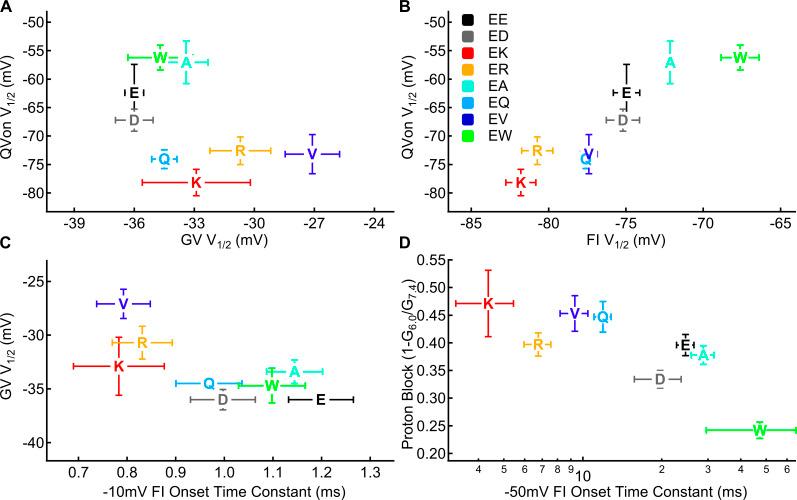
Inheritable and de novo variants in the cardiac voltage-gated sodium channel, Nav1.5, are responsible for both long-QT syndrome type 3 (LQT3) and Brugada syndrome type 1 (BrS1). Interestingly, a subset of Nav1.5 variants can cause both LQT3 and BrS1. Many of these variants are found in channel structures that form the channel fast inactivation machinery, altering the rate, voltage dependence, and completeness of the fast inactivation process. We used a series of mutants at position 1784 to show that the most common inheritable Nav1.5 variant, E1784K, alters fast inactivation through two separable mechanisms: (1) a charge-dependent interaction that increases the noninactivating current characteristic of E1784K; and (2) a hyperpolarized voltage dependence and accelerated rate of fast inactivation that decreases the peak sodium current. Using a homology model built on the NavPaS structure, we find that the charge-dependent interaction is between E1784 and K1493 in the DIII-DIV linker of the channel, five residues downstream of the putative inactivation gate. This interaction can be disrupted by a positive charge at position 1784 and rescued with the K1493E/E1784K double mutant that abolishes the noninactivating current. However, the double mutant does not restore either the voltage dependence or rates of fast inactivation. Conversely, a mutant at the bottom of DIVS4, K1641D, causes a hyperpolarizing shift in the voltage dependence of fast inactivation and accelerates the rate of fast inactivation without causing an increase in noninactivating current. These findings provide novel mechanistic insights into how the most common inheritable arrhythmogenic mixed syndrome variant, E1784K, simultaneously decreases transient sodium currents and increases noninactivating currents, leading to both BrS1 and LQT3.
在心脏电压门控钠离子通道 Nav1.5 中,可遗传和新生的变异体可导致长 QT 综合征 3 型(LQT3)和 Brugada 综合征 1 型(BrS1)。有趣的是,Nav1.5 变异体的一部分可导致 LQT3 和 BrS1。这些变异体的许多都存在于构成通道快速失活机制的通道结构中,改变了快速失活过程的速率、电压依赖性和完全性。我们使用位置 1784 的一系列突变体表明,最常见的可遗传 Nav1.5 变异体 E1784K 通过两种可分离的机制改变快速失活:(1)一种增加 E1784K 非失活电流特征的电荷依赖性相互作用;(2)超极化电压依赖性和快速失活的加速速率,导致钠电流峰值降低。使用基于 NavPaS 结构的同源模型,我们发现电荷依赖性相互作用位于通道的 DIII-DIV 连接体中的 E1784 和 K1493 之间,这是失活门下游的五个残基。这种相互作用可以被位置 1784 的正电荷破坏,并通过消除非失活电流的 K1493E/E1784K 双突变体来挽救。然而,双突变体既不能恢复电压依赖性也不能恢复快速失活的速率。相反,在 DIVS4 的底部突变体 K1641D 导致快速失活的电压依赖性超极化移位,并加速快速失活的速率,而不会引起非失活电流的增加。这些发现为最常见的遗传性心律失常混合综合征变异体 E1784K 如何同时降低瞬时钠电流和增加非失活电流提供了新的机制见解,导致 BrS1 和 LQT3。



 Zotero 插件