
采用杀菌紫外线、汽化过氧化氢和干热对 SARS-CoV-2 假病毒污染的口罩和过滤式呼吸防护器进行消毒。
The use of germicidal ultraviolet light, vaporized hydrogen peroxide and dry heat to decontaminate face masks and filtering respirators contaminated with a SARS-CoV-2 surrogate virus.
机构信息
Veterinary Virology and Animal Viral Diseases, Department of Infectious and Parasitic Diseases, FARAH Research Centre, Faculty of Veterinary Medicine, Liège University, Liège, Belgium.
Laboratory of Virology, Faculty of Veterinary Medicine, Ghent University, Merelbeke, Belgium.
出版信息
J Hosp Infect. 2020 Nov;106(3):577-584. doi: 10.1016/j.jhin.2020.08.025. Epub 2020 Sep 1.
BACKGROUND
In the context of the ongoing severe acute respiratory syndrome coronavirus 2 (SARS-CoV-2) pandemic, the supply of personal protective equipment remains under severe strain. To address this issue, re-use of surgical face masks and filtering facepiece respirators has been recommended; prior decontamination is paramount to their re-use.
AIM
We aim to provide information on the effects of three decontamination procedures on porcine respiratory coronavirus (PRCV)-contaminated masks and respirators, presenting a stable model for infectious coronavirus decontamination of these typically single-use-only products.
METHODS
Surgical masks and filtering facepiece respirator coupons and straps were inoculated with infectious PRCV and submitted to three decontamination treatments, ultraviolet (UV) irradiation, vaporized HO, and dry heat treatment. Viruses were recovered from sample materials and viral titres were measured in swine testicle cells.
FINDINGS
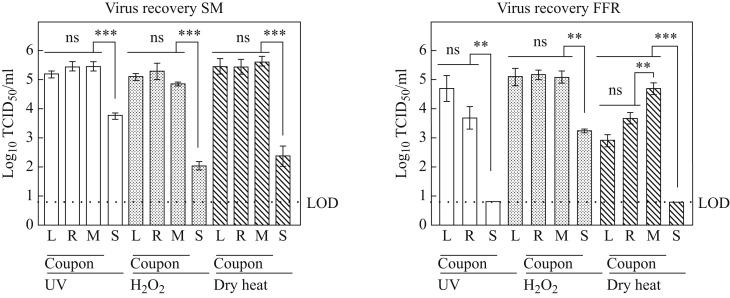
UV irradiation, vaporized HO and dry heat reduced infectious PRCV by more than three orders of magnitude on mask and respirator coupons and rendered it undetectable in all decontamination assays.
CONCLUSION
This is the first description of stable disinfection of face masks and filtering facepiece respirators contaminated with an infectious SARS-CoV-2 surrogate using UV irradiation, vaporized HO and dry heat treatment. The three methods permit demonstration of a loss of infectivity by more than three orders of magnitude of an infectious coronavirus in line with the United States Food and Drug Administration policy regarding face masks and respirators. It presents advantages of uncomplicated manipulation and utilization in a BSL2 facility, therefore being easily adaptable to other respirator and mask types.
背景
在持续的严重急性呼吸综合征冠状病毒 2(SARS-CoV-2)大流行背景下,个人防护设备的供应仍然严重紧张。为了解决这个问题,已经建议重复使用手术口罩和过滤式口罩;在重复使用之前,对其进行消毒至关重要。
目的
我们旨在提供有关三种消毒程序对受猪传染性呼吸道冠状病毒(PRCV)污染的口罩和过滤式口罩的影响的信息,为这些通常仅限一次性使用的产品的传染性冠状病毒消毒提供稳定的模型。
方法
将手术口罩和过滤式口罩的小部件和带子接种传染性 PRCV,并进行三种消毒处理,即紫外线(UV)照射、汽化 HO 和干热处理。从样品材料中回收病毒,并在猪睾丸细胞中测量病毒滴度。
结果
UV 照射、汽化 HO 和干热处理使口罩和过滤式口罩小部件上的传染性 PRCV 减少了三个数量级以上,并且在所有消毒试验中都无法检测到。
结论
这是首次使用紫外线照射、汽化 HO 和干热处理稳定消毒受 SARS-CoV-2 替代物污染的口罩和过滤式口罩的描述。这三种方法均证明了传染性冠状病毒的感染力降低了三个数量级以上,符合美国食品和药物管理局关于口罩和过滤式口罩的政策。它具有操作和利用简单、在生物安全二级设施中易于实施的优点,因此很容易适用于其他口罩和过滤式口罩类型。



 Zotero 插件