
SARS-CoV-2 ORF8 结构,一种快速进化的免疫逃逸蛋白。
Structure of SARS-CoV-2 ORF8, a rapidly evolving immune evasion protein.
机构信息
Department of Molecular and Cell Biology, University of California, Berkeley, CA 94720.
California Institute for Quantitative Biosciences, University of California, Berkeley, CA 94720.
出版信息
Proc Natl Acad Sci U S A. 2021 Jan 12;118(2). doi: 10.1073/pnas.2021785118.
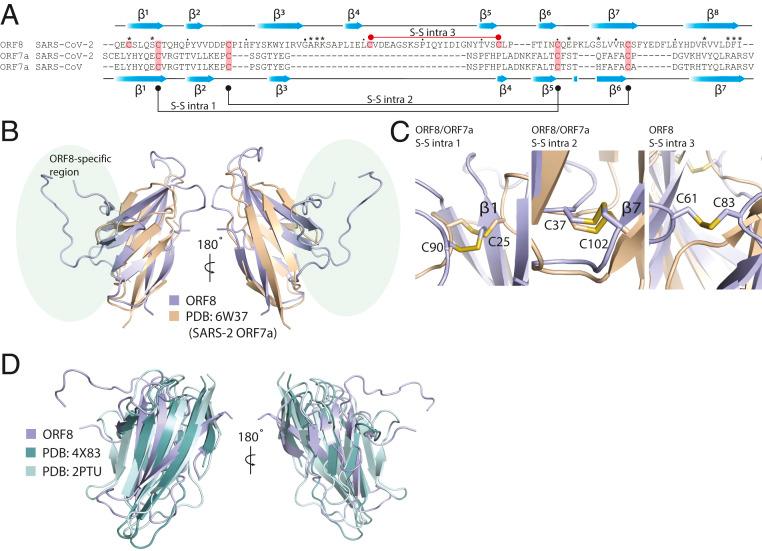
The molecular basis for the severity and rapid spread of the COVID-19 disease caused by severe acute respiratory syndrome coronavirus 2 (SARS-CoV-2) is largely unknown. ORF8 is a rapidly evolving accessory protein that has been proposed to interfere with immune responses. The crystal structure of SARS-CoV-2 ORF8 was determined at 2.04-Å resolution by X-ray crystallography. The structure reveals a ∼60-residue core similar to SARS-CoV-2 ORF7a, with the addition of two dimerization interfaces unique to SARS-CoV-2 ORF8. A covalent disulfide-linked dimer is formed through an N-terminal sequence specific to SARS-CoV-2, while a separate noncovalent interface is formed by another SARS-CoV-2-specific sequence, YIDI Together, the presence of these interfaces shows how SARS-CoV-2 ORF8 can form unique large-scale assemblies not possible for SARS-CoV, potentially mediating unique immune suppression and evasion activities.
严重急性呼吸综合征冠状病毒 2(SARS-CoV-2)引起的 COVID-19 疾病的严重程度和快速传播的分子基础在很大程度上尚不清楚。ORF8 是一种快速进化的辅助蛋白,据推测它会干扰免疫反应。通过 X 射线晶体学确定了 SARS-CoV-2 ORF8 的晶体结构,分辨率为 2.04-Å。该结构揭示了一个约 60 个残基的核心,类似于 SARS-CoV-2 ORF7a,并添加了两个独特的 SARS-CoV-2 ORF8 二聚化界面。通过 SARS-CoV-2 特有的 N 端序列形成一个共价二硫键连接的二聚体,而另一个非共价界面则由另一个 SARS-CoV-2 特有的序列 YIDI 形成。这些界面的存在表明了 SARS-CoV-2 ORF8 如何能够形成 SARS-CoV 不可能形成的独特大规模组装体,从而可能介导独特的免疫抑制和逃逸活动。




 Zotero 插件