
CD39和CD73在T细胞上的表达增强在抗肿瘤免疫反应的调节中发挥作用。
Enhanced expression of CD39 and CD73 on T cells in the regulation of anti-tumor immune responses.
作者信息
Shevchenko Ivan, Mathes Andreas, Groth Christopher, Karakhanova Svetlana, Müller Verena, Utikal Jochen, Werner Jens, Bazhin Alexandr V, Umansky Viktor
机构信息
Clinical Cooperation Unit Dermato-Oncology, German Cancer Research Center (DKFZ), Heidelberg, Germany.
Department of Dermatology, Venereology and Allergology, University Medical Center Mannheim, Ruprecht-Karl University of Heidelberg, Mannheim, Germany.
出版信息
Oncoimmunology. 2020 Apr 9;9(1):1744946. doi: 10.1080/2162402X.2020.1744946.
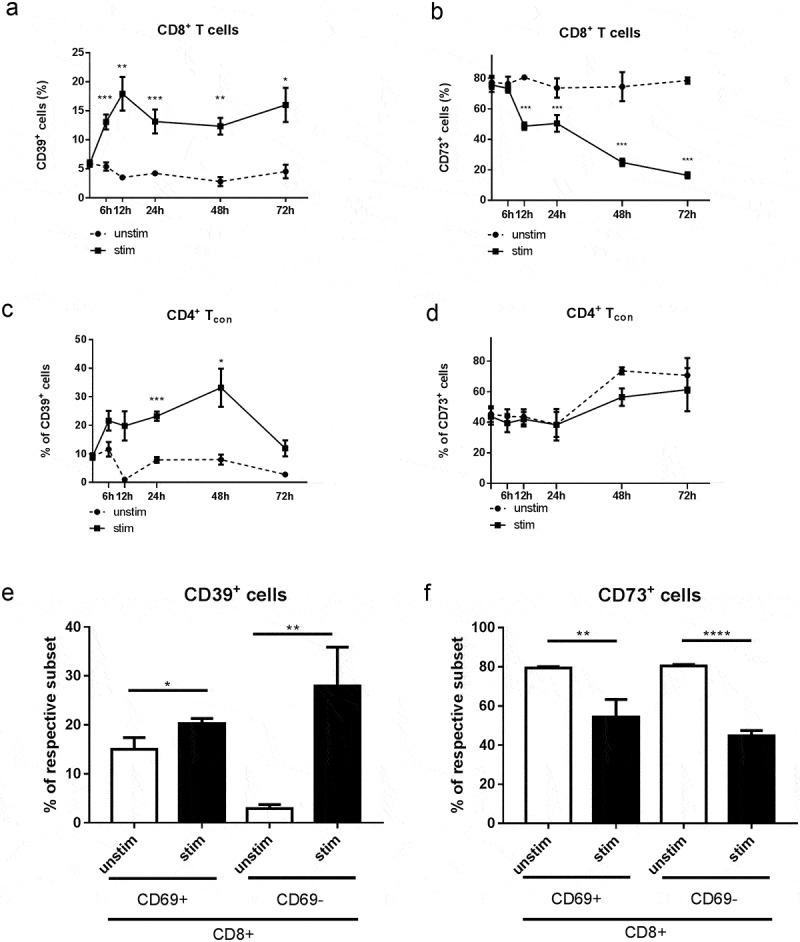
Synthesis of extracellular adenosine by the ectonucleotidases CD39 and CD73 represents an important pathway of immune suppression in the tumor microenvironment. Using two mouse models ( transgenic melanoma and Panc02 orthotopic pancreatic adenocarcinoma), we identified an elevated frequency of ectonucleotidase-expressing T cells in tumors and spleens. Importantly, these ectonucleotidase-positive T cells also showed a pronounced expression of PD-1. Conversely, the PD-1 T cell subsets in tumors contained substantially larger proportions of ectonucleotidase-expressing cells compared to their counterparts lacking PD-1 expression. Our experiments showed that the activation of normal T cells resulted in an increase in the CD39 expression. CD39 and CD73 T cells displayed effector or memory phenotypes and produced IFN-γ, thereby linking ectonucleotidase expression to T cell effector functions. An accumulation of conventional and regulatory T cells expressing CD39 and/or CD73 was also detected in the peripheral blood of patients with melanoma and pancreatic cancer. Moreover, we demonstrated a significant association between low frequencies of circulating CD73CD8 T cells and CD73CD4 regulatory T cells and better overall survival of melanoma patients. Tumor-derived soluble factors (in particular, TGF-β) significantly enhanced the frequencies of ectonucleotidase-expressing cells in mice. Our findings suggest that the upregulation of ectonucleotidase expression in T cells promotes extracellular adenosine accumulation and represents an important mechanism of homeostatic immune auto-regulation, which could be hijacked by tumors to evade anti-cancer immunity. Targeting CD39 and CD73 can open new avenues for cancer immunotherapy.
胞外核苷酸酶CD39和CD73合成细胞外腺苷是肿瘤微环境中免疫抑制的重要途径。利用两种小鼠模型(转基因黑色素瘤和Panc02原位胰腺腺癌),我们发现肿瘤和脾脏中表达核苷酸酶的T细胞频率升高。重要的是,这些核苷酸酶阳性T细胞也显示出PD-1的显著表达。相反,与缺乏PD-1表达的对应T细胞相比,肿瘤中的PD-1 T细胞亚群中表达核苷酸酶的细胞比例要大得多。我们的实验表明,正常T细胞的激活导致CD39表达增加。表达CD39和CD73的T细胞表现出效应或记忆表型并产生IFN-γ,从而将核苷酸酶表达与T细胞效应功能联系起来。在黑色素瘤和胰腺癌患者的外周血中也检测到表达CD39和/或CD73的传统T细胞和调节性T细胞的积累。此外,我们证明循环中CD73⁺CD8⁺ T细胞和CD73⁺CD4⁺调节性T细胞的低频率与黑色素瘤患者更好的总生存率之间存在显著关联。肿瘤衍生的可溶性因子(特别是TGF-β)显著提高了小鼠中表达核苷酸酶的细胞频率。我们的研究结果表明,T细胞中核苷酸酶表达的上调促进细胞外腺苷积累,是稳态免疫自调节的重要机制,肿瘤可能利用这一机制逃避抗癌免疫。靶向CD39和CD73可为癌症免疫治疗开辟新途径。




 Zotero 插件