
片段组学揭示的循环核 DNA 结构特征、起源和完整大小分布
Circulating nuclear DNA structural features, origins, and complete size profile revealed by fragmentomics.
机构信息
IRCM, Institut de Recherche en Cancérologie de Montpellier, INSERM U1194, Université de Montpellier, Institut régional du Cancer de Montpellier, Montpellier, France.
Thoracic Oncology Unit, Arnaud de Villeneuve Hospital, University Hospital of Montpellier, Montpellier, France.
出版信息
JCI Insight. 2021 Apr 8;6(7):144561. doi: 10.1172/jci.insight.144561.
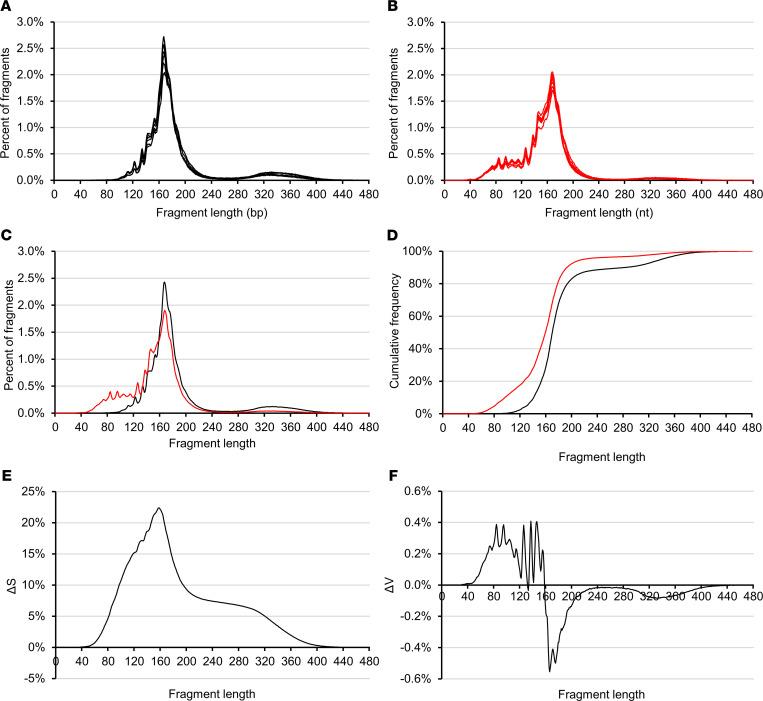
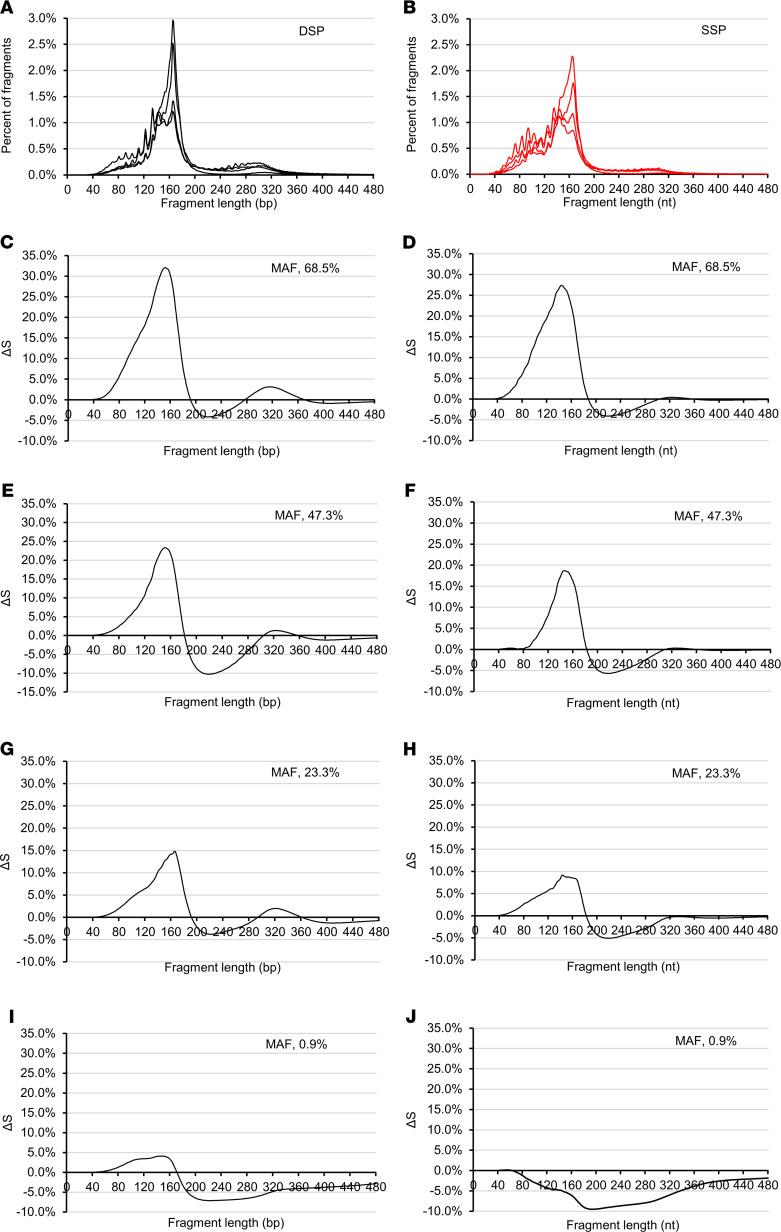
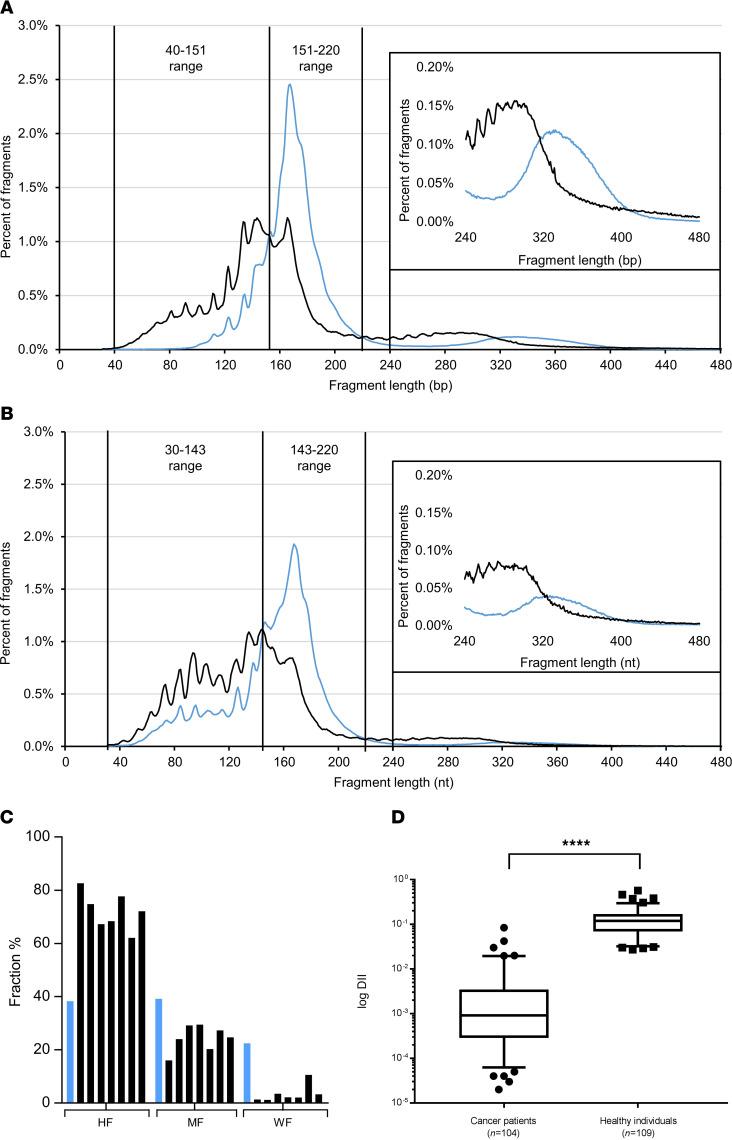
To unequivocally address their unresolved intimate structures in blood, we scrutinized the size distribution of circulating cell-free DNA (cfDNA) using whole-genome sequencing (WGS) from both double- and single-strand DNA library preparations (DSP and SSP, n = 7) and using quantitative PCR (Q-PCR, n = 116). The size profile in healthy individuals was remarkably homogenous when using DSP sequencing or SSP sequencing. CfDNA size profile had a characteristic nucleosome fragmentation pattern. Overall, our data indicate that the proportion of cfDNA inserted in mono-nucleosomes, di-nucleosomes, and chromatin of higher molecular size (>1000 bp) can be estimated as 67.5% to 80%, 9.4% to 11.5%, and 8.5% to 21.0%, respectively. Although DNA on single chromatosomes or mono-nucleosomes is detectable, our data revealed that cfDNA is highly nicked (97%-98%) on those structures, which appear to be subjected to continuous nuclease activity in the bloodstream. Fragments analysis allows the distinction of cfDNA of different origins: first, cfDNA size profile analysis may be useful in cfDNA extract quality control; second, subtle but reliable differences between metastatic colorectal cancer patients and healthy individuals vary with the proportion of malignant cell-derived cfDNA in plasma extracts, pointing to a higher degree of cfDNA fragmentation and nuclease activity in samples with high malignant cell cfDNA content.
为了明确解决血液中尚未解决的与亲密相关的结构问题,我们使用双链和单链 DNA 文库制备的全基因组测序(WGS)(DSP 和 SSP,n = 7)和定量 PCR(Q-PCR,n = 116)分析了循环无细胞 DNA(cfDNA)的大小分布。使用 DSP 测序或 SSP 测序时,健康个体的大小分布非常均匀。cfDNA 大小分布具有特征性的核小体碎片化模式。总的来说,我们的数据表明,cfDNA 插入单核小体、双核小体和更高分子量(>1000 bp)染色质中的比例可以分别估计为 67.5%至 80%、9.4%至 11.5%和 8.5%至 21.0%。虽然可以检测到单染色体或单核小体上的 DNA,但我们的数据显示,cfDNA 在这些结构上高度断裂(97%-98%),这些结构似乎在血流中受到持续的核酸酶活性的影响。片段分析允许区分不同来源的 cfDNA:首先,cfDNA 大小分布分析可能有助于 cfDNA 提取物的质量控制;其次,转移性结直肠癌患者与健康个体之间的细微但可靠差异随血浆提取物中恶性细胞衍生 cfDNA 的比例而变化,表明在高恶性细胞 cfDNA 含量的样本中 cfDNA 碎片化和核酸酶活性更高。



 Zotero 插件