
iRGD-抗CD3与PD-1阻断的联合疗法增强了脐血来源T细胞的抗肿瘤效力。
Combination Therapy with iRGD-antiCD3 and PD-1 Blockade Enhances Antitumor Potency of Cord Blood-Derived T Cells.
作者信息
Zhu Mei, Wang Hongmei, Zhou Shujuan, Wei Jia, Ding Naiqing, Shao Jie, Yu Lixia, Feng Zhenqing, Liu Baorui
机构信息
The Comprehensive Cancer Centre of Nanjing Drum Tower Hospital, Clinical College of Nanjing Medical University, Nanjing, Jiangsu, 210008, People's Republic of China.
The Comprehensive Cancer Centre of Drum Tower Hospital, Medical School of Nanjing University and Clinical Cancer Institute of Nanjing University, Nanjing, Jiangsu, 210008, People's Republic of China.
出版信息
Onco Targets Ther. 2021 Feb 5;14:835-844. doi: 10.2147/OTT.S291086. eCollection 2021.
BACKGROUND
T cell-redirecting bispecific antibodies (BsAbs) are emerging as a potent cancer therapy that crosslinks tumor cells and T cells by simultaneously binding to tumor-associated antigen and CD3ε. However, immune inhibitory molecules can be remarkably upregulated after BsAbs treatment, leading to a suppressive tumor microenvironment and treatment resistance. This can be partially reversed by combination with immune checkpoint inhibitors. In our previous work, we successfully constructed the recombinant protein iRGD-antiCD3 and demonstrated that it promoted antitumor efficacy of transferred T cells by promoting T cell activation and infiltration.
METHODS
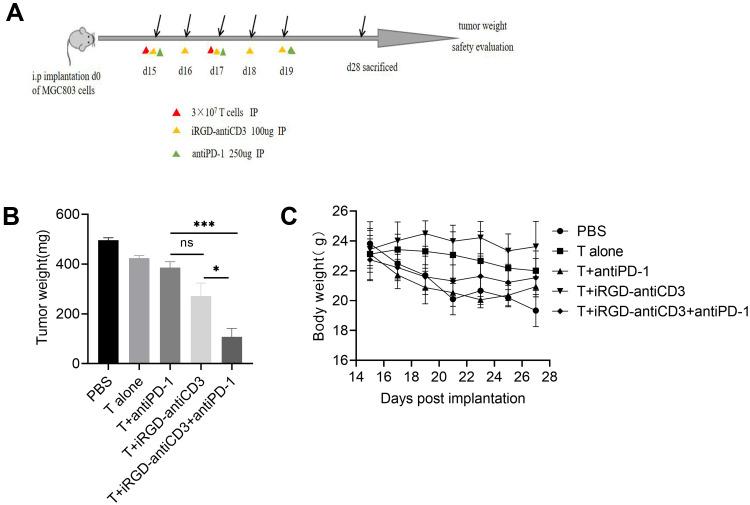
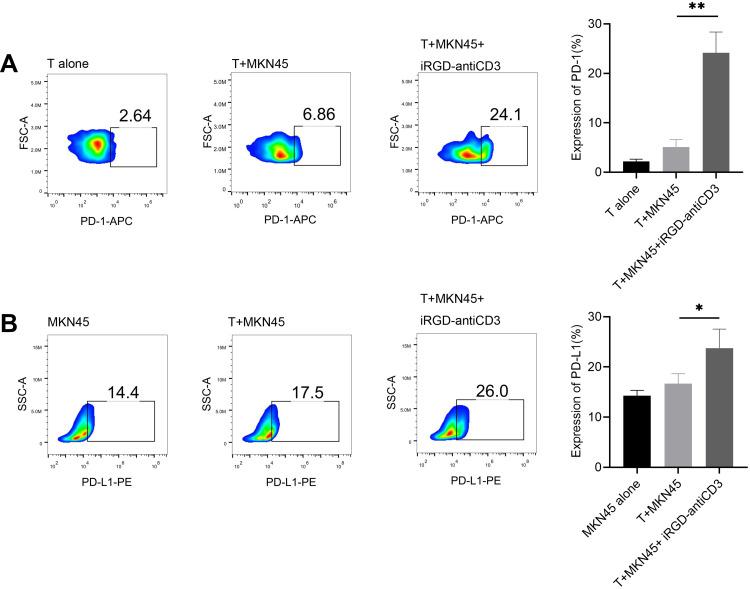
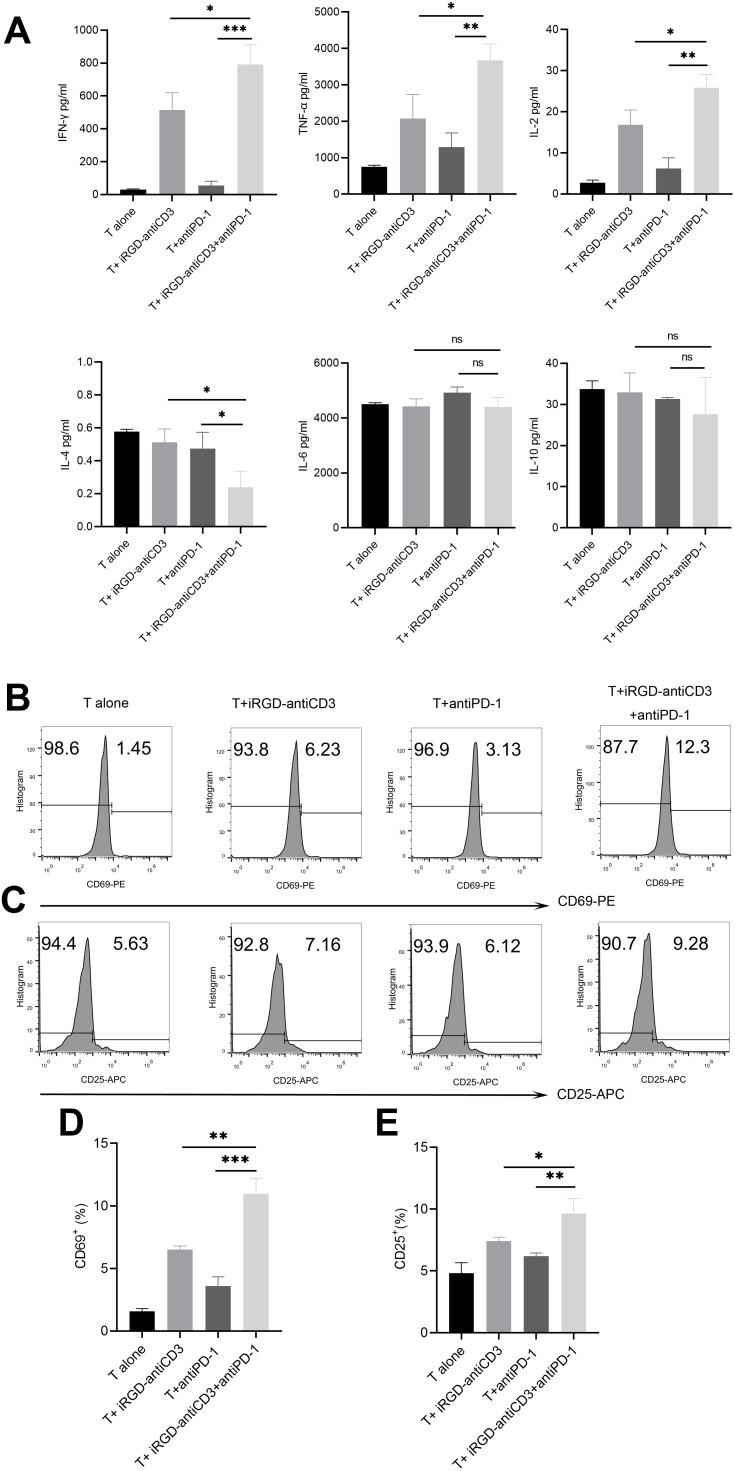
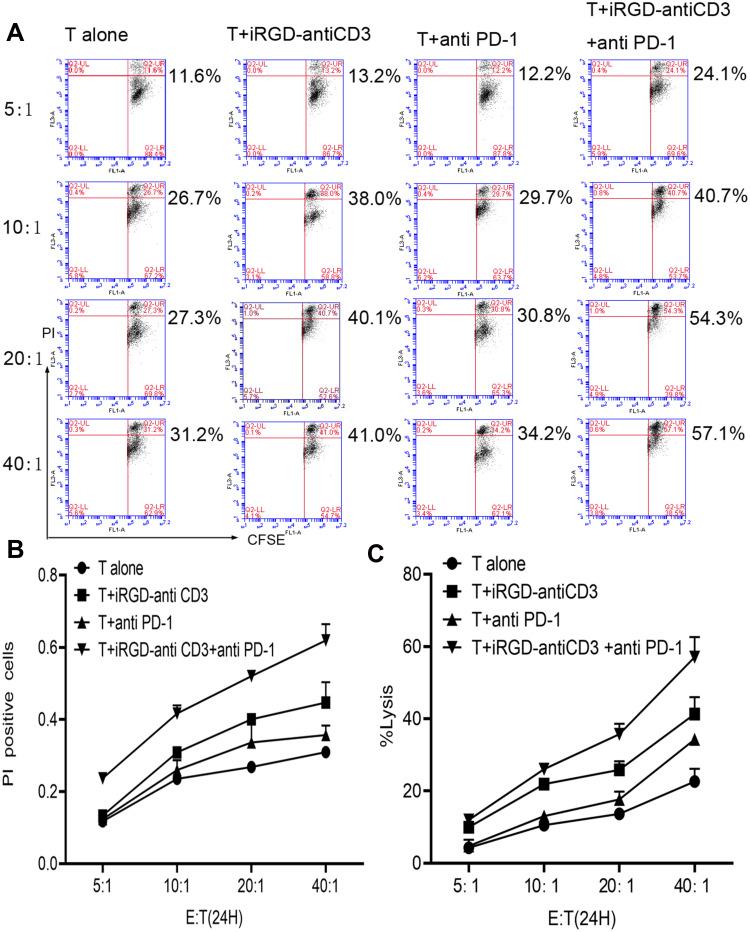
We detected the levels of both PD-1 and PD-L1 as resistance to iRGD-antiCD3 treatment. Using cord blood-derived T cells, we assessed the activation and effects of iRGD-antiCD3 combined with PD-1 as evidenced by activation markers, Th1/Th2-cytokines, and killing capability against tumor cells in vitro. Moreover, to better mimic the physiological characteristics of in vivo solid tumors, we generated 3D spheroids from target cell lines. Spheroids were stained with a Viability/Cytotoxicity Assay Kit and examined by confocal microscopy to study the in vitro antitumor effect of T cells co-administered with combination iRGD-antiCD3 and PD-1 blockade. The mouse peritoneal metastatic gastric tumor model was employed. The synergistic antitumor effect and safety profiles in vivo were evaluated by tumor and body weight of tumor-bearing mice.
RESULTS
We found that expression of both PD-1 and PD-L1 were increased as resistance to iRGD-antiCD3 treatment. We found that PD-1 blockade partially restored T cell activation as evidenced by elevated activation markers, Th1-cytokines, and killing capability against tumor cells in vitro. The combination of PD-1 blockade consistently and significantly increased cord blood-derived T cell cytotoxicity against 3D tumor spheroids. In vivo, we observed synergistic antitumor activity without obvious side effects.
CONCLUSION
These results demonstrated that combining iRGD-antiCD3 with PD-1 blockade could further improve antitumor efficacy of T cells, and this strategy holds great potential for the treatment of solid malignancies.
背景
T细胞重定向双特异性抗体(BsAbs)正在成为一种有效的癌症治疗方法,它通过同时结合肿瘤相关抗原和CD3ε,使肿瘤细胞和T细胞交联。然而,在BsAbs治疗后,免疫抑制分子可显著上调,导致肿瘤微环境抑制和治疗耐药。联合免疫检查点抑制剂可部分逆转这种情况。在我们之前的工作中,我们成功构建了重组蛋白iRGD-抗CD3,并证明它通过促进T细胞活化和浸润来提高转移T细胞的抗肿瘤疗效。
方法
我们检测了对iRGD-抗CD3治疗产生耐药的PD-1和PD-L1水平。使用脐血来源的T细胞,我们评估了iRGD-抗CD3与PD-1联合使用后的活化情况及效果,体外通过活化标志物、Th1/Th2细胞因子以及对肿瘤细胞的杀伤能力来证明。此外,为了更好地模拟体内实体瘤的生理特征,我们从靶细胞系生成了三维球体。用活力/细胞毒性检测试剂盒对球体进行染色,并通过共聚焦显微镜检查,以研究与iRGD-抗CD3和PD-1阻断联合给药的T细胞的体外抗肿瘤作用。采用小鼠腹膜转移性胃癌模型。通过荷瘤小鼠的肿瘤和体重评估体内的协同抗肿瘤作用和安全性。
结果
我们发现,作为对iRGD-抗CD3治疗产生耐药的表现,PD-1和PD-L1的表达均增加。我们发现,PD-1阻断部分恢复了T细胞活化,体外活化标志物、Th1细胞因子升高以及对肿瘤细胞的杀伤能力增强证明了这一点。PD-1阻断的联合使用持续且显著地增加了脐血来源的T细胞对三维肿瘤球体的细胞毒性。在体内,我们观察到协同抗肿瘤活性且无明显副作用。
结论
这些结果表明,将iRGD-抗CD3与PD-1阻断联合使用可进一步提高T细胞的抗肿瘤疗效,并且该策略在实体恶性肿瘤治疗中具有巨大潜力。

 Zotero 插件