
瑜伽体式干预对糖尿病周围神经病变患者站立平衡能力的影响:一项初步研究。
Effect of Yogasana Intervention on Standing Balance Performance among People with Diabetic Peripheral Neuropathy: A Pilot Study.
作者信息
Kanjirathingal Jinny P, Mullerpatan Rajani P, Nehete Girish, Raghuram Nagarathna
机构信息
Department of Musculoskeletal Physiotherapy, MGM School of Physiotherapy, MGM Institute of Health Sciences, Navi Mumbai, Maharashtra, India.
MGM Centre of Human Movement Science, MGM School of Physiotherapy, MGM Institute of Health Sciences, Navi Mumbai, Maharashtra, India.
出版信息
Int J Yoga. 2021 Jan-Apr;14(1):60-70. doi: 10.4103/ijoy.IJOY_75_20. Epub 2021 Feb 5.
BACKGROUND
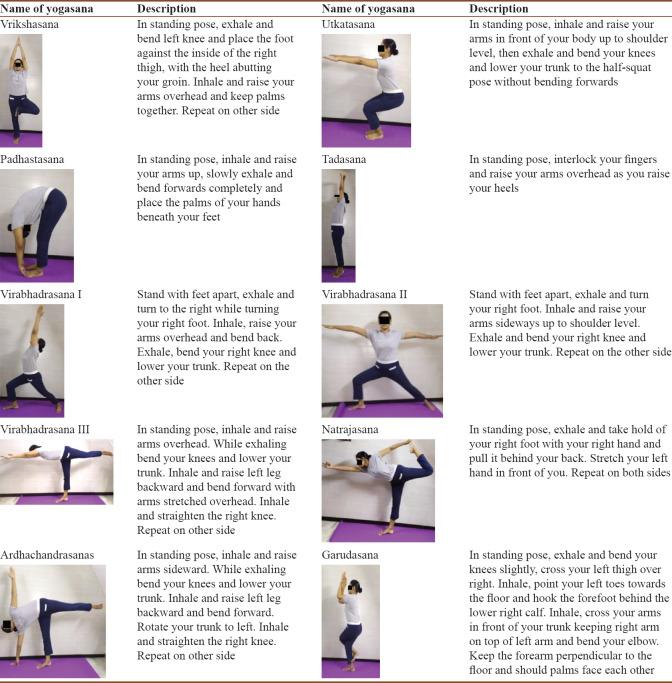
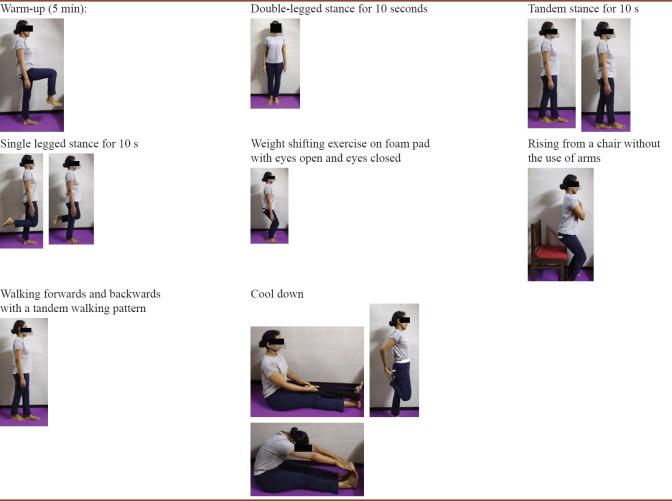
Diabetic peripheral neuropathy (DPN) is known to cause impaired balance and eventually increased risk of fall. Yogasanas characterized by slow, gentle transitions into postures with a varying base of support and focus on body awareness during movement hold potential for training balance control. Therefore, the current study aimed to evaluate effect of structured Yogasana intervention compared to conventional balance exercise on static and dynamic balance performance among people with diabetic neuropathy.
METHODS
: Thirty-five people with DPN aged 42-70 years were recruited to Yogasana intervention group ( = 11), conventional balance exercises group ( = 10), and Control group ( = 14) following ethical approval. All participants were evaluated at baseline and post 12-week intervention on star excursion balance test, single-limb stance test, and center of pressure (CoP) excursion for balance performance, Modified fall efficacy scale for fear of falls and lower extremity strength using chair stand test and step-up test.
RESULTS
Balance performance (static and dynamic measured by star excursion balance test, single-limb stance test, and CoP excursion, lower extremity strength (using chair stand test and step-up test) demonstrated improvement and fear of fall reduced among Yogasana intervention group ( = 0.05) and conventional balance exercises group ( = 0.05) post 12-week intervention. CoP excursion increased in the control group indicating deterioration in balance performance after 12 weeks ( = 0.05). comparison revealed that Yogasana intervention was marginally more effective in improving static and dynamic balance performance compared to conventional balance exercises in all variables of standing balance performance ( = 0.025).
CONCLUSION
Yogasana and conventional balance exercises were effective in improving static and dynamic balance performance, lower extremity muscle strength, and reducing fear of fall among people with DPN. Yogasana intervention demonstrated marginally greater improvement in static and dynamic balance performance and lower extremity muscle strength compared to conventional exercise.
背景
已知糖尿病周围神经病变(DPN)会导致平衡能力受损,并最终增加跌倒风险。瑜伽体式的特点是缓慢、轻柔地过渡到具有不同支撑基础的姿势,并在运动过程中注重身体感知,具有训练平衡控制的潜力。因此,本研究旨在评估与传统平衡运动相比,结构化瑜伽体式干预对糖尿病神经病变患者静态和动态平衡能力的影响。
方法
在获得伦理批准后,招募了35名年龄在42 - 70岁的DPN患者,分为瑜伽体式干预组(n = 11)、传统平衡运动组(n = 10)和对照组(n = 14)。所有参与者在基线和12周干预后,接受星标偏移平衡测试、单腿站立测试和压力中心(CoP)偏移以评估平衡能力,采用改良跌倒效能量表评估跌倒恐惧,并通过椅子站立测试和上台阶测试评估下肢力量。
结果
12周干预后,瑜伽体式干预组(P = 0.05)和传统平衡运动组(P = 0.05)的平衡能力(通过星标偏移平衡测试、单腿站立测试和CoP偏移测量静态和动态平衡)、下肢力量(通过椅子站立测试和上台阶测试)均有改善,跌倒恐惧降低。对照组的CoP偏移增加,表明12周后平衡能力下降(P = 0.05)。比较显示,在站立平衡能力的所有变量方面,与传统平衡运动相比,瑜伽体式干预在改善静态和动态平衡能力方面略更有效(P = 0.025)。
结论
瑜伽体式和传统平衡运动在改善DPN患者的静态和动态平衡能力、下肢肌肉力量以及降低跌倒恐惧方面均有效。与传统运动相比,瑜伽体式干预在静态和动态平衡能力以及下肢肌肉力量方面的改善略更显著。

 Zotero 插件