
在 26 个国家和地区的侵袭性呼吸道感染监测倡议中,COVID-19 大流行期间肺炎链球菌、流感嗜血杆菌和脑膜炎奈瑟菌引起的侵袭性疾病发病率的变化:监测数据的前瞻性分析。
Changes in the incidence of invasive disease due to Streptococcus pneumoniae, Haemophilus influenzae, and Neisseria meningitidis during the COVID-19 pandemic in 26 countries and territories in the Invasive Respiratory Infection Surveillance Initiative: a prospective analysis of surveillance data.
机构信息
Nuffield Department of Population Health, Big Data Institute, University of Oxford, Oxford, UK.
Nuffield Department of Population Health, Big Data Institute, University of Oxford, Oxford, UK.
出版信息
Lancet Digit Health. 2021 Jun;3(6):e360-e370. doi: 10.1016/S2589-7500(21)00077-7.
BACKGROUND
Streptococcus pneumoniae, Haemophilus influenzae, and Neisseria meningitidis, which are typically transmitted via respiratory droplets, are leading causes of invasive diseases, including bacteraemic pneumonia and meningitis, and of secondary infections subsequent to post-viral respiratory disease. The aim of this study was to investigate the incidence of invasive disease due to these pathogens during the early months of the COVID-19 pandemic.
METHODS
In this prospective analysis of surveillance data, laboratories in 26 countries and territories across six continents submitted data on cases of invasive disease due to S pneumoniae, H influenzae, and N meningitidis from Jan 1, 2018, to May, 31, 2020, as part of the Invasive Respiratory Infection Surveillance (IRIS) Initiative. Numbers of weekly cases in 2020 were compared with corresponding data for 2018 and 2019. Data for invasive disease due to Streptococcus agalactiae, a non-respiratory pathogen, were collected from nine laboratories for comparison. The stringency of COVID-19 containment measures was quantified using the Oxford COVID-19 Government Response Tracker. Changes in population movements were assessed using Google COVID-19 Community Mobility Reports. Interrupted time-series modelling quantified changes in the incidence of invasive disease due to S pneumoniae, H influenzae, and N meningitidis in 2020 relative to when containment measures were imposed.
FINDINGS
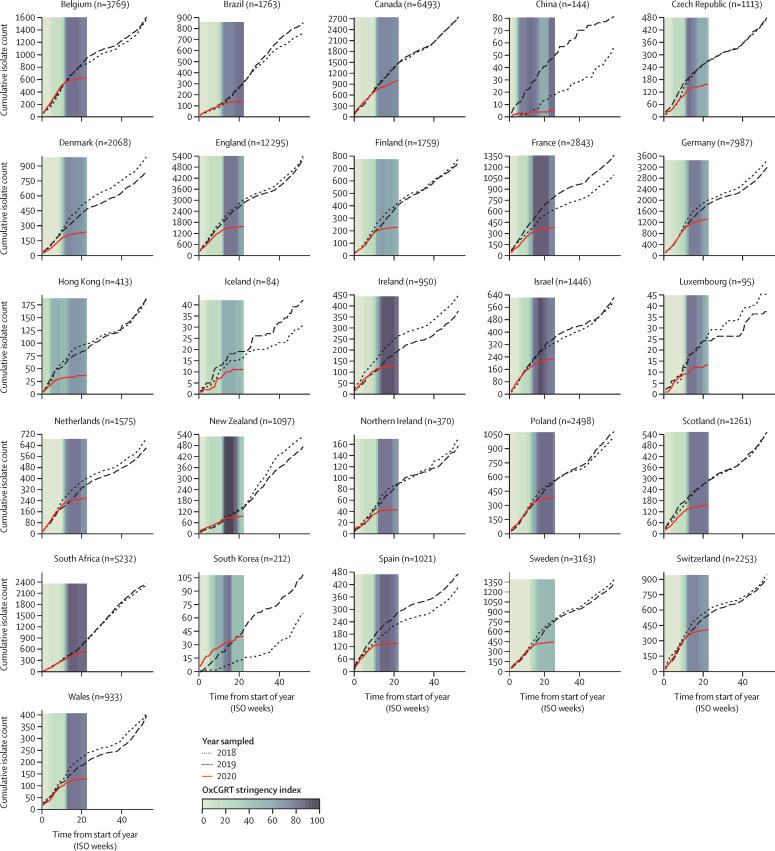
27 laboratories from 26 countries and territories submitted data to the IRIS Initiative for S pneumoniae (62 837 total cases), 24 laboratories from 24 countries submitted data for H influenzae (7796 total cases), and 21 laboratories from 21 countries submitted data for N meningitidis (5877 total cases). All countries and territories had experienced a significant and sustained reduction in invasive diseases due to S pneumoniae, H influenzae, and N meningitidis in early 2020 (Jan 1 to May 31, 2020), coinciding with the introduction of COVID-19 containment measures in each country. By contrast, no significant changes in the incidence of invasive S agalactiae infections were observed. Similar trends were observed across most countries and territories despite differing stringency in COVID-19 control policies. The incidence of reported S pneumoniae infections decreased by 68% at 4 weeks (incidence rate ratio 0·32 [95% CI 0·27-0·37]) and 82% at 8 weeks (0·18 [0·14-0·23]) following the week in which significant changes in population movements were recorded.
INTERPRETATION
The introduction of COVID-19 containment policies and public information campaigns likely reduced transmission of S pneumoniae, H influenzae, and N meningitidis, leading to a significant reduction in life-threatening invasive diseases in many countries worldwide.
FUNDING
Wellcome Trust (UK), Robert Koch Institute (Germany), Federal Ministry of Health (Germany), Pfizer, Merck, Health Protection Surveillance Centre (Ireland), SpID-Net project (Ireland), European Centre for Disease Prevention and Control (European Union), Horizon 2020 (European Commission), Ministry of Health (Poland), National Programme of Antibiotic Protection (Poland), Ministry of Science and Higher Education (Poland), Agencia de Salut Pública de Catalunya (Spain), Sant Joan de Deu Foundation (Spain), Knut and Alice Wallenberg Foundation (Sweden), Swedish Research Council (Sweden), Region Stockholm (Sweden), Federal Office of Public Health of Switzerland (Switzerland), and French Public Health Agency (France).
背景
通常通过呼吸道飞沫传播的肺炎链球菌、流感嗜血杆菌和脑膜炎奈瑟菌是细菌性肺炎和脑膜炎等侵袭性疾病以及病毒性呼吸道疾病后继发的继发性感染的主要原因。本研究旨在调查 COVID-19 大流行早期这些病原体引起的侵袭性疾病的发病率。
方法
在这项针对监测数据的前瞻性分析中,来自六大洲 26 个国家和地区的 27 个实验室从 2018 年 1 月 1 日至 2020 年 5 月 31 日提交了肺炎链球菌、流感嗜血杆菌和脑膜炎奈瑟菌引起的侵袭性疾病病例的数据,作为侵袭性呼吸道感染监测(IRIS)计划的一部分。2020 年每周病例数与 2018 年和 2019 年的数据进行了比较。来自 9 个实验室的侵袭性疾病数据与非呼吸道病原体肺炎链球菌进行了比较。使用牛津 COVID-19 政府反应追踪器量化 COVID-19 遏制措施的严格程度。使用谷歌 COVID-19 社区流动性报告评估人口流动的变化。中断时间序列模型量化了 2020 年肺炎链球菌、流感嗜血杆菌和脑膜炎奈瑟菌引起的侵袭性疾病发病率与实施遏制措施时相比的变化。
结果
来自 26 个国家和地区的 27 个实验室向 IRIS 计划提交了肺炎链球菌(总病例数 62837 例)的数据,来自 24 个国家的 24 个实验室提交了流感嗜血杆菌(总病例数 7796 例)的数据,来自 21 个国家的 21 个实验室提交了脑膜炎奈瑟菌(总病例数 5877 例)的数据。所有国家和地区在 2020 年初(1 月 1 日至 5 月 31 日)都经历了肺炎链球菌、流感嗜血杆菌和脑膜炎奈瑟菌引起的侵袭性疾病的显著和持续减少,这与每个国家引入 COVID-19 遏制措施相吻合。相比之下,侵袭性酿脓链球菌感染的发病率没有显著变化。尽管 COVID-19 控制政策的严格程度不同,但在大多数国家和地区都观察到了类似的趋势。在记录到人口流动显著变化的那一周后,报告的肺炎球菌感染发病率在 4 周时下降了 68%(发病率比 0.32 [95%CI 0.27-0.37]),在 8 周时下降了 82%(0.18 [0.14-0.23])。
解释
COVID-19 遏制政策和公共信息运动的推出可能降低了肺炎链球菌、流感嗜血杆菌和脑膜炎奈瑟菌的传播,导致全球许多国家危及生命的侵袭性疾病显著减少。
资金
威康信托基金会(英国)、罗伯特科赫研究所(德国)、联邦卫生部(德国)、辉瑞公司、默克公司、健康保护监测中心(爱尔兰)、SpID-Net 项目(爱尔兰)、欧洲疾病预防控制中心(欧盟)、地平线 2020(欧盟委员会)、卫生部(波兰)、国家抗生素保护计划(波兰)、科学与高等教育部(波兰)、加泰罗尼亚公共卫生署(西班牙)、圣若望德迪乌基金会(西班牙)、Knut 和 Alice Wallenberg 基金会(瑞典)、瑞典研究理事会(瑞典)、斯德哥尔摩地区(瑞典)、瑞士联邦公共卫生办公室(瑞士)和法国公共卫生署(法国)。


 Zotero 插件