
低能电子辐照是替代 γ 辐照用于制造 ATMP 中(CAR-NK-92)细胞灭活的有效方法。
Low Energy Electron Irradiation Is a Potent Alternative to Gamma Irradiation for the Inactivation of (CAR-)NK-92 Cells in ATMP Manufacturing.
机构信息
Department for GMP Process Development/ATMP Design, Fraunhofer Institute for Cell Therapy and Immunology (IZI), Leipzig, Germany.
Fraunhofer Institute for Toxicology and Experimental Medicine (ITEM), Department for Preclinical Pharmacology and Toxicology, Member of the German Center for Lung Research (DZL), Biomedical Research in Endstage and Obstructive Lung Disease (BREATH) research network, Hannover, Germany.
出版信息
Front Immunol. 2021 Jun 4;12:684052. doi: 10.3389/fimmu.2021.684052. eCollection 2021.
BACKGROUND
With increasing clinical use of NK-92 cells and their CAR-modified derivatives in cancer immunotherapy, there is a growing demand for efficient production processes of these "off-the-shelf" therapeutics. In order to ensure safety and prevent the occurrence of secondary tumors, (CAR-)NK-92 cell proliferation has to be inactivated before transfusion. This is commonly achieved by gamma irradiation. Recently, we showed proof of concept that low energy electron irradiation (LEEI) is a new method for NK-92 inactivation. LEEI has several advantages over gamma irradiation, including a faster reaction time, a more reproducible dose rate and much less requirements on radiation shielding. Here, LEEI was further evaluated as a promising alternative to gamma irradiation yielding cells with highly maintained cytotoxic effector function.
METHODS
Effectiveness and efficiency of LEEI and gamma irradiation were analyzed using NK-92 and CD123-directed CAR-NK-92 cells. LEE-irradiated cells were extensively characterized and compared to gamma-irradiated cells flow cytometry, cytotoxicity assays, and comet assays, amongst others.
RESULTS
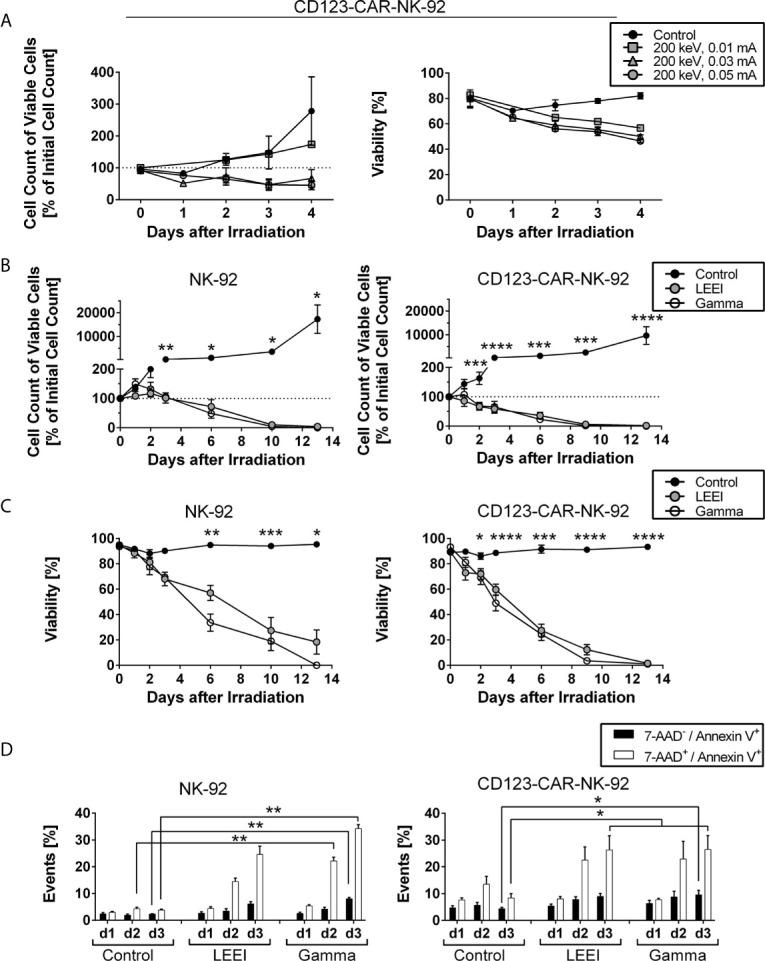
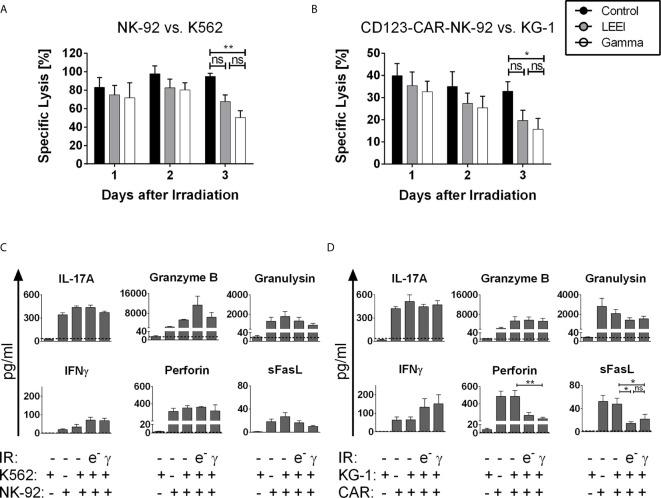
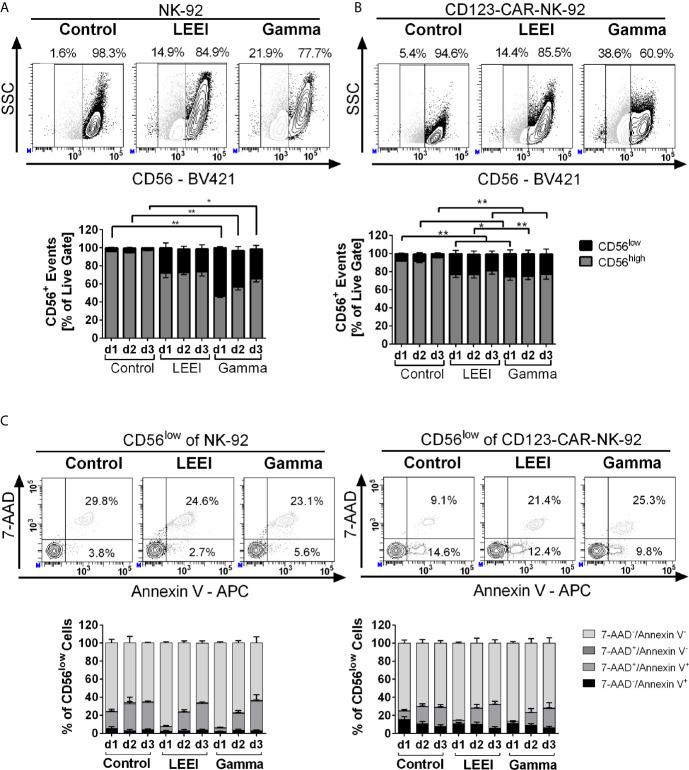
Our results show that both irradiation methods caused a progressive decrease in cell viability and are, therefore, suitable for inhibition of cell proliferation. Notably, the NK-mediated specific lysis of tumor cells was maintained at stable levels for three days post-irradiation, with a trend towards higher activities after LEEI treatment as compared to gamma irradiation. Both gamma irradiation as well as LEEI led to substantial DNA damage and an accumulation of irradiated cells in the G2/M cell cycle phases. In addition, transcriptomic analysis of irradiated cells revealed approximately 12-fold more differentially expressed genes two hours after gamma irradiation, compared to LEEI. Analysis of surface molecules revealed an irradiation-induced decrease in surface expression of CD56, but no changes in the levels of the activating receptors NKp46, NKG2D, or NKp30.
CONCLUSIONS
The presented data show that LEEI inactivates (CAR-)NK-92 cells as efficiently as gamma irradiation, but with less impact on the overall gene expression. Due to logistic advantages, LEEI might provide a superior alternative for the manufacture of (CAR-)NK-92 cells for clinical application.
背景
随着 NK-92 细胞及其嵌合抗原受体(CAR)修饰衍生物在癌症免疫治疗中的临床应用不断增加,对这些“现货”疗法进行高效生产的需求也日益增长。为了确保安全性并防止继发性肿瘤的发生,(CAR)-NK-92 细胞的增殖必须在输注前被灭活。这通常通过伽马辐照来实现。最近,我们证明了低能电子辐照(LEEI)是一种用于 NK-92 失活的新方法。与伽马辐照相比,LEEI 具有几个优势,包括更快的反应时间、更可重复的剂量率以及对辐射屏蔽的要求低得多。在这里,LEEI 被进一步评估为伽马辐照的有前途的替代方法,产生具有高度保持的细胞毒性效应功能的细胞。
方法
使用 NK-92 和靶向 CD123 的 CAR-NK-92 细胞分析 LEEI 和伽马辐照的有效性和效率。通过流式细胞术、细胞毒性测定和彗星试验等方法对 LEE 辐照的细胞进行了广泛的表征,并与伽马辐照的细胞进行了比较。
结果
我们的结果表明,两种辐照方法都导致细胞活力逐渐下降,因此适用于抑制细胞增殖。值得注意的是,NK 介导的肿瘤细胞的特异性裂解在辐照后三天内保持稳定水平,与伽马辐照相比,LEEI 处理后活性呈上升趋势。伽马辐照和 LEEI 都导致了大量的 DNA 损伤,并使辐照细胞在 G2/M 细胞周期阶段积累。此外,辐照细胞的转录组分析显示,与 LEEI 相比,伽马辐照后两小时差异表达基因的数量增加了约 12 倍。表面分子分析显示,辐照导致 CD56 的表面表达减少,但激活受体 NKp46、NKG2D 或 NKp30 的水平没有变化。
结论
所提供的数据表明,LEEI 对(CAR)-NK-92 细胞的失活效率与伽马辐照相当,但对整体基因表达的影响较小。由于后勤优势,LEEI 可能为临床应用中(CAR)-NK-92 细胞的制造提供更好的替代方法。

 Zotero 插件