
优化 NK-92 细胞系杀手:γ射线照射、CD95/Fas 配体结合和 NK 或 LAK 攻击限制细胞毒性功效。
Optimizing NK-92 serial killers: gamma irradiation, CD95/Fas-ligation, and NK or LAK attack limit cytotoxic efficacy.
机构信息
University of Nevada, Reno School of Medicine, Reno, NV, 89557, USA.
Fred Hutchinson Cancer Research Center, Seattle, WA, 98109, USA.
出版信息
J Transl Med. 2022 Apr 2;20(1):151. doi: 10.1186/s12967-022-03350-6.
BACKGROUND
The NK cell line NK-92 and its genetically modified variants are receiving attention as immunotherapies to treat a range of malignancies. However, since NK-92 cells are themselves tumors, they require irradiation prior to transfer and are potentially susceptible to attack by patients' immune systems. Here, we investigated NK-92 cell-mediated serial killing for the effects of gamma-irradiation and ligation of the death receptor Fas (CD95), and NK-92 cell susceptibility to attack by activated primary blood NK cells.
METHODS
To evaluate serial killing, we used Cr-release assays with low NK-92 effector cell to target Raji, Daudi or K562 tumor cell (E:T) ratios to determine killing frequencies at 2-, 4-, 6-, and 8-h.
RESULTS
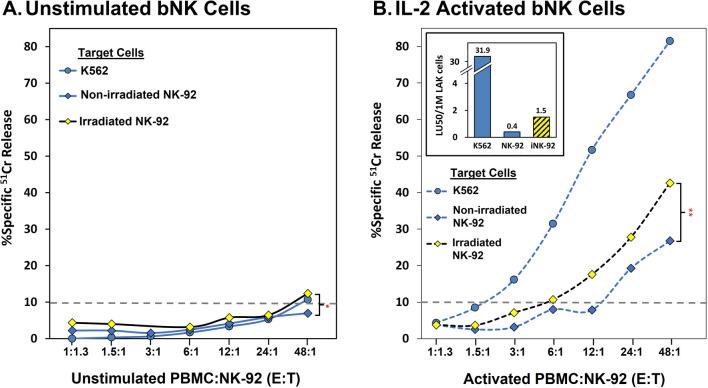
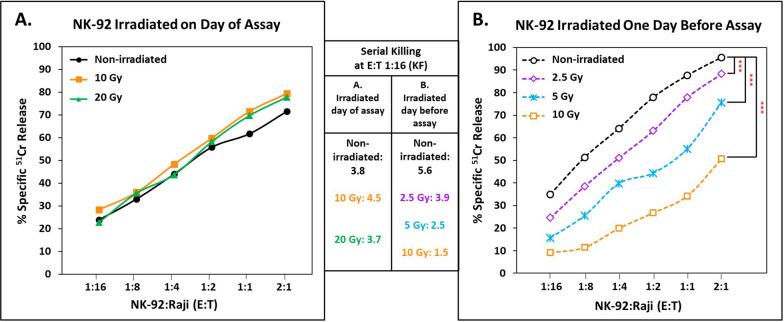
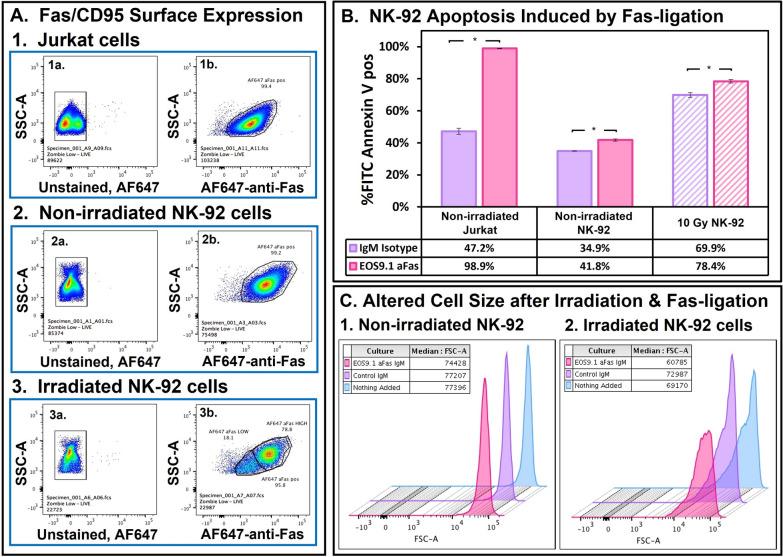
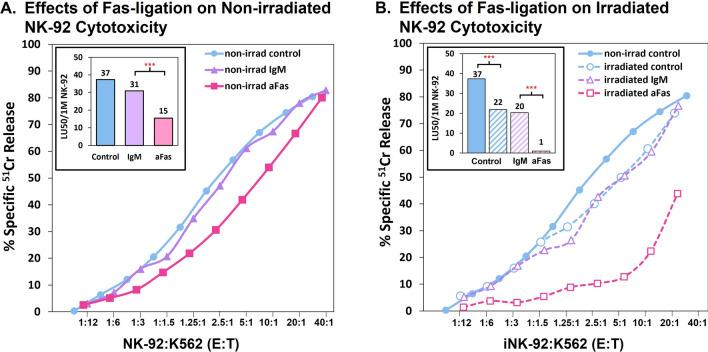
NK-92 cells were able to kill up to 14 Raji cells per NK-92 cell in 8 h. NK-92 cells retained high cytotoxic activity immediately after irradiation with 10 Gy but the cells surviving irradiation lost > 50% activity 1 day after irradiation. Despite high expression of CD95, NK-92 cells maintained their viability following overnight Fas/CD95-ligation but lost some cytotoxic activity. However, 1 day after irradiation, NK-92 cells were more susceptible to Fas ligation, resulting in decreased cytotoxic activity of the cells surviving irradiation. Irradiated NK-92 cells were also susceptible to killing by both unstimulated and IL-2 activated primary NK cells (LAK). In contrast, non-irradiated NK-92 cells were more resistant to attack by NK and LAK cells.
CONCLUSIONS
Irradiation is deleterious to both the survival and cytotoxicity mediated by NK-92 cells and renders the NK-92 cells susceptible to Fas-initiated death and death initiated by primary blood NK cells. Therefore, replacement of irradiation as an antiproliferative pretreatment and genetic deletion of Fas and/or NK activation ligands from adoptively transferred cell lines are indicated as new approaches to increase therapeutic efficacy.
背景
NK 细胞系 NK-92 及其基因修饰变体作为免疫疗法,正在受到关注,用于治疗多种恶性肿瘤。然而,由于 NK-92 细胞本身就是肿瘤细胞,在转移之前需要进行辐照,并且容易受到患者免疫系统的攻击。在这里,我们研究了 NK-92 细胞介导的连续杀伤作用,以及 γ 射线照射和 Fas(CD95)死亡受体交联对 NK-92 细胞的影响,以及 NK-92 细胞对激活的原代血液 NK 细胞攻击的敏感性。
方法
为了评估连续杀伤作用,我们使用低 NK-92 效应细胞与 Raji、Daudi 或 K562 肿瘤细胞(E:T)比值的 Cr 释放测定法,在 2、4、6 和 8 小时确定杀伤频率。
结果
NK-92 细胞在 8 小时内可以杀死多达 14 个 Raji 细胞/个 NK-92 细胞。NK-92 细胞在接受 10Gy 照射后立即保持高细胞毒性活性,但在照射后 1 天存活的细胞活性丧失超过 50%。尽管 CD95 表达水平高,但 NK-92 细胞在 Fas/CD95 交联过夜后仍能维持其存活能力,但丧失了一些细胞毒性活性。然而,在照射后 1 天,NK-92 细胞对 Fas 交联更为敏感,导致存活的照射细胞的细胞毒性活性降低。辐照的 NK-92 细胞也容易被未刺激和 IL-2 激活的原代 NK 细胞(LAK)杀伤。相比之下,未经照射的 NK-92 细胞对 NK 和 LAK 细胞的攻击更为耐受。
结论
辐照对 NK-92 细胞介导的存活和细胞毒性均有损害,并使 NK-92 细胞易受 Fas 起始的死亡和原代血液 NK 细胞起始的死亡的影响。因此,作为一种抗增殖预处理,辐照的替代方法以及从过继转移细胞系中删除 Fas 和/或 NK 激活配体,被认为是提高治疗效果的新方法。

 Zotero 插件