
脂肪间充质干细胞联合富血小板血浆通过调节 Notch 通路加速糖尿病创面愈合。
Adipose mesenchymal stem cells combined with platelet-rich plasma accelerate diabetic wound healing by modulating the Notch pathway.
机构信息
Department of Histology and Cell Biology Faculty of Medicine, Benha University, Benha, Egypt.
Stem Cell Unit, Faculty of Medicine, Benha University, Benha, Egypt.
出版信息
Stem Cell Res Ther. 2021 Jul 13;12(1):392. doi: 10.1186/s13287-021-02454-y.
BACKGROUND
Diabetic foot ulceration is a serious chronic complication of diabetes mellitus characterized by high disability, mortality, and morbidity. Platelet-rich plasma (PRP) has been widely used for diabetic wound healing due to its high content of growth factors. However, its application is limited due to the rapid degradation of growth factors. The present study aimed to evaluate the efficacy of combined adipose-derived mesenchymal stem cells (ADSCs) and PRP therapy in promoting diabetic wound healing in relation to the Notch signaling pathway.
METHODS
Albino rats were allocated into 6 groups [control (unwounded), sham (wounded but non-diabetic), diabetic, PRP-treated, ADSC-treated, and PRP+ADSCs-treated groups]. The effect of individual and combined therapy was evaluated by assessing wound closure rate, epidermal thickness, dermal collagen, and angiogenesis. Moreover, gene and protein expression of key elements of the Notch signaling pathway (Notch1, Delta-like canonical Notch ligand 4 (DLL4), Hairy Enhancer of Split-1 (Hes1), Hey1, Jagged-1), gene expression of angiogenic marker (vascular endothelial growth factor and stromal cell-derived factor 1) and epidermal stem cells (EPSCs) related gene (ß1 Integrin) were assessed.
RESULTS
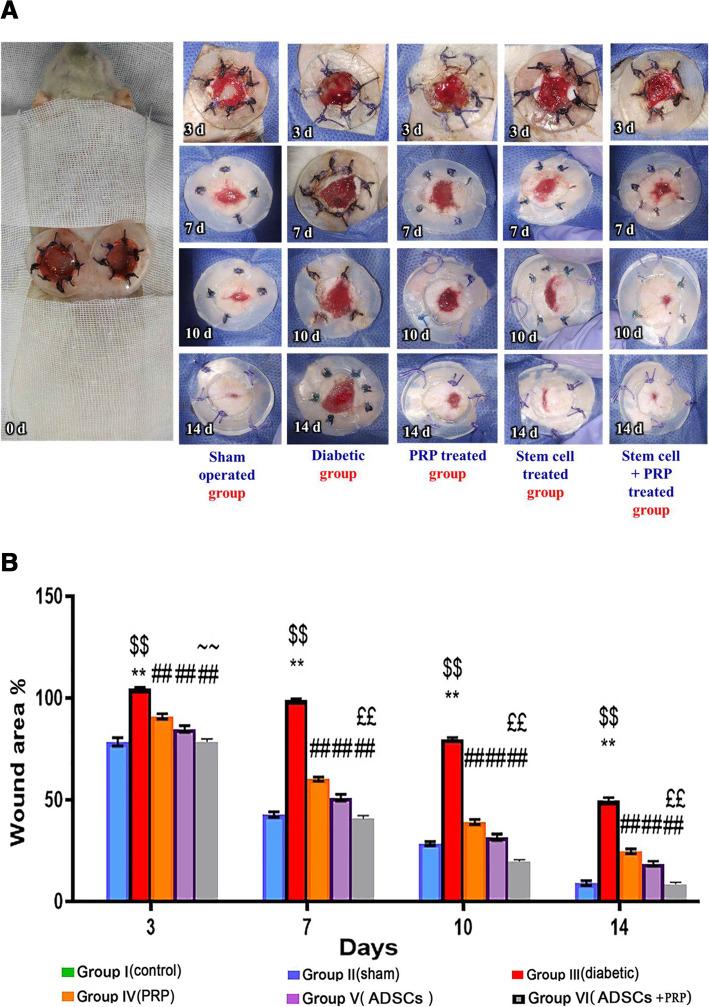
Our data showed better wound healing of PRP+ADSCs compared to their individual use after 7 and 14 days as the combined therapy caused reepithelialization and granulation tissue formation with a marked increase in area percentage of collagen, epidermal thickness, and angiogenesis. Moreover, Notch signaling was significantly downregulated, and EPSC proliferation and recruitment were enhanced compared to other treated groups and diabetic groups.
CONCLUSIONS
These data demonstrated that PRP and ADSCs combined therapy significantly accelerated healing of diabetic wounds induced experimentally in rats via modulating the Notch pathway, promoting angiogenesis and EPSC proliferation.
背景
糖尿病足溃疡是糖尿病的一种严重慢性并发症,其特点是残疾率、死亡率和发病率高。富血小板血浆(PRP)由于其生长因子含量高,已被广泛用于糖尿病伤口愈合。然而,由于生长因子的快速降解,其应用受到限制。本研究旨在评估联合脂肪间充质干细胞(ADSCs)和 PRP 治疗对 Notch 信号通路促进糖尿病伤口愈合的疗效。
方法
将白化大鼠分为 6 组[对照组(未受伤)、假手术组(受伤但非糖尿病)、糖尿病组、PRP 治疗组、ADSC 治疗组和 PRP+ADSC 治疗组]。通过评估伤口闭合率、表皮厚度、真皮胶原和血管生成,评估单独和联合治疗的效果。此外,还评估了 Notch 信号通路的关键元素(Notch1、Delta-like 经典 Notch 配体 4(DLL4)、Hairy Enhancer of Split-1(Hes1)、Hey1、Jagged-1)的基因和蛋白表达、血管生成标记物(血管内皮生长因子和基质细胞衍生因子 1)和表皮干细胞(EPSCs)相关基因(ß1 整合素)的基因表达。
结果
我们的数据显示,与单独使用相比,PRP+ADSC 在第 7 天和第 14 天的联合治疗后具有更好的伤口愈合效果,因为联合治疗导致了再上皮化和肉芽组织形成,胶原面积百分比、表皮厚度和血管生成显著增加。此外,与其他治疗组和糖尿病组相比,Notch 信号显著下调,EPSC 增殖和募集增强。
结论
这些数据表明,PRP 和 ADSC 联合治疗通过调节 Notch 通路,促进血管生成和 EPSC 增殖,显著加速了实验诱导的大鼠糖尿病伤口的愈合。




 Zotero 插件