
慢性肾脏病中的早衰:超越界限的持续炎症的后果。
Premature Aging in Chronic Kidney Disease: The Outcome of Persistent Inflammation beyond the Bounds.
机构信息
Departamento de Biología de Sistemas, Universidad de Alcalá, 28871 Alcalá de Henares, Madrid, Spain/Instituto Ramón y Cajal de Investigación Sanitaria (IRYCIS), 28034 Madrid, Spain.
Departamento de Biomedicina y Biotecnología, Universidad de Alcalá, 28871 Alcalá de Henares, Madrid, Spain.
出版信息
Int J Environ Res Public Health. 2021 Jul 29;18(15):8044. doi: 10.3390/ijerph18158044.
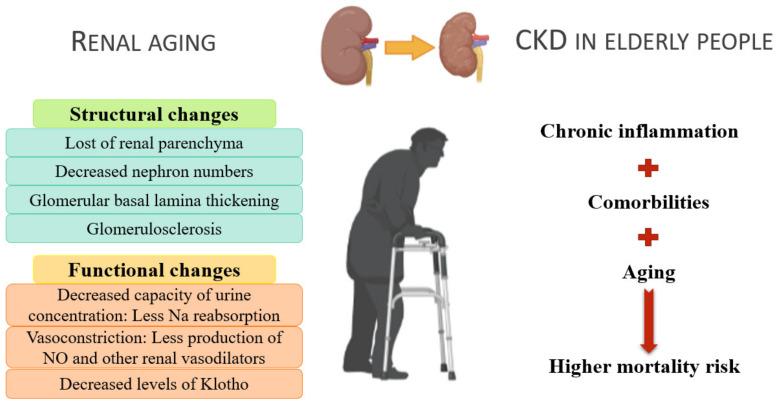
Over the last hundred years, life expectancy in developed countries has increased because of healthier living habits and the treatment of chronic pathologies causing premature aging. Aging is an inexorable, time-dependent, multifactorial process characterized by a series of progressive and irreversible physiological changes associated with loss of functional, psychological, and social capabilities. Numerous factors, such as oxidative stress, inflammation, and cellular senescence, and an irreversible geriatric syndrome known as frailty, contribute to human body deterioration in aging. The speed of aging may differ between individuals depending on the presence or absence of multiple factors (genetic and/or environment) and the subsequent misbalance of homeostasis, together with the increase of frailty, which also plays a key role in developing chronic diseases. In addition, pathological circumstances have been reported to precipitate or accelerate the aging process. This review investigated the mechanisms involved in the developing pathologies, particularly chronic kidney disease, associated with aging.
在过去的一百年中,由于更健康的生活习惯和对导致早衰的慢性病理的治疗,发达国家的预期寿命有所增加。衰老是一个不可避免的、与时间相关的、多因素的过程,其特征是一系列与功能、心理和社会能力丧失相关的进行性和不可逆转的生理变化。许多因素,如氧化应激、炎症和细胞衰老,以及一种称为虚弱的不可逆转的老年综合征,导致衰老过程中人体的恶化。衰老的速度可能因个体而异,具体取决于多种因素(遗传和/或环境)的存在与否,以及随后的内稳态失衡,加上虚弱的增加,这也在慢性疾病的发展中起着关键作用。此外,已经有报道称病理情况会引发或加速衰老过程。本综述研究了与衰老相关的疾病发展机制,特别是慢性肾脏病。


 Zotero 插件