
磷平衡与慢性肾脏病-矿物质和骨异常
Phosphate Balance and CKD-Mineral Bone Disease.
作者信息
Sprague Stuart M, Martin Kevin J, Coyne Daniel W
机构信息
Division of Nephrology and Hypertension, NorthShore University Health System, Evanston, IL, USA.
Saint Louis University-St. Louis, MO, USA.
出版信息
Kidney Int Rep. 2021 May 17;6(8):2049-2058. doi: 10.1016/j.ekir.2021.05.012. eCollection 2021 Aug.
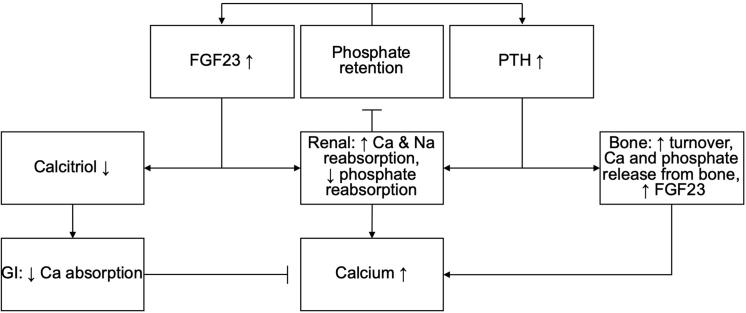
Chronic kidney disease-mineral bone disorder (CKD-MBD) is a common comorbidity in patients with CKD. Characterized by laboratory abnormalities, bone abnormality, and vascular calcification, CKD-MBD encompasses a group of mineral and hormone disturbances that are strongly associated with increased cardiovascular (CV) morbidity and mortality. Abnormal serum phosphate concentrations are an independent risk factor for CV morbidity and mortality, and overall mortality. Phosphate retention plays a central role in initiating and driving many other disturbances in CKD-MBD (e.g., increased parathyroid hormone and fibroblast growth factor 23 concentrations, hypocalcemia, low vitamin D) that are also linked to increased CV risk. Thus, effective phosphate control is a logical therapeutic target for CKD-MBD treatment. Current phosphate management strategies (dietary restrictions, dialysis, phosphate binders) are insufficient to consistently achieve and maintain target phosphate concentrations in patients on dialysis. Phosphate binders reduce available phosphate for intestinal absorption but do not impair the dominant phosphate absorption pathway. Novel therapies that consider new mechanistic understandings of intestinal phosphate absorption are needed. One such therapy is tenapanor, a targeted sodium-hydrogen exchanger isoform 3 inhibitor that has been shown to reduce serum phosphate concentrations in multiple clinical trials. Tenapanor has a novel mechanism of action that reduces intestinal phosphate absorption in the primary paracellular phosphate absorption pathway.
慢性肾脏病-矿物质与骨异常(CKD-MBD)是慢性肾脏病患者常见的合并症。CKD-MBD以实验室检查异常、骨异常和血管钙化特征,包括一组与心血管(CV)发病率和死亡率增加密切相关的矿物质和激素紊乱。血清磷酸盐浓度异常是CV发病率和死亡率以及全因死亡率的独立危险因素。磷酸盐潴留在引发和推动CKD-MBD中的许多其他紊乱(如甲状旁腺激素和成纤维细胞生长因子23浓度升高、低钙血症、维生素D缺乏)中起核心作用,这些紊乱也与CV风险增加有关。因此,有效控制磷酸盐是CKD-MBD治疗的合理靶点。目前的磷酸盐管理策略(饮食限制、透析、磷酸盐结合剂)不足以在透析患者中持续达到并维持目标磷酸盐浓度。磷酸盐结合剂可减少肠道吸收的可用磷酸盐,但不会损害主要的磷酸盐吸收途径。需要考虑对肠道磷酸盐吸收有新机制认识的新型疗法。其中一种疗法是替那帕诺,一种靶向钠-氢交换体3抑制剂,已在多项临床试验中显示可降低血清磷酸盐浓度。替那帕诺具有一种新的作用机制,可减少主要细胞旁磷酸盐吸收途径中的肠道磷酸盐吸收。
 Zotero 插件