
韩国某地区 COVID-19 大流行前后院外心脏骤停的急救医疗服务反应和结局比较。
The Comparison of Emergency Medical Service Responses to and Outcomes of Out-of-hospital Cardiac Arrest before and during the COVID-19 Pandemic in an Area of Korea.
机构信息
Department of Emergency Medicine, Gyeongsang National University College of Medicine, Gyeongsang National University Changwon Hospital, Changwon, Korea.
Department of Emergency Medicine, Dong-A University College of Medicine, Dong-A University Hospital, Busan, Korea.
出版信息
J Korean Med Sci. 2021 Sep 13;36(36):e255. doi: 10.3346/jkms.2021.36.e255.
BACKGROUND
Since the declaration of the coronavirus disease 2019 (COVID-19) pandemic, COVID-19 has affected the responses of emergency medical service (EMS) systems to cases of out-of-hospital cardiac arrest (OHCA). The purpose of this study was to identify the impact of the COVID-19 pandemic on EMS responses to and outcomes of adult OHCA in an area of South Korea.
METHODS
This was a retrospective observational study of adult OHCA patients attended by EMS providers comparing the EMS responses to and outcomes of adult OHCA during the COVID-19 pandemic to those during the pre-COVID-19 period. Propensity score matching was used to compare the survival rates, and logistic regression analysis was used to assess the impact of the COVID-19 pandemic on the survival of OHCA patients.
RESULTS
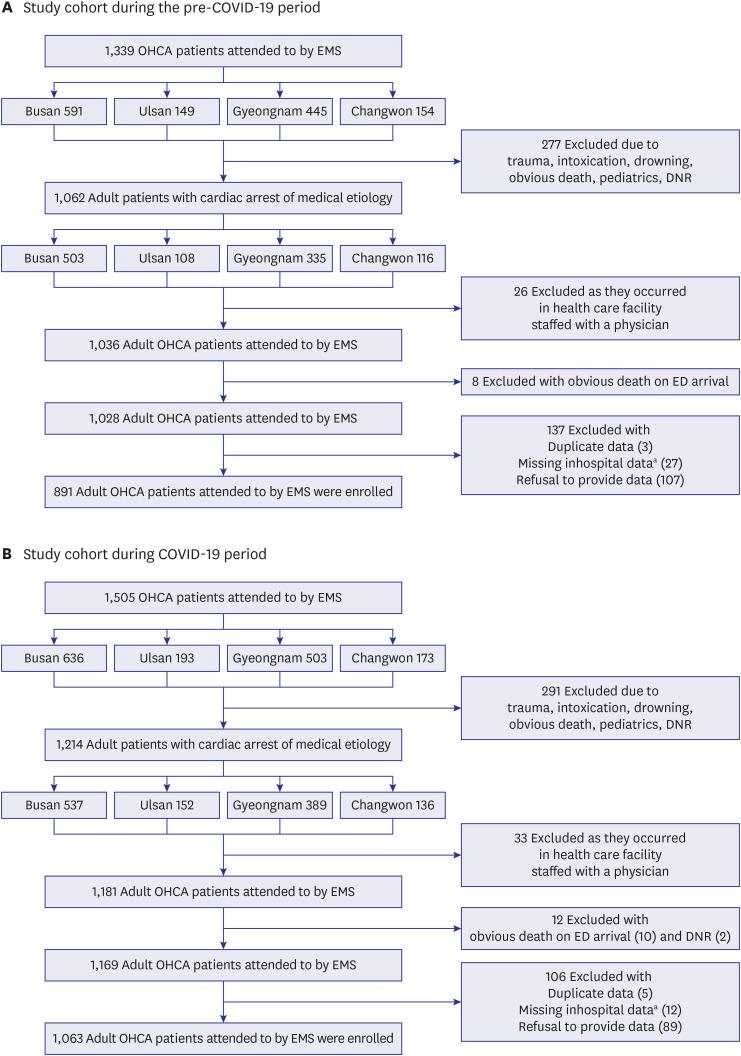
A total of 891 patients in the pre-COVID-19 group and 1,063 patients in the COVID-19 group were included in the final analysis. During the COVID-19 period, the EMS call time was shifted to a later time period (16:00-24:00, < 0.001), and the presence of an initial shockable rhythm was increased (pre-COVID-19 vs. COVID-19, 7.97% vs. 11.95%, = 0.004). The number of tracheal intubations decreased (5.27% vs. 1.22%, < 0.001), and the use of mechanical chest compression devices (30.53% vs. 44.59%, < 0.001) and EMS response time (median [quartile 1-quartile 3], 7 [5-10] vs. 8 [6-11], < 0.001) increased. After propensity score matching, the survival at admission rate (22.52% vs. 18.24%, = 0.025), survival to discharge rate (7.77% vs. 5.52%, = 0.056), and favorable neurological outcome (5.97% vs. 3.49%, < 0.001) decreased. In the propensity score matching analysis of the impact of COVID-19, odds ratios of 0.768 (95% confidence interval [CI], 0.592-0.995) for survival at admission and 0.693 (95% CI, 0.446-1.077) for survival to discharge were found.
CONCLUSION
During the COVID-19 period, there were significant changes in the EMS responses to OHCA. These changes are considered to be partly due to social distancing measures. As a result, the proportion of patients with an initial shockable rhythm in the COVID-19 period was greater than that in the pre-COVID-19 period, but the final survival rate and favorable neurological outcome were lower.
背景
自 2019 年冠状病毒病(COVID-19)大流行宣布以来,COVID-19 已影响了急救医疗服务(EMS)系统对院外心脏骤停(OHCA)病例的反应。本研究的目的是确定 COVID-19 大流行对韩国某地区 EMS 对成人 OHCA 的反应和结局的影响。
方法
这是一项回顾性观察性研究,比较了 COVID-19 大流行期间和大流行前 EMS 对成人 OHCA 的反应和结局。使用倾向评分匹配比较 OHCA 患者的生存率,并使用 logistic 回归分析评估 COVID-19 大流行对 OHCA 患者生存率的影响。
结果
在 COVID-19 大流行期间,共纳入了 891 名 COVID-19 前组患者和 1063 名 COVID-19 组患者进行最终分析。在 COVID-19 期间,EMS 呼叫时间转移到了较晚的时间段(16:00-24:00, < 0.001),初始可除颤节律的出现率增加(COVID-19 前组 vs. COVID-19 组,7.97% vs. 11.95%, = 0.004)。气管插管的数量减少(5.27% vs. 1.22%, < 0.001),机械胸部按压装置的使用(30.53% vs. 44.59%, < 0.001)和 EMS 反应时间(中位数[四分位距 1-3],7[5-10] vs. 8[6-11], < 0.001)增加。经过倾向评分匹配后,入院时的生存率(22.52% vs. 18.24%, = 0.025)、出院时的生存率(7.77% vs. 5.52%, = 0.056)和良好的神经功能结局(5.97% vs. 3.49%, < 0.001)下降。在 COVID-19 对 EMS 反应影响的倾向性评分匹配分析中,入院生存率的比值比为 0.768(95%置信区间 [CI],0.592-0.995),出院生存率的比值比为 0.693(95%CI,0.446-1.077)。
结论
在 COVID-19 期间,EMS 对 OHCA 的反应发生了重大变化。这些变化部分归因于社交距离措施。因此,COVID-19 期间初始可除颤节律的患者比例大于 COVID-19 前组,但最终生存率和良好的神经功能结局较低。


 Zotero 插件