
新型冠状病毒肺炎对成人重症监护病房医院获得性感染特征的影响
The Impact of COVID-19 on the Profile of Hospital-Acquired Infections in Adult Intensive Care Units.
作者信息
Despotovic Aleksa, Milosevic Branko, Cirkovic Andja, Vujovic Ankica, Cucanic Ksenija, Cucanic Teodora, Stevanovic Goran
机构信息
Faculty of Medicine, University of Belgrade, 11000 Belgrade, Serbia.
Teaching Hospital for Infectious and Tropical Diseases, University Clinical Center of Serbia, 11000 Belgrade, Serbia.
出版信息
Antibiotics (Basel). 2021 Sep 23;10(10):1146. doi: 10.3390/antibiotics10101146.
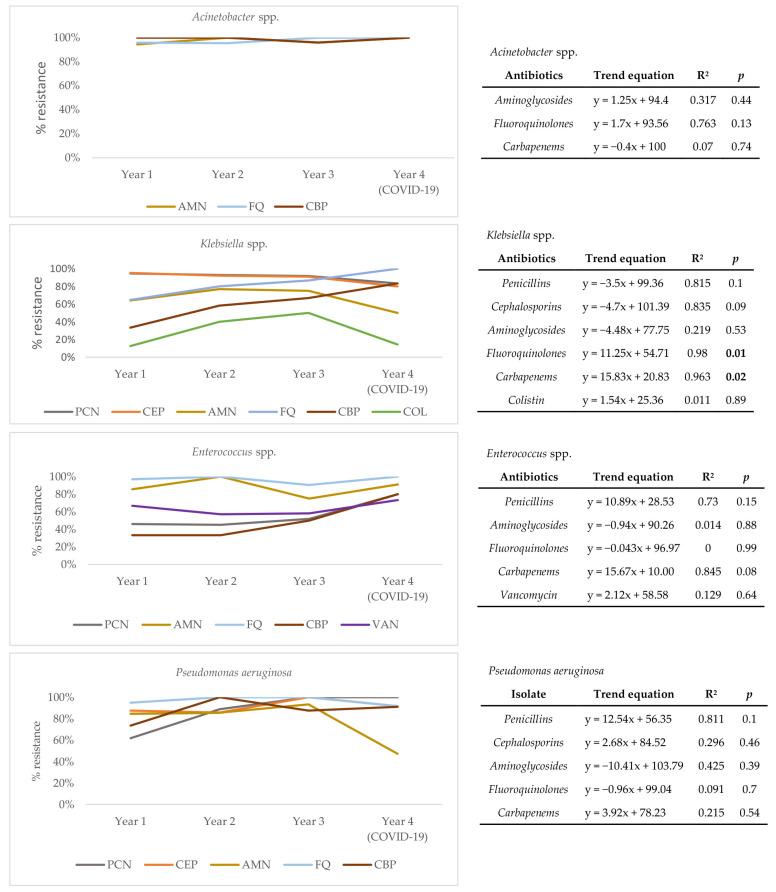
Hospital-acquired infections (HAIs) are a global public health concern. As the COVID-19 pandemic continues, its contribution to mortality and antimicrobial resistance (AMR) grows, particularly in intensive care units (ICUs). A two-year retrospective study from April 2019-April 2021 was conducted in an adult ICU at the Hospital for Infectious and Tropical Diseases, Belgrade, Serbia to assess causative agents of HAIs and AMR rates, with the COVID-19 pandemic ensuing halfway through the study. Resistance rates >80% were observed for the majority of tested antimicrobials. In COVID-19 patients, spp. was the dominant cause of HAIs and more frequently isolated than in non-COVID-19 patients. (67 vs. 18, = 0.001). Also, resistance was higher for imipenem (56.8% vs. 24.5%, < 0.001), meropenem (61.1% vs. 24.3%, < 0.001) and ciprofloxacin (59.5% vs. 36.9%, = 0.04). AMR rates were aggregated with findings from our previous study to identify resistance trends and establish empiric treatment recommendations. The increased presence of spp. and a positive trend in spp. resistance to fluoroquinolones (R = 0.980, = 0.01) and carbapenems (R = 0.963, = 0.02) could have contributed to alarming resistance rates across bloodstream infections (BSIs), pneumonia (PN), and urinary tract infections (UTIs). Exceptions were vancomycin (16.0%) and linezolid (2.6%) in BSIs; tigecycline (14.3%) and colistin (0%) in PNs; and colistin (12.0%) and linezolid (0%) in UTIs. COVID-19 has changed the landscape of HAIs in our ICUs. Approval of new drugs and rigorous surveillance is urgently needed.
医院获得性感染(HAIs)是一个全球公共卫生问题。随着新冠疫情的持续,其对死亡率和抗菌药物耐药性(AMR)的影响不断增加,尤其是在重症监护病房(ICUs)。塞尔维亚贝尔格莱德热带病医院的一个成人重症监护病房进行了一项为期两年的回顾性研究,时间从2019年4月至2021年4月,以评估医院获得性感染的病原体和抗菌药物耐药率,新冠疫情在研究进行到一半时爆发。大多数受试抗菌药物的耐药率>80%。在新冠患者中, 菌属是医院获得性感染的主要原因,且比非新冠患者更频繁地被分离出来。(67例对18例, = 0.001)。此外,亚胺培南(56.8%对24.5%, < 0.001)、美罗培南(61.1%对24.3%, < 0.001)和环丙沙星(59.5%对36.9%, = 0.04)的耐药性更高。抗菌药物耐药率与我们之前研究的结果汇总,以确定耐药趋势并制定经验性治疗建议。 菌属的增加以及 菌属对氟喹诺酮类(R = 0.980, = 0.01)和碳青霉烯类(R = 0.963, = 0.02)耐药性的上升趋势,可能导致了血流感染(BSIs)、肺炎(PN)和尿路感染(UTIs)令人担忧的耐药率。血流感染中的万古霉素(16.0%)和利奈唑胺(2.6%);肺炎中的替加环素(14.3%)和黏菌素(0%);尿路感染中的黏菌素(12.0%)和利奈唑胺(0%)为例外情况。新冠疫情改变了我们重症监护病房医院获得性感染的格局。迫切需要批准新药并进行严格监测。


 Zotero 插件