
糖尿病和冠心病患者的微粒体血管生成含量可预测内皮功能障碍网络。
Angiogenic content of microparticles in patients with diabetes and coronary artery disease predicts networks of endothelial dysfunction.
机构信息
Department of Pharmacology, Weill Cornell Medicine-Qatar, Doha, Qatar.
National Heart and Lung Institute, Imperial College London, London, UK.
出版信息
Cardiovasc Diabetol. 2022 Feb 2;21(1):17. doi: 10.1186/s12933-022-01449-0.
BACKGROUND
Elevated endothelial microparticles (EMPs) levels are surrogate markers of vascular dysfunction. We analyzed EMPs with apoptotic characteristics and assessed the angiogenic contents of microparticles in the blood of patients with type 2 diabetes (T2D) according to the presence of coronary artery disease (CAD).
METHODS
A total of 80 participants were recruited and equally classified as (1) healthy without T2D, (2) T2D without cardiovascular complications, (3) T2D and chronic coronary artery disease (CAD), and (4) T2D and acute coronary syndrome (ACS). MPs were isolated from the peripheral circulation, and EMPs were characterized using flow cytometry of CD42 and CD31. CD62E was used to determine EMPs' apoptotic/activation state. MPs content was extracted and profiled using an angiogenesis array.
RESULTS
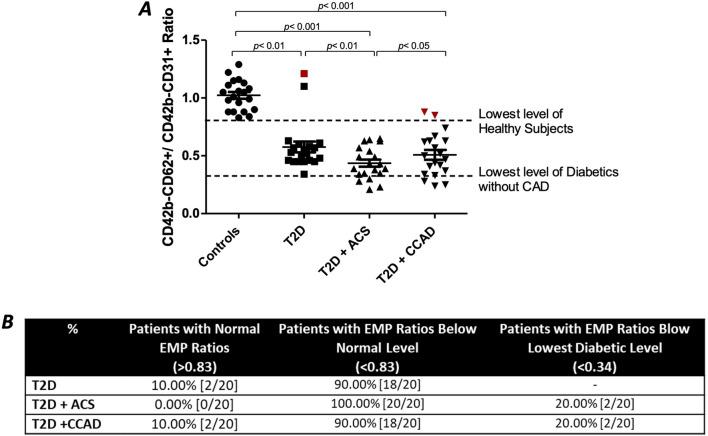
Levels of CD42- CD31 + EMPs were significantly increased in T2D with ACS (257.5 ± 35.58) when compared to healthy subjects (105.7 ± 12.96, p < 0.01). There was no significant difference when comparing T2D with and without chronic CAD. The ratio of CD42-CD62 +/CD42-CD31 + EMPs was reduced in all T2D patients, with further reduction in ACS when compared to chronic CAD, reflecting a release by apoptotic endothelial cells. The angiogenic content of the full population of MPs was analyzed. It revealed a significant differential expression of 5 factors in patients with ACS and diabetes, including TGF-β1, PD-ECGF, platelet factor 4, serpin E1, and thrombospondin 1. Ingenuity Pathway Analysis revealed that those five differentially expressed molecules, mainly TGF-β1, inhibit key pathways involved in normal endothelial function. Further comparison of the three diabetes groups to healthy controls and diabetes without cardiovascular disease to diabetes with CAD identified networks that inhibit normal endothelial cell function. Interestingly, DDP-IV was the only differentially expressed protein between chronic CAD and ACS in patients with diabetes.
CONCLUSION
Our data showed that the release of apoptosis-induced EMPs is increased in diabetes, irrespective of CAD, ACS patients having the highest levels. The protein contents of MPs interact in networks that indicate vascular dysfunction.
背景
升高的内皮细胞微颗粒(EMP)水平是血管功能障碍的替代标志物。我们根据是否存在冠状动脉疾病(CAD)分析了具有凋亡特征的 EMP 并评估了 2 型糖尿病(T2D)患者血液中微颗粒的血管生成含量。
方法
共招募了 80 名参与者,并将其平均分为 4 组:(1)无 T2D 的健康者,(2)无心血管并发症的 T2D 患者,(3)T2D 合并慢性 CAD 患者,(4)T2D 合并急性冠脉综合征(ACS)患者。从外周循环中分离 MPs,并通过流式细胞术检测 CD42 和 CD31 来表征 EMP。使用 CD62E 来确定 EMP 的凋亡/激活状态。使用血管生成阵列提取和分析 MPs 含量。
结果
与健康对照组(105.7 ± 12.96)相比,ACS 合并 T2D 患者的 CD42-CD31+ EMPs 水平明显升高(257.5 ± 35.58,p < 0.01)。与慢性 CAD 相比,T2D 患者中无显著差异。所有 T2D 患者的 CD42-CD62+/CD42-CD31+ EMPs 比值均降低,ACS 患者与慢性 CAD 患者相比进一步降低,反映了凋亡内皮细胞的释放。分析了所有患者 MPs 的整体血管生成含量。结果表明,ACS 和糖尿病患者中 5 种因子的表达存在显著差异,包括 TGF-β1、PD-ECGF、血小板因子 4、丝氨酸蛋白酶 E1 和血栓调节蛋白 1。IPA 分析表明,这 5 种差异表达的分子主要是 TGF-β1,抑制了正常内皮功能涉及的关键途径。进一步将三组糖尿病患者与健康对照组和无心血管疾病的糖尿病患者进行比较,确定了抑制正常内皮细胞功能的网络。有趣的是,DPP-IV 是糖尿病患者中慢性 CAD 和 ACS 之间唯一差异表达的蛋白质。
结论
我们的数据表明,无论 CAD 如何,糖尿病患者中诱导凋亡的 EMP 释放增加,ACS 患者的水平最高。 MPs 的蛋白质含量相互作用于表明血管功能障碍的网络中。





 Zotero 插件