
个人防护设备(PPE)在世界上最大的内陆封闭水体——里海的污染。
Personal protective equipment (PPE) pollution in the Caspian Sea, the largest enclosed inland water body in the world.
机构信息
School of Environment, College of Engineering, University of Tehran, Tehran, Iran.
Department of Fisheries and Marine Science, Faculty of Science, Noakhali Science and Technology University, Noakhali, Bangladesh.
出版信息
Sci Total Environ. 2022 Jun 10;824:153771. doi: 10.1016/j.scitotenv.2022.153771. Epub 2022 Feb 16.
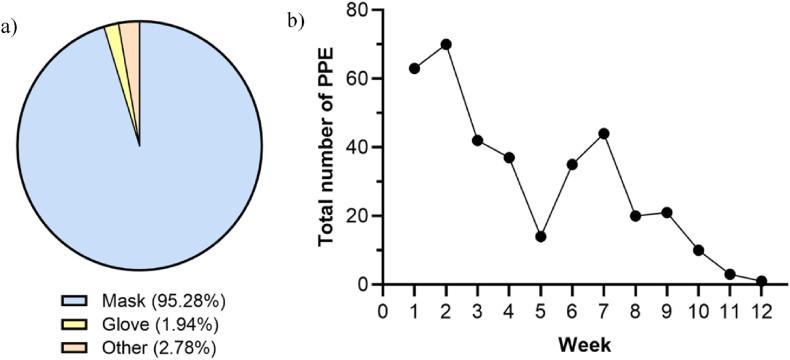
The COVID-19 pandemic led to a still ongoing international health and sanity crisis. In the current scenario, the actions taken by the national authorities and the public prioritized measures to control the transmission of the virus, such as social distancing, and face mask-wearing. Unfortunately, due to the debilitated waste management systems and incorrect disposal of single-use face masks and other types of personal protective equipment (PPE), the occurrence of these types of items has led to the exacerbation of marine plastic pollution. Although various studies have focused on surveying marine coasts for PPE pollution, studies on inland water are largely lacking. In order to fill this knowledge gap, the present study assessed PPE pollution in the Iranian coast of the Caspian Sea, the largest enclosed inland water body in the world by following standard monitoring procedures. The results concerning the density (1.02 × 10 PPE/m) composition (face masks represented 95.3% of all PPE) of PPE are comparable to previous studies in marine waters. However, a notable decrease in the occurrence of PPE was observed, probably to behavioral and seasonality reasons. The possible consequences of PPE pollution were discussed, although much more research is needed regarding the ecotoxicological aspects of secondary PPE contaminants, such as microplastics and chemical additives. It is expected that face mask mandates will be eventually halted, and PPE will stop being emitted to the environment. However, based on the lessons learned from the COVID-19 scenario, several recommendations for coastal solid waste management are provided. These are proposed to serve during and after the pandemic.
COVID-19 大流行导致了一场仍在持续的国际卫生和理智危机。在当前情况下,国家当局和公众采取的行动优先考虑了控制病毒传播的措施,如社交距离和戴口罩。不幸的是,由于废物管理系统不完善以及一次性口罩和其他类型的个人防护设备(PPE)的不正确处理,这些物品的出现导致了海洋塑料污染的加剧。尽管各种研究都集中在调查海洋海岸的 PPE 污染,但对内陆水域的研究却很少。为了填补这一知识空白,本研究按照标准监测程序评估了世界上最大的封闭内陆水体——里海的伊朗海岸的 PPE 污染。关于 PPE 密度(1.02×10 PPE/m)组成(口罩占所有 PPE 的 95.3%)的结果与海洋水域的先前研究相当。然而,由于行为和季节性原因,PPE 的出现明显减少。讨论了 PPE 污染的可能后果,尽管需要更多关于次要 PPE 污染物(如微塑料和化学添加剂)的生态毒理学方面的研究。预计口罩强制令最终将被停止,PPE 将不再排放到环境中。然而,根据从 COVID-19 情景中吸取的教训,为沿海固体废物管理提供了一些建议。这些建议是在大流行期间和之后提出的。



 Zotero 插件