
顶复门寄生虫在脂代谢中的灵活性。
The flexibility of Apicomplexa parasites in lipid metabolism.
机构信息
Apicolipid Team, Institute for Advanced Biosciences, CNRS UMR5309, Université Grenoble Alpes, INSERM U1209, Grenoble, France.
出版信息
PLoS Pathog. 2022 Mar 17;18(3):e1010313. doi: 10.1371/journal.ppat.1010313. eCollection 2022 Mar.
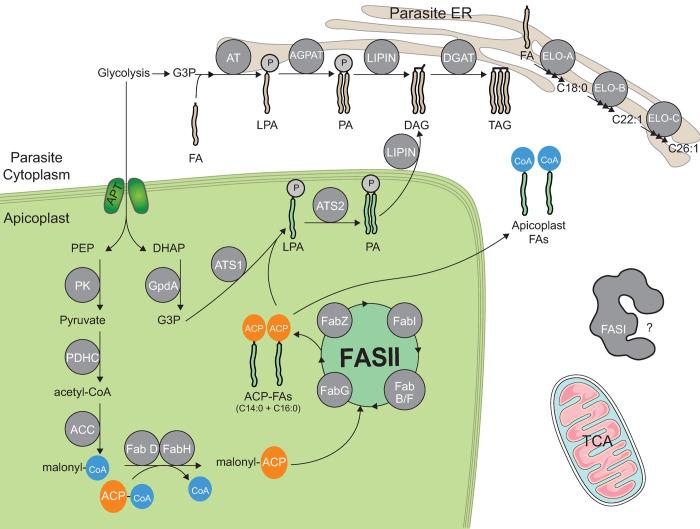
Apicomplexa are obligate intracellular parasites responsible for major human infectious diseases such as toxoplasmosis and malaria, which pose social and economic burdens around the world. To survive and propagate, these parasites need to acquire a significant number of essential biomolecules from their hosts. Among these biomolecules, lipids are a key metabolite required for parasite membrane biogenesis, signaling events, and energy storage. Parasites can either scavenge lipids from their host or synthesize them de novo in a relict plastid, the apicoplast. During their complex life cycle (sexual/asexual/dormant), Apicomplexa infect a large variety of cells and their metabolic flexibility allows them to adapt to different host environments such as low/high fat content or low/high sugar levels. In this review, we discuss the role of lipids in Apicomplexa parasites and summarize recent findings on the metabolic mechanisms in host nutrient adaptation.
顶复门生物是专性细胞内寄生虫,可引起包括弓形体病和疟疾在内的主要人类传染病,给全世界带来了社会和经济负担。为了生存和繁殖,这些寄生虫需要从宿主中获取大量必需的生物分子。在这些生物分子中,脂质是寄生虫膜发生、信号事件和能量储存所必需的关键代谢物。寄生虫可以从宿主中掠夺脂质,也可以在遗留的质体(类质体)中从头合成脂质。在其复杂的生命周期(有性/无性/休眠)中,顶复门生物感染了大量不同的细胞,其代谢灵活性使它们能够适应不同的宿主环境,如低/高脂肪含量或低/高糖水平。在这篇综述中,我们讨论了脂质在顶复门寄生虫中的作用,并总结了宿主营养适应中代谢机制的最新发现。



 Zotero 插件