
全基因组关联研究确定了儿童癌症幸存者表观遗传年龄加速的新遗传位点。
Genome-wide association studies identify novel genetic loci for epigenetic age acceleration among survivors of childhood cancer.
机构信息
Department of Epidemiology and Cancer Control, St. Jude Children's Research Hospital, 262 Danny Thomas Place, MS 735, Memphis, TN, 38105, USA.
College of Pharmacy, Chungbuk National University, Cheongju, Korea.
出版信息
Genome Med. 2022 Mar 22;14(1):32. doi: 10.1186/s13073-022-01038-6.
BACKGROUND
Increased epigenetic age acceleration (EAA) in survivors of childhood cancer is associated with specific treatment exposures, unfavorable health behaviors, and presence of certain chronic health conditions. To better understand inter-individual variability, we investigated the genetic basis underlying EAA.
METHODS
Genome-wide association studies of EAA based on multiple epigenetic clocks (Hannum, Horvath, PhenoAge, and GrimAge) were performed. MethylationEPIC BeadChip array and whole-genome sequencing data were generated with blood-derived DNA from participants in the St. Jude Lifetime Cohort Study (discovery: 2138 pre-existing and 502 newly generated data, all survivors; exploratory: 282 community controls). Linear regression models were fit for each epigenetic age against the allelic dose of each genetic variant, adjusting for age at sampling, sex, and cancer treatment exposures. Fixed-effects meta-analysis was used to combine summary statistics from two discovery data sets. LD (Linkage disequilibrium) score regression was used to estimate single-nucleotide polymorphism (SNP)-based heritability.
RESULTS
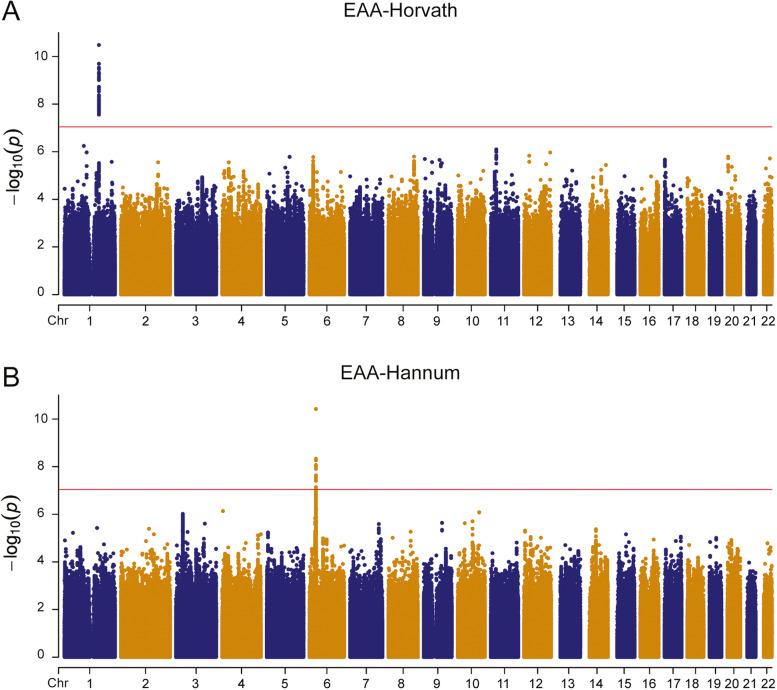
For EAA-Horvath, a genome-wide significant association was mapped to the SELP gene with the strongest SNP rs732314 (meta-GWAS: β=0.57, P=3.30×10). Moreover, the stratified analysis of the association between rs732314 and EAA-Horvath showed a substantial heterogeneity between children and adults (meta-GWAS: β=0.97 vs. 0.51, I=73.1%) as well as between survivors with and without chest/abdominal/pelvic-RT exposure (β=0.64 vs. 0.31, I=66.3%). For EAA-Hannum, an association was mapped to the HLA locus with the strongest SNP rs28366133 (meta-GWAS: β=0.78, P=3.78×10). There was no genome-wide significant hit for EAA-PhenoAge or EAA-GrimAge. Interestingly, among community controls, rs732314 was associated with EAA-Horvath (β=1.09, P=5.43×10), whereas rs28366133 was not associated with EAA-Hannum (β=0.21, P=0.49). The estimated heritability was 0.33 (SE=0.20) for EAA-Horvath and 0.17 (SE=0.23) for EAA-Hannum, but close to zero for EAA-PhenoAge and EAA-GrimAge.
CONCLUSIONS
We identified novel genetic variants in the SELP gene and HLA region associated with EAA-Horvath and EAA-Hannum, respectively, among survivors of childhood cancer. The new genetic variants in combination with other replicated known variants can facilitate the identification of survivors at higher risk in developing accelerated aging and potentially inform drug targets for future intervention strategies among vulnerable survivors.
背景
儿童癌症幸存者的表观遗传年龄加速(EAA)增加与特定的治疗暴露、不良的健康行为以及某些慢性健康状况有关。为了更好地理解个体间的可变性,我们研究了 EAA 的遗传基础。
方法
基于多个表观遗传时钟(Hannum、Horvath、PhenoAge 和 GrimAge)进行了 EAA 的全基因组关联研究。使用来自圣裘德终身队列研究(发现:2138 个预先存在的和 502 个新生成的数据,均为幸存者;探索性研究:282 个社区对照)参与者的血液衍生 DNA 生成了甲基化 EPIC BeadChip 阵列和全基因组测序数据。针对每个表观遗传年龄与每个遗传变异的等位基因剂量进行线性回归模型拟合,调整采样时的年龄、性别和癌症治疗暴露。使用固定效应荟萃分析将两个发现数据集的汇总统计数据合并。使用 LD(连锁不平衡)评分回归估计基于 SNP 的遗传率。
结果
对于 EAA-Horvath,SELP 基因中的最强 SNP rs732314 映射到全基因组显著关联(meta-GWAS:β=0.57,P=3.30×10)。此外,rs732314 与 EAA-Horvath 之间的关联分层分析表明,儿童和成人之间(meta-GWAS:β=0.97 与 0.51,I=73.1%)以及有和没有胸部/腹部/骨盆-RT 暴露的幸存者之间(β=0.64 与 0.31,I=66.3%)存在很大的异质性。对于 EAA-Hannum,与 HLA 位点相关的最强 SNP rs28366133 映射到全基因组显著关联(meta-GWAS:β=0.78,P=3.78×10)。对于 EAA-PhenoAge 或 EAA-GrimAge,没有全基因组显著命中。有趣的是,在社区对照中,rs732314 与 EAA-Horvath 相关(β=1.09,P=5.43×10),而 rs28366133 与 EAA-Hannum 不相关(β=0.21,P=0.49)。EAA-Horvath 的遗传率估计值为 0.33(SE=0.20),EAA-Hannum 的遗传率估计值为 0.17(SE=0.23),但 EAA-PhenoAge 和 EAA-GrimAge 的遗传率接近零。
结论
我们在儿童癌症幸存者中发现了与 EAA-Horvath 和 EAA-Hannum 相关的 SELP 基因和 HLA 区域的新遗传变异。新的遗传变异与其他已复制的已知变异结合,可以帮助识别处于加速衰老风险更高的幸存者,并有可能为脆弱幸存者的未来干预策略提供药物靶点信息。


 Zotero 插件