
长期新冠患者新发糖尿病的风险与负担:一项队列研究。
Risks and burdens of incident diabetes in long COVID: a cohort study.
作者信息
Xie Yan, Al-Aly Ziyad
机构信息
Clinical Epidemiology Center, Research and Development Service, VA Saint Louis Health Care System, Saint Louis, MO, USA; Department of Epidemiology and Biostatistics, College for Public Health and Social Justice, Saint Louis University, Saint Louis, MO, USA; Veterans Research and Education Foundation of Saint Louis, Saint Louis, MO, USA.
Clinical Epidemiology Center, Research and Development Service, VA Saint Louis Health Care System, Saint Louis, MO, USA; Nephrology Section, Medicine Service, VA Saint Louis Health Care System, Saint Louis, MO, USA; Veterans Research and Education Foundation of Saint Louis, Saint Louis, MO, USA; Department of Medicine, Washington University School of Medicine, Saint Louis, MO, USA; Institute for Public Health, Washington University in Saint Louis, Saint Louis, MO, USA.
出版信息
Lancet Diabetes Endocrinol. 2022 May;10(5):311-321. doi: 10.1016/S2213-8587(22)00044-4. Epub 2022 Mar 21.
BACKGROUND
There is growing evidence suggesting that beyond the acute phase of SARS-CoV-2 infection, people with COVID-19 could experience a wide range of post-acute sequelae, including diabetes. However, the risks and burdens of diabetes in the post-acute phase of the disease have not yet been comprehensively characterised. To address this knowledge gap, we aimed to examine the post-acute risk and burden of incident diabetes in people who survived the first 30 days of SARS-CoV-2 infection.
METHODS
In this cohort study, we used the national databases of the US Department of Veterans Affairs to build a cohort of 181 280 participants who had a positive COVID-19 test between March 1, 2020, and Sept 30, 2021, and survived the first 30 days of COVID-19; a contemporary control (n=4 118 441) that enrolled participants between March 1, 2020, and Sept 30, 2021; and a historical control (n=4 286 911) that enrolled participants between March 1, 2018, and Sept 30, 2019. Both control groups had no evidence of SARS-CoV-2 infection. Participants in all three comparison groups were free of diabetes before cohort entry and were followed up for a median of 352 days (IQR 245-406). We used inverse probability weighted survival analyses, including predefined and algorithmically selected high dimensional variables, to estimate post-acute COVID-19 risks of incident diabetes, antihyperglycaemic use, and a composite of the two outcomes. We reported two measures of risk: hazard ratio (HR) and burden per 1000 people at 12 months.
FINDINGS
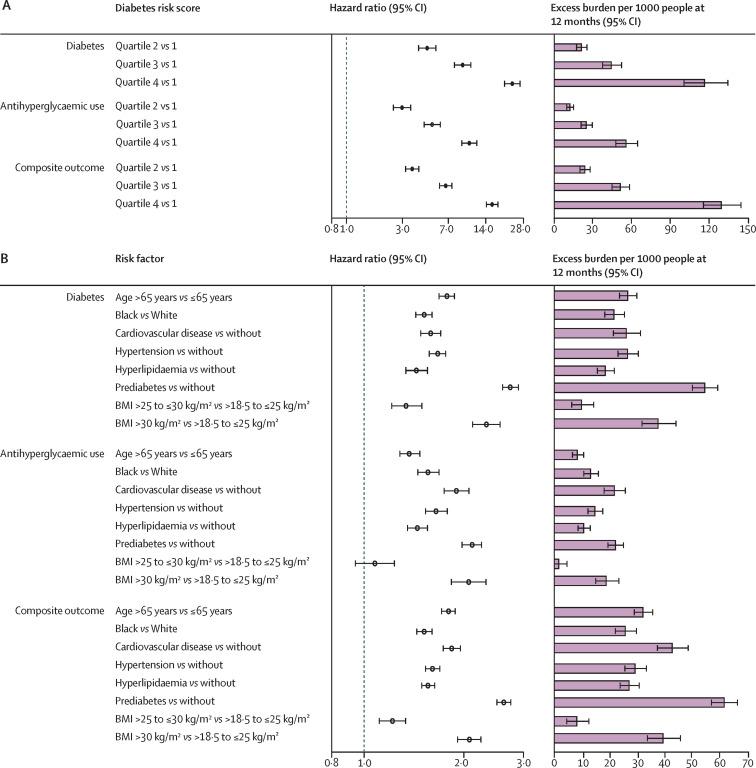
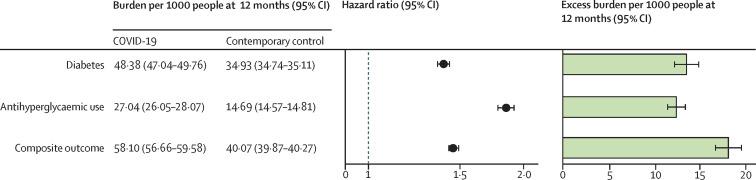
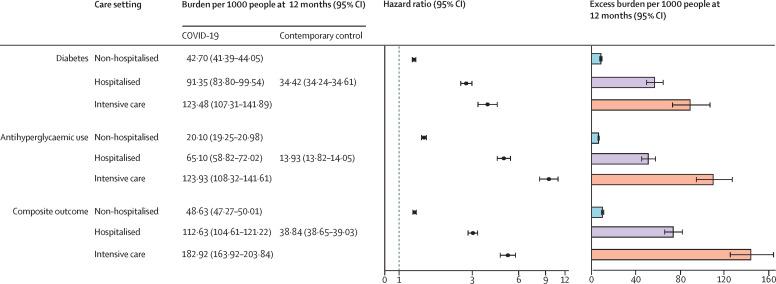
In the post-acute phase of the disease, compared with the contemporary control group, people with COVID-19 exhibited an increased risk (HR 1·40, 95% CI 1·36-1·44) and excess burden (13·46, 95% CI 12·11-14·84, per 1000 people at 12 months) of incident diabetes; and an increased risk (1·85, 1·78-1·92) and excess burden (12·35, 11·36-13·38) of incident antihyperglycaemic use. Additionally, analyses to estimate the risk of a composite endpoint of incident diabetes or antihyperglycaemic use yielded a HR of 1·46 (95% CI 1·43-1·50) and an excess burden of 18·03 (95% CI 16·59-19·51) per 1000 people at 12 months. Risks and burdens of post-acute outcomes increased in a graded fashion according to the severity of the acute phase of COVID-19 (whether patients were non-hospitalised, hospitalised, or admitted to intensive care). All the results were consistent in analyses using the historical control as the reference category.
INTERPRETATION
In the post-acute phase, we report increased risks and 12-month burdens of incident diabetes and antihyperglycaemic use in people with COVID-19 compared with a contemporary control group of people who were enrolled during the same period and had not contracted SARS-CoV-2, and a historical control group from a pre-pandemic era. Post-acute COVID-19 care should involve identification and management of diabetes.
FUNDING
US Department of Veterans Affairs and the American Society of Nephrology.
背景
越来越多的证据表明,在新型冠状病毒2(SARS-CoV-2)感染的急性期之后,新冠病毒病(COVID-19)患者可能会经历广泛的急性后遗症,包括糖尿病。然而,该疾病急性期后糖尿病的风险和负担尚未得到全面描述。为了填补这一知识空白,我们旨在研究SARS-CoV-2感染前30天存活的患者发生糖尿病的急性期后风险和负担。
方法
在这项队列研究中,我们使用美国退伍军人事务部的国家数据库建立了一个队列,其中包括181280名在2020年3月1日至2021年9月30日期间COVID-19检测呈阳性且在COVID-19的前30天存活的参与者;一个当代对照组(n = 4118441),该组在2020年3月1日至2021年9月30日期间招募参与者;以及一个历史对照组(n = 4286911),该组在2018年3月1日至2019年9月30日期间招募参与者。两个对照组均无SARS-CoV-2感染的证据。所有三个比较组的参与者在进入队列之前均无糖尿病,并随访了352天(四分位距245 - 406天)。我们使用逆概率加权生存分析,包括预定义和算法选择的高维变量,来估计COVID-19急性期后发生糖尿病、使用抗高血糖药物以及这两个结局综合情况的风险。我们报告了两种风险度量:风险比(HR)和12个月时每1000人的负担。
结果
在疾病的急性期后,与当代对照组相比,COVID-19患者发生糖尿病的风险增加(HR 1.40,95%置信区间1.36 - 1.44),且负担过重(12个月时每1000人中有13.46例,95%置信区间12.11 - 14.84);使用抗高血糖药物的风险增加(1.85,1.78 - 1.92),且负担过重(12.35,11.36 - 13.38)。此外,对发生糖尿病或使用抗高血糖药物这一复合终点风险的分析得出HR为1.46(95%置信区间1.43 - 1.50),12个月时每1000人的额外负担为18.03(95%置信区间16.59 - 19.51)。急性期后结局的风险和负担根据COVID-19急性期的严重程度(患者是否未住院、住院或入住重症监护病房)呈分级增加。在以历史对照组作为参考类别的分析中,所有结果均一致。
解读
在急性期后,我们报告与同期招募且未感染SARS-CoV-2的当代对照组以及大流行前时代的历史对照组相比,COVID-19患者发生糖尿病和使用抗高血糖药物的风险及12个月负担增加。COVID-19急性期后的护理应包括糖尿病的识别和管理。
资金来源
美国退伍军人事务部和美国肾脏病学会。
 Zotero 插件