
异维 A 酸通过 PPARγ 信号通路损害睑板腺的分泌功能。
Isotretinoin Impairs the Secretory Function of Meibomian Gland Via the PPARγ Signaling Pathway.
机构信息
Beijing Institute of Ophthalmology, Beijing Tongren Eye Center, Beijing Tongren Hospital, Capital Medical University, Beijing Ophthalmology and Visual Sciences Key Lab, Beijing, China.
出版信息
Invest Ophthalmol Vis Sci. 2022 Mar 2;63(3):29. doi: 10.1167/iovs.63.3.29.
PURPOSE
To investigate the effects of isotretinoin on the ocular surface and to explore the possible mechanisms.
METHODS
Rats were treated with isotretinoin 20 mg/kg/d for five months and tested monthly for tear secretion, fluorescein staining, and infrared photography. After five months of treatment, tissues were harvested for routine staining to evaluate the morphological changes; and real-time polymerase chain reaction, Western blot, and immunohistochemistry to study the expression of associated genes and their products such as forkhead box protein O1 (FoxO1), forkhead box protein O3, peroxisome proliferator-activated receptor γ (PPARγ), adipose differentiation-related protein, elongation of very long chain fatty acids protein 4, fatty acid binding protein 4, matrix metalloproteinase-9, and interleukin-6.
RESULTS
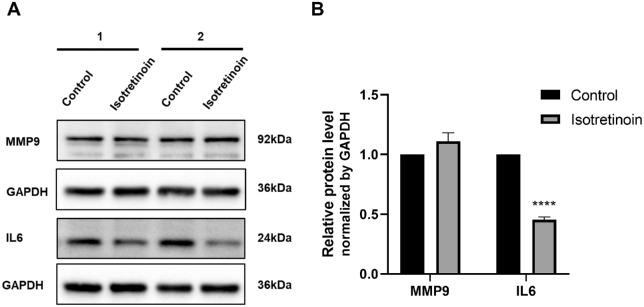
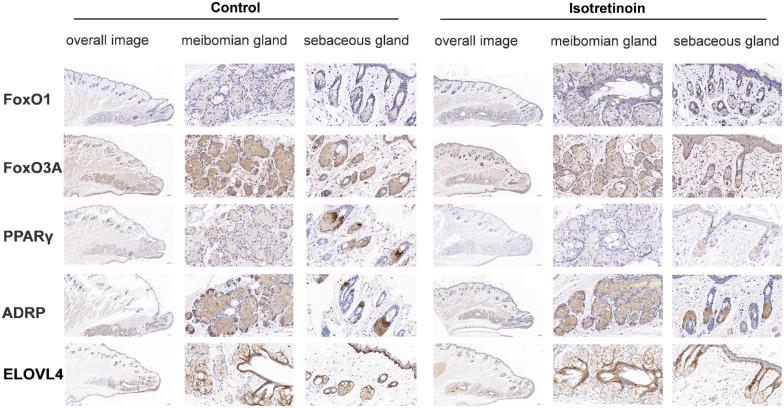
Systemically, isotretinoin-treated rats have a significantly lower body weight that controls and apparent skin damage. Locally, although there was no alteration in tear secretion, a significant corneal involvement indicated by increased fluorescein staining scores, and also the contrast of meibomian gland was significantly reduced but no significant atrophy of the acinus was found. In addition, isotretinoin causes a decrease in conjunctival goblet cells. Furthermore, isotretinoin treatment did not cause the upregulation of FoxO1 and inflammation related genes but significantly suppressed the expression of PPARγ pathway.
CONCLUSIONS
Isotretinoin does not cause a significant atrophy of the acinus and a significant change of FoxO1 expression in the meibomian gland. Isotretinoin causes meibomian gland dysfunction, affecting meibocyte differentiation and qualitative and quantitative changes in the meibum, through PPARγ pathway.
目的
研究异维 A 酸对眼表的影响,并探讨其可能的机制。
方法
将大鼠用 20mg/kg/d 的异维 A 酸处理五个月,并每月测试泪液分泌、荧光素染色和红外摄影。治疗五个月后,采集组织进行常规染色以评估形态变化;并通过实时聚合酶链反应、Western blot 和免疫组织化学研究相关基因及其产物(叉头框蛋白 O1(FoxO1)、叉头框蛋白 O3、过氧化物酶体增殖物激活受体γ(PPARγ)、脂肪分化相关蛋白、长链脂肪酸延长蛋白 4、脂肪酸结合蛋白 4、基质金属蛋白酶-9 和白细胞介素-6)的表达。
结果
全身性地,异维 A 酸处理的大鼠体重明显低于对照组,且有明显的皮肤损伤。局部上,尽管泪液分泌没有改变,但角膜明显受累,荧光素染色评分增加,并且还发现睑板腺对比度明显降低,但腺泡没有明显萎缩。此外,异维 A 酸导致结膜杯状细胞减少。此外,异维 A 酸治疗并未引起 FoxO1 和炎症相关基因的上调,但显著抑制了 PPARγ 通路的表达。
结论
异维 A 酸不会导致睑板腺腺泡明显萎缩和 FoxO1 表达明显改变。异维 A 酸通过 PPARγ 通路引起睑板腺功能障碍,影响睑板细胞分化以及睑脂的定性和定量变化。



 Zotero 插件