
聚合物囊泡介导的环状二核苷酸STING激动剂的胞质递送增强肿瘤免疫治疗。
Polymersome-mediated cytosolic delivery of cyclic dinucleotide STING agonist enhances tumor immunotherapy.
作者信息
Zheng Huan, Guo Beibei, Qiu Xinyun, Xia Yifeng, Qu Yan, Cheng Liang, Meng Fenghua, Zhong Zhiyuan
机构信息
Biomedical Polymers Laboratory, College of Chemistry, Chemical Engineering and Materials Science, and State Key Laboratory of Radiation Medicine and Protection, Soochow University, Suzhou, 215123, PR China.
Department of Pharmaceutics, College of Pharmaceutical Sciences, Soochow University, Suzhou, 215123, PR China.
出版信息
Bioact Mater. 2022 Mar 4;16:1-11. doi: 10.1016/j.bioactmat.2022.02.029. eCollection 2022 Oct.
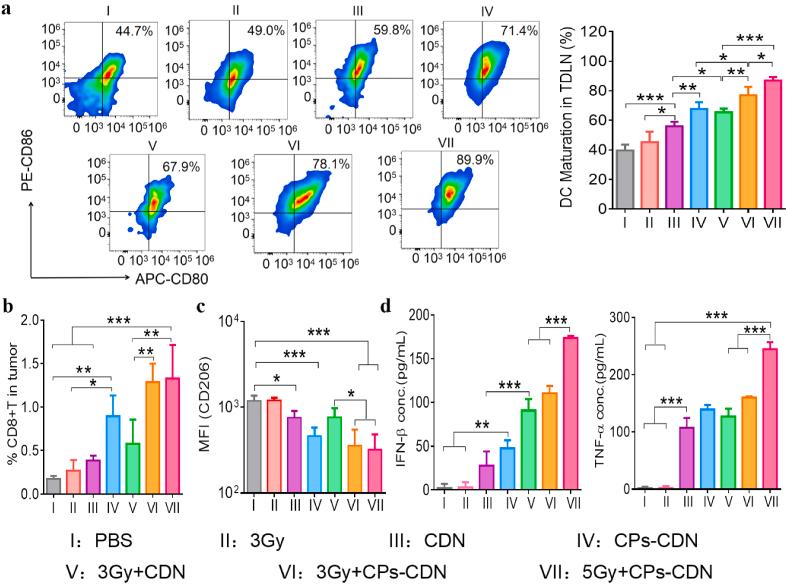
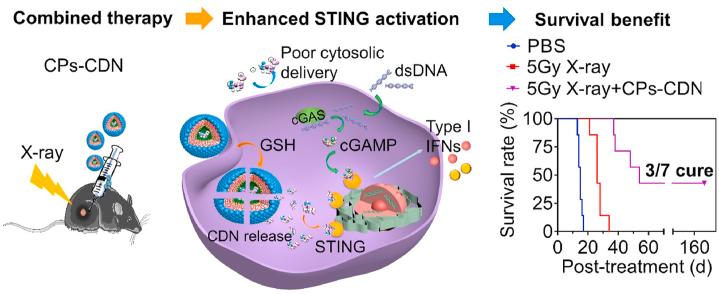
Cyclic dinucleotides (CDNs) as stimulator of interferon genes (STING) agonists capable of inducing strong antitumor innate immune response are highly promising for tumor immunotherapy. The efficacy of these CDNs is, however, reduced greatly by their fast clearance, poor cell uptake and inefficient cytosolic transportation. Here, we report that reduction-responsive biodegradable chimaeric polymersomes (CPs) markedly enhance tumor retention and cytosolic delivery of a synthetic CDN, ADU-S100, and bolster STING pathway activation in the tumor microenvironment and tumor draining lymph nodes, giving significantly better tumor repression and survival of B16F10 melanoma-bearing mice compared with free CDN control. The superiority of CPs-mediated CDN delivery is further verified in combination therapy with low-dose fractionated radiation, which brings about clearly stronger and longer-term immunotherapeutic effects and protection against tumor re-challenge. The development of nano-STING agonists that are able to overcome the delivery barriers of CDNs represents an effective strategy to potentiate cancer immunotherapy.
环二核苷酸(CDNs)作为能够诱导强烈抗肿瘤先天免疫反应的干扰素基因(STING)激动剂,在肿瘤免疫治疗方面极具前景。然而,这些CDNs的快速清除、较差的细胞摄取和低效的胞质运输极大地降低了它们的疗效。在此,我们报道还原响应性可生物降解嵌合聚合物囊泡(CPs)显著增强了合成CDN——ADU-S100在肿瘤中的滞留和胞质递送,并增强了肿瘤微环境和肿瘤引流淋巴结中STING通路的激活,与游离CDN对照相比,对携带B16F10黑色素瘤的小鼠具有显著更好的肿瘤抑制效果和更长的生存期。CPs介导的CDN递送的优越性在与低剂量分割放疗的联合治疗中得到进一步验证,这带来了明显更强且更持久的免疫治疗效果以及对肿瘤再攻击的保护作用。能够克服CDNs递送障碍的纳米STING激动剂的开发是增强癌症免疫治疗的有效策略。


 Zotero 插件