
在南非西开普省,与之前的几波疫情相比,奥密克戎驱动的第四波疫情中实验室确诊的 SARS-CoV-2 感染的结果。
Outcomes of laboratory-confirmed SARS-CoV-2 infection in the Omicron-driven fourth wave compared with previous waves in the Western Cape Province, South Africa.
机构信息
Health Intelligence, Western Cape Government: Health, Cape Town, South Africa.
Centre for Infectious Disease Epidemiology and Research, School of Public Health and Family Medicine, University of Cape Town, Cape Town, South Africa.
出版信息
Trop Med Int Health. 2022 Jun;27(6):564-573. doi: 10.1111/tmi.13752. Epub 2022 May 10.
OBJECTIVES
The objective was to compare COVID-19 outcomes in the Omicron-driven fourth wave with prior waves in the Western Cape, assess the contribution of undiagnosed prior infection to differences in outcomes in a context of high seroprevalence due to prior infection and determine whether protection against severe disease conferred by prior infection and/or vaccination was maintained.
METHODS
In this cohort study, we included public sector patients aged ≥20 years with a laboratory-confirmed COVID-19 diagnosis between 14 November and 11 December 2021 (wave four) and equivalent prior wave periods. We compared the risk between waves of the following outcomes using Cox regression: death, severe hospitalisation or death and any hospitalisation or death (all ≤14 days after diagnosis) adjusted for age, sex, comorbidities, geography, vaccination and prior infection.
RESULTS
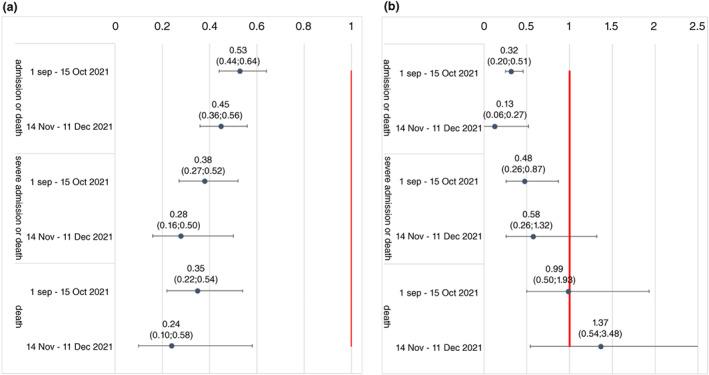
We included 5144 patients from wave four and 11,609 from prior waves. The risk of all outcomes was lower in wave four compared to the Delta-driven wave three (adjusted hazard ratio (aHR) [95% confidence interval (CI)] for death 0.27 [0.19; 0.38]. Risk reduction was lower when adjusting for vaccination and prior diagnosed infection (aHR: 0.41, 95% CI: 0.29; 0.59) and reduced further when accounting for unascertained prior infections (aHR: 0.72). Vaccine protection was maintained in wave four (aHR for outcome of death: 0.24; 95% CI: 0.10; 0.58).
CONCLUSIONS
In the Omicron-driven wave, severe COVID-19 outcomes were reduced mostly due to protection conferred by prior infection and/or vaccination, but intrinsically reduced virulence may account for a modest reduction in risk of severe hospitalisation or death compared to the Delta-driven wave.
目的
本研究旨在比较第四波由奥密克戎驱动的 COVID-19 疫情与西开普省之前几波疫情的结果,评估在既往感染导致高血清阳性率的情况下,未确诊的既往感染对结果差异的影响,并确定既往感染和/或疫苗接种对严重疾病的保护作用是否仍然存在。
方法
在这项队列研究中,我们纳入了 2021 年 11 月 14 日至 12 月 11 日期间(第四波)在公共卫生部门就诊、实验室确诊 COVID-19 的年龄≥20 岁的患者,以及同期之前几波疫情的患者。我们使用 Cox 回归比较了以下结果在两波疫情之间的风险:死亡、严重住院或死亡以及任何住院或死亡(均在确诊后 14 天内),调整了年龄、性别、合并症、地理位置、疫苗接种和既往感染等因素。
结果
我们纳入了第四波的 5144 例患者和之前几波的 11609 例患者。与德尔塔驱动的第三波相比,第四波的所有结果的风险均降低(死亡的调整危险比[aHR] [95%置信区间[CI]]:0.27 [0.19; 0.38])。当调整疫苗接种和既往确诊感染时,风险降低幅度较小(aHR:0.41,95% CI:0.29; 0.59),当考虑到未确定的既往感染时,风险进一步降低(aHR:0.72)。第四波疫苗的保护作用仍然存在(死亡结果的 aHR:0.24;95% CI:0.10; 0.58)。
结论
在奥密克戎驱动的波中,严重的 COVID-19 结果的降低主要归因于既往感染和/或疫苗接种的保护作用,但内在的毒力降低可能导致与德尔塔驱动的波相比,严重住院或死亡的风险略有降低。

 Zotero 插件