
肿瘤浸润淋巴细胞的空间特征与乳腺癌进展
Spatial Characterization of Tumor-Infiltrating Lymphocytes and Breast Cancer Progression.
作者信息
Fassler Danielle J, Torre-Healy Luke A, Gupta Rajarsi, Hamilton Alina M, Kobayashi Soma, Van Alsten Sarah C, Zhang Yuwei, Kurc Tahsin, Moffitt Richard A, Troester Melissa A, Hoadley Katherine A, Saltz Joel
机构信息
Department of Biomedical Informatics, Stony Brook University, Stony Brook, NY 11790, USA.
Department of Pathology and Laboratory Medicine, University of North Carolina at Chapel Hill, Chapel Hill, NC 27599, USA.
出版信息
Cancers (Basel). 2022 Apr 26;14(9):2148. doi: 10.3390/cancers14092148.
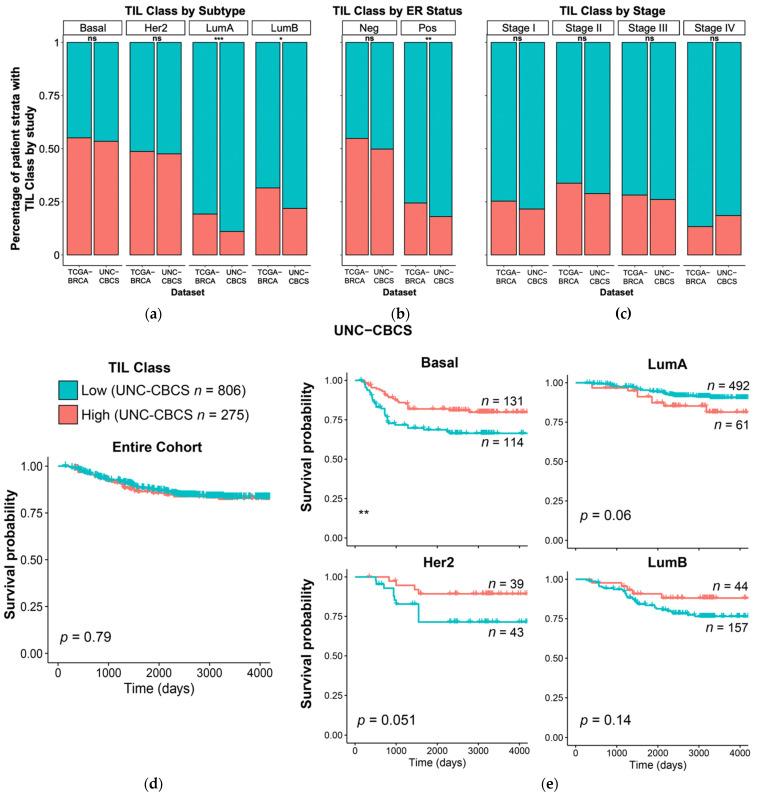
Tumor-infiltrating lymphocytes (TILs) have been established as a robust prognostic biomarker in breast cancer, with emerging utility in predicting treatment response in the adjuvant and neoadjuvant settings. In this study, the role of TILs in predicting overall survival and progression-free interval was evaluated in two independent cohorts of breast cancer from the Cancer Genome Atlas (TCGA BRCA) and the Carolina Breast Cancer Study (UNC CBCS). We utilized machine learning and computer vision algorithms to characterize TIL infiltrates in digital whole-slide images (WSIs) of breast cancer stained with hematoxylin and eosin (H&E). Multiple parameters were used to characterize the global abundance and spatial features of TIL infiltrates. Univariate and multivariate analyses show that large aggregates of peritumoral and intratumoral TILs (forests) were associated with longer survival, whereas the absence of intratumoral TILs (deserts) is associated with increased risk of recurrence. Patients with two or more high-risk spatial features were associated with significantly shorter progression-free interval (PFI). This study demonstrates the practical utility of Pathomics in evaluating the clinical significance of the abundance and spatial patterns of distribution of TIL infiltrates as important biomarkers in breast cancer.
肿瘤浸润淋巴细胞(TILs)已被确立为乳腺癌中一种可靠的预后生物标志物,在预测辅助和新辅助治疗环境中的治疗反应方面具有越来越大的实用价值。在本研究中,在来自癌症基因组图谱(TCGA BRCA)和卡罗来纳乳腺癌研究(UNC CBCS)的两个独立乳腺癌队列中,评估了TILs在预测总生存期和无进展生存期方面的作用。我们利用机器学习和计算机视觉算法,对用苏木精和伊红(H&E)染色的乳腺癌数字全切片图像(WSIs)中的TIL浸润情况进行特征描述。使用多个参数来描述TIL浸润的整体丰度和空间特征。单变量和多变量分析表明,肿瘤周围和肿瘤内TILs的大聚集(森林)与更长的生存期相关,而肿瘤内无TILs(沙漠)与复发风险增加相关。具有两个或更多高风险空间特征的患者,其无进展生存期(PFI)显著缩短。本研究证明了病理组学在评估TIL浸润的丰度和空间分布模式作为乳腺癌重要生物标志物的临床意义方面的实际效用。



 Zotero 插件