
社会经济和地理因素与美国成年人饮食质量的关联。
Association of Socioeconomic and Geographic Factors With Diet Quality in US Adults.
机构信息
Department of Population Science, American Cancer Society, Kennesaw, Georgia.
Department of Surveillance and Health Equity Science, American Cancer Society, Kennesaw, Georgia.
出版信息
JAMA Netw Open. 2022 Jun 1;5(6):e2216406. doi: 10.1001/jamanetworkopen.2022.16406.
IMPORTANCE
Poor diet quality is a key factor associated with obesity and chronic disease. Understanding associations of socioeconomic and geographic factors with diet quality can inform public health and policy efforts for advancing health equity.
OBJECTIVE
To identify socioeconomic and geographic factors associated with diet quality in a large US cohort study.
DESIGN, SETTING, AND PARTICIPANTS: This cross-sectional study included adult men and women who enrolled in the Cancer Prevention Study-3 at American Cancer Society community events in 35 US states, the District of Columbia, and Puerto Rico between 2006 and 2013. Participants completed a validated food frequency questionnaire between 2015 and 2017. Data were analyzed from February to November 2021.
EXPOSURES
The main exposures included self-reported race and ethnicity, education, and household income. Geocoded addresses were used to classify urbanization level using Rural-Urban Commuting Area codes; US Department of Agriculture's Food Access Research Atlas database classified residence in food desert.
MAIN OUTCOMES AND MEASURES
Poor diet quality was defined as lowest quartile of dietary concordance with the 2020 American Cancer Society recommendations for cancer prevention score, based on sex-specific intake categories of vegetables and legumes, whole fruits, whole grains, red and processed meat, highly processed foods and refined grains, and sugar-sweetened beverages.
RESULTS
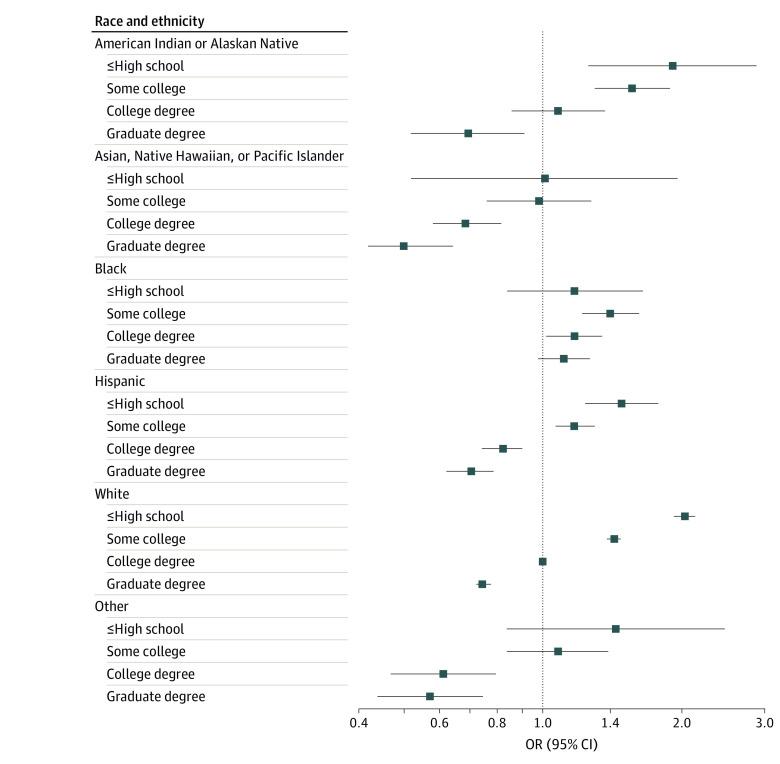
Among 155 331 adults, 123 115 were women (79.3%), and the mean (SD) age was 52 (9.7) years), and there were 1408 American Indian or Alaskan Native individuals (0.9%); 2721 Asian, Native Hawaiian, or Pacific Islander individuals (1.8%); 3829 Black individuals (2.5%); 7967 Hispanic individuals (5.1%); and 138 166 White individuals (88.9%). All key exposures assessed were statistically significantly and independently associated with poor diet quality. Compared with White participants, Black participants had a 16% (95% CI, 8%-25%) higher risk of poor diet quality, while Hispanic/Latino had 16% (95% CI, 12%-21%) lower risk and Asian, Native Hawaiian, and Pacific Islander participants had 33% (95% CI, 26%-40%) lower risk of poor diet quality. After controlling for other characteristics, rural residence was associated with a 61% (95% CI, 48%-75%) higher risk of poor diet quality, and living in a food desert was associated with a 17% (95% CI, 12%-22%) higher risk. Associations of income with diet quality and education with diet quality varied by race and ethnicity (income: P for interaction = .01; education: P for interaction < .001). All diet score components were associated with disparities observed.
CONCLUSIONS AND RELEVANCE
This cross-sectional study found that multiple individual-level socioeconomic and geographic variables were independently associated with poor diet quality among a large, racially and ethnically and geographically diverse US cohort. These findings could help to identify groups at highest risk of outcomes associated with poor diet to inform future approaches for advancing health equity.
重要性
不良的饮食质量是与肥胖和慢性病相关的关键因素。了解社会经济和地理因素与饮食质量的关联,可以为推进健康公平的公共卫生和政策工作提供信息。
目的
在一项大型美国队列研究中确定与饮食质量相关的社会经济和地理因素。
设计、地点和参与者:这项横断面研究包括在 2006 年至 2013 年期间,在美国癌症协会社区活动中参加美国癌症协会癌症预防研究-3 的成年男性和女性。参与者在 2015 年至 2017 年之间完成了一份经过验证的食物频率问卷。数据于 2021 年 2 月至 11 月进行分析。
暴露因素
主要暴露因素包括自我报告的种族和民族、教育程度和家庭收入。通过农村-城市通勤区代码对居住地址进行地理编码,以确定城市化水平;美国农业部的食品获取研究地图集数据库将居住地划分为食品荒漠。
主要结果和测量
不良的饮食质量定义为根据性别特异性蔬菜和豆类、全水果、全谷物、红色和加工肉类、高度加工食品和精制谷物以及含糖饮料的摄入量类别,与 2020 年美国癌症协会癌症预防建议得分最低四分位值一致的饮食一致性最低。
结果
在 155331 名成年人中,有 123115 名女性(79.3%),平均(SD)年龄为 52(9.7)岁,有 1408 名美洲印第安人或阿拉斯加原住民(0.9%);2721 名亚洲人、夏威夷原住民或太平洋岛民(1.8%);3829 名黑人(2.5%);7967 名西班牙裔(5.1%)和 138166 名白人(88.9%)。所有评估的关键暴露因素均与不良饮食质量显著且独立相关。与白人参与者相比,黑人参与者不良饮食质量的风险增加 16%(95%置信区间,8%-25%),而西班牙裔/拉丁裔的风险降低 16%(95%置信区间,12%-21%),而亚洲、夏威夷原住民和太平洋岛民参与者的风险降低 33%(95%置信区间,26%-40%)。在控制其他特征后,农村居住与不良饮食质量的风险增加 61%(95%置信区间,48%-75%)相关,而居住在食品荒漠与不良饮食质量的风险增加 17%(95%置信区间,12%-22%)相关。收入与饮食质量的关系以及教育与饮食质量的关系因种族和民族而异(收入:P 交互 = .01;教育:P 交互 < .001)。所有饮食评分成分都与观察到的差异有关。
结论和相关性
这项横断面研究发现,在美国一个大型、种族、民族和地理上多样化的队列中,多个个体社会经济和地理变量与不良饮食质量独立相关。这些发现可以帮助确定与不良饮食相关的结果风险最高的群体,为推进健康公平的未来方法提供信息。

 Zotero 插件