
脓毒症相关性急性肾损伤重症患者实时死亡率预测机器学习模型的开发与验证
Development and Validation of Machine Learning Models for Real-Time Mortality Prediction in Critically Ill Patients With Sepsis-Associated Acute Kidney Injury.
作者信息
Luo Xiao-Qin, Yan Ping, Duan Shao-Bin, Kang Yi-Xin, Deng Ying-Hao, Liu Qian, Wu Ting, Wu Xi
机构信息
Department of Nephrology, Hunan Key Laboratory of Kidney Disease and Blood Purification, The Second Xiangya Hospital of Central South University, Changsha, China.
出版信息
Front Med (Lausanne). 2022 Jun 15;9:853102. doi: 10.3389/fmed.2022.853102. eCollection 2022.
BACKGROUND
Sepsis-associated acute kidney injury (SA-AKI) is common in critically ill patients, which is associated with significantly increased mortality. Existing mortality prediction tools showed insufficient predictive power or failed to reflect patients' dynamic clinical evolution. Therefore, the study aimed to develop and validate machine learning-based models for real-time mortality prediction in critically ill patients with SA-AKI.
METHODS
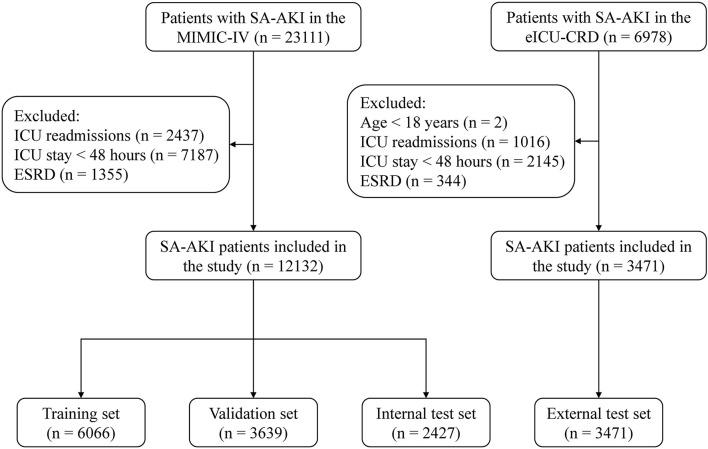
The multi-center retrospective study included patients from two distinct databases. A total of 12,132 SA-AKI patients from the Medical Information Mart for Intensive Care IV (MIMIC-IV) were randomly allocated to the training, validation, and internal test sets. An additional 3,741 patients from the eICU Collaborative Research Database (eICU-CRD) served as an external test set. For every 12 h during the ICU stays, the state-of-the-art eXtreme Gradient Boosting (XGBoost) algorithm was used to predict the risk of in-hospital death in the following 48, 72, and 120 h and in the first 28 days after ICU admission. Area under the receiver operating characteristic curves (AUCs) were calculated to evaluate the models' performance.
RESULTS
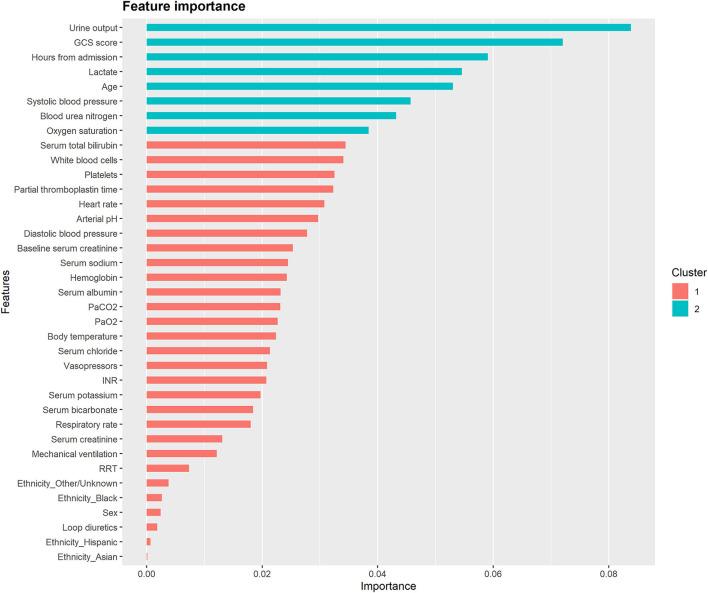
The XGBoost models, based on routine clinical variables updated every 12 h, showed better performance in mortality prediction than the SOFA score and SAPS-II. The AUCs of the XGBoost models for mortality over different time periods ranged from 0.848 to 0.804 in the internal test set and from 0.818 to 0.748 in the external test set. The shapley additive explanation method provided interpretability for the XGBoost models, which improved the understanding of the association between the predictor variables and future mortality.
CONCLUSIONS
The interpretable machine learning XGBoost models showed promising performance in real-time mortality prediction in critically ill patients with SA-AKI, which are useful tools for early identification of high-risk patients and timely clinical interventions.
背景
脓毒症相关急性肾损伤(SA-AKI)在危重症患者中很常见,与死亡率显著增加相关。现有的死亡率预测工具显示预测能力不足或未能反映患者的动态临床演变。因此,本研究旨在开发并验证基于机器学习的模型,用于对SA-AKI危重症患者进行实时死亡率预测。
方法
这项多中心回顾性研究纳入了来自两个不同数据库的患者。重症监护医学信息数据库IV(MIMIC-IV)中的12132例SA-AKI患者被随机分配到训练集、验证集和内部测试集。另外,来自电子重症监护病房协作研究数据库(eICU-CRD)的3741例患者作为外部测试集。在重症监护病房住院期间,每隔12小时使用最先进的极端梯度提升(XGBoost)算法预测接下来48、72和120小时以及重症监护病房入院后前28天内的院内死亡风险。计算受试者工作特征曲线下面积(AUC)以评估模型性能。
结果
基于每12小时更新的常规临床变量的XGBoost模型在死亡率预测方面比序贯器官衰竭评估(SOFA)评分和简化急性生理学评分II(SAPS-II)表现更好。XGBoost模型在不同时间段的死亡率AUC在内部测试集中为0.848至0.804,在外部测试集中为0.818至0.748。夏普利值相加解释方法为XGBoost模型提供了可解释性,增进了对预测变量与未来死亡率之间关联的理解。
结论
可解释的机器学习XGBoost模型在SA-AKI危重症患者的实时死亡率预测中表现出良好的性能,是早期识别高危患者和及时进行临床干预的有用工具。


 Zotero 插件