
血根碱被鉴定为一种天然生物碱 LSD1 抑制剂,可抑制肺癌细胞的生长和迁移。
Sanguinarine, identified as a natural alkaloid LSD1 inhibitor, suppresses lung cancer cell growth and migration.
作者信息
Qin Ting-Ting, Li Zhong-Hua, Li Li-Xin, Du Kun, Yang Ji-Ge, Zhang Zhen-Qiang, Wu Xiang-Xiang, Ma Jin-Lian
机构信息
Academy of Chinese Medical Sciences, Henan University of Chinese Medicine, Zhengzhou 450046, Henan Province, China.
School of Pharmacy, Henan University of Chinese Medicine, Zhengzhou 450046, Henan province, China.
出版信息
Iran J Basic Med Sci. 2022 Jun;25(6):781-788. doi: 10.22038/IJBMS.2022.62541.13851.
OBJECTIVES
Lysine-specific demethylase1 (LSD1), an important class of histone demethylases, plays a crucial role in regulation of mammalian biology. The up-regulated LSD1 expression was frequently associated with progress and oncogenesis of multiple human cancers, including non-small cell lung cancer (NSCLC). Therefore, inhibition of LSD1 may provide an attractive strategy for cancer treatment. We investigated the effect of sanguinarine against lung cancer cells as a natural alkaloid LSD1 inhibitor.
MATERIALS AND METHODS
The inhibition properties of sanguinarine to the recombinant LSD1 were evaluated by a fluorescence-based method. Subsequently, assays such as viability, apoptosis, clonogenicity, wound healing, and transwell were performed on H1299 and H1975 cells after treatment with sanguinarine.
RESULTS
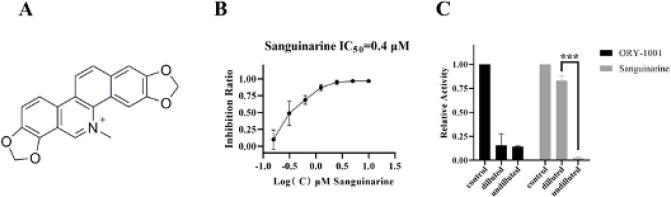
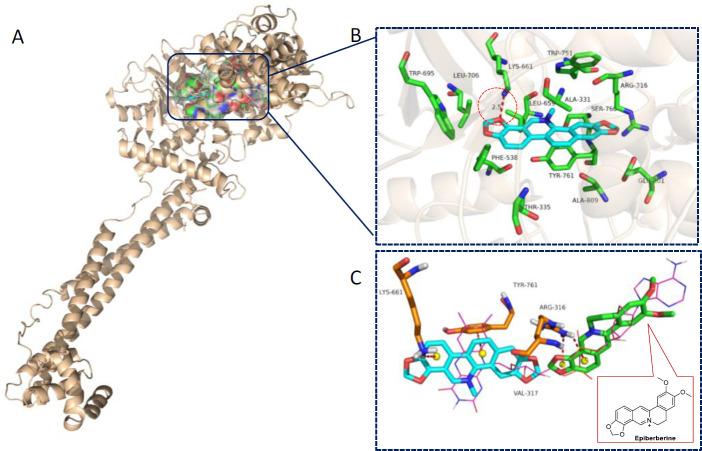
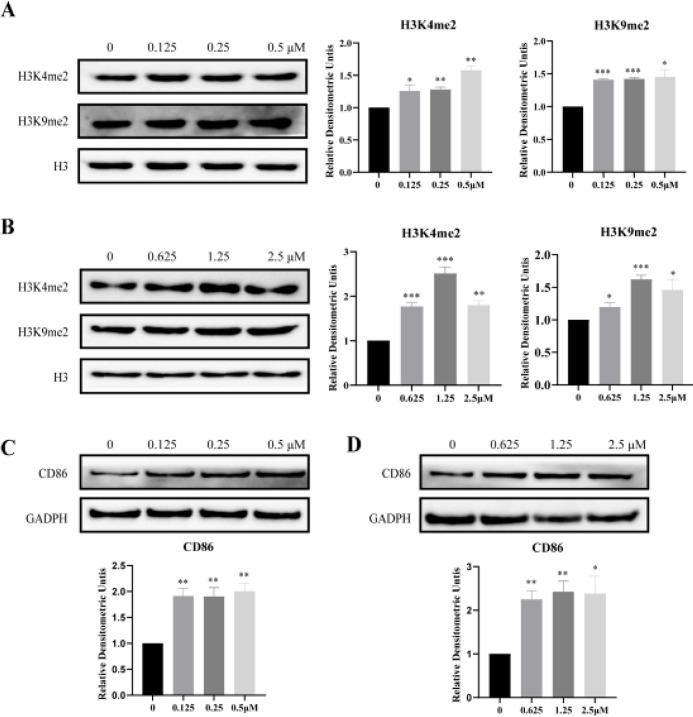
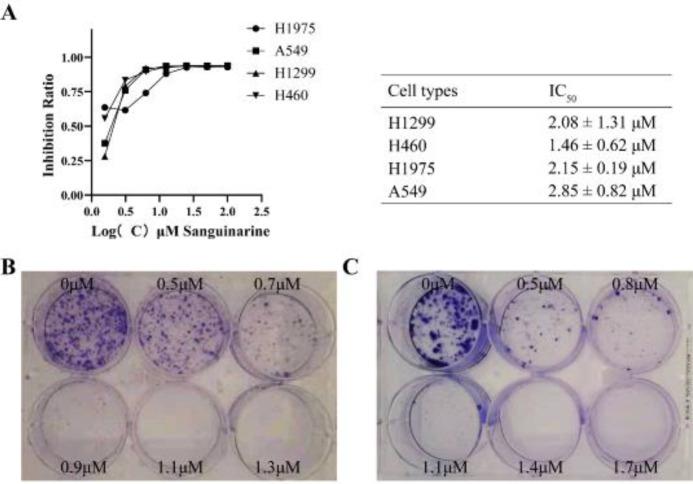
Upon screening our in-house natural chemical library toward LSD1, we found that sanguinarine possessed a potent inhibitory effect against LSD1 with the IC50 value of 0.4 μM in a reversible manner. Molecular docking simulation suggested that sanguinarine may inactivate LSD1 by inserting into the binding pocket of LSD1 to compete with the FAD site. In H1299 and H1975 cells, sanguinarine inhibited the demethylation of LSD1, validating its cellular activity against the enzyme. Further studies showed that sanguinarine exhibited a strong capacity to suppress colony formation, inhibit migration and invasion, as well as induce apoptosis of H1299 and H1975 cells.
CONCLUSION
Our findings present a new chemical scaffold for LSD1 inhibitors, and also provide new insight into the anti-NSCLC action of sanguinarine.
目的
赖氨酸特异性去甲基化酶1(LSD1)是一类重要的组蛋白去甲基化酶,在哺乳动物生物学调控中起关键作用。LSD1表达上调常与包括非小细胞肺癌(NSCLC)在内的多种人类癌症的进展和肿瘤发生相关。因此,抑制LSD1可能为癌症治疗提供一种有吸引力的策略。我们研究了血根碱作为一种天然生物碱LSD1抑制剂对肺癌细胞的作用。
材料与方法
采用基于荧光的方法评估血根碱对重组LSD1的抑制特性。随后,在用血根碱处理H1299和H1975细胞后,进行了诸如活力、凋亡、克隆形成、伤口愈合和Transwell等实验。
结果
在筛选我们内部的天然化学文库针对LSD1的过程中,我们发现血根碱对LSD1具有强效抑制作用,IC50值为0.4μM,且为可逆性抑制。分子对接模拟表明,血根碱可能通过插入LSD1的结合口袋与FAD位点竞争来使LSD1失活。在H1299和H1975细胞中,血根碱抑制了LSD1的去甲基化,证实了其对该酶的细胞活性。进一步研究表明,血根碱具有强大的抑制H1299和H1975细胞集落形成、抑制迁移和侵袭以及诱导凋亡的能力。
结论
我们的研究结果为LSD1抑制剂提供了一种新的化学支架,也为血根碱的抗NSCLC作用提供了新的见解。


 Zotero 插件