
单细胞分辨率下的致死性 COVID-19 和特发性肺纤维化的肺血管系统。
The pulmonary vasculature in lethal COVID-19 and idiopathic pulmonary fibrosis at single-cell resolution.
机构信息
Laboratory of Angiogenesis and Vascular Metabolism, Department of Oncology and Leuven Cancer Institute (LKI), KU Leuven, VIB Center for Cancer Biology, VIB, Leuven 3000, Belgium.
Laboratory of Translational Genetics, Center for Cancer Biology, VIB & Department of Genetics, KU Leuven, Leuven 3000, Belgium.
出版信息
Cardiovasc Res. 2023 Mar 31;119(2):520-535. doi: 10.1093/cvr/cvac139.
AIMS
Severe acute respiratory syndrome coronavirus-2 infection causes COVID-19, which in severe cases evokes life-threatening acute respiratory distress syndrome (ARDS). Transcriptome signatures and the functional relevance of non-vascular cell types (e.g. immune and epithelial cells) in COVID-19 are becoming increasingly evident. However, despite its known contribution to vascular inflammation, recruitment/invasion of immune cells, vascular leakage, and perturbed haemostasis in the lungs of severe COVID-19 patients, an in-depth interrogation of the endothelial cell (EC) compartment in lethal COVID-19 is lacking. Moreover, progressive fibrotic lung disease represents one of the complications of COVID-19 pneumonia and ARDS. Analogous features between idiopathic pulmonary fibrosis (IPF) and COVID-19 suggest partial similarities in their pathophysiology, yet, a head-to-head comparison of pulmonary cell transcriptomes between both conditions has not been implemented to date.
METHODS AND RESULTS
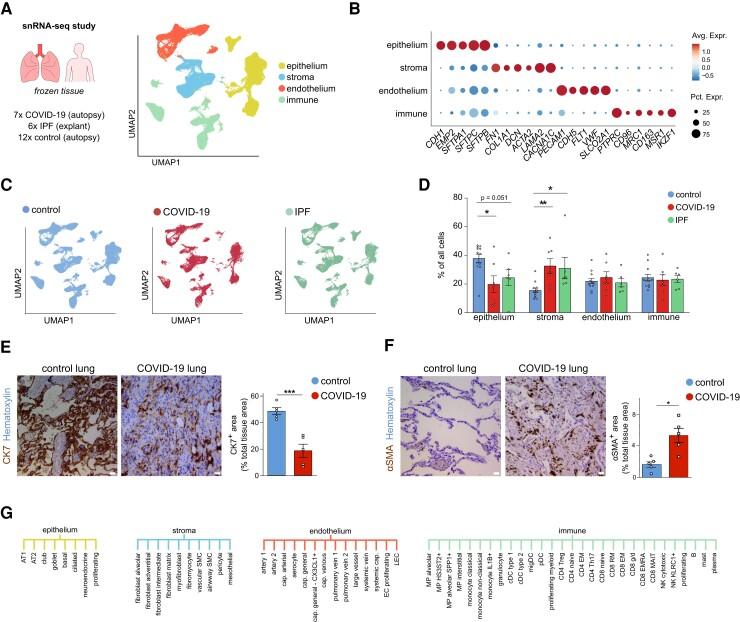
We performed single-nucleus RNA-sequencing on frozen lungs from 7 deceased COVID-19 patients, 6 IPF explant lungs, and 12 controls. The vascular fraction, comprising 38 794 nuclei, could be subclustered into 14 distinct EC subtypes. Non-vascular cell types, comprising 137 746 nuclei, were subclustered and used for EC-interactome analyses. Pulmonary ECs of deceased COVID-19 patients showed an enrichment of genes involved in cellular stress, as well as signatures suggestive of dampened immunomodulation and impaired vessel wall integrity. In addition, increased abundance of a population of systemic capillary and venous ECs was identified in COVID-19 and IPF. COVID-19 systemic ECs closely resembled their IPF counterparts, and a set of 30 genes was found congruently enriched in systemic ECs across studies. Receptor-ligand interaction analysis of ECs with non-vascular cell types in the pulmonary micro-environment revealed numerous previously unknown interactions specifically enriched/depleted in COVID-19 and/or IPF.
CONCLUSIONS
This study uncovered novel insights into the abundance, expression patterns, and interactomes of EC subtypes in COVID-19 and IPF, relevant for future investigations into the progression and treatment of both lethal conditions.
目的
严重急性呼吸综合征冠状病毒 2 型感染可引起 COVID-19,在严重情况下可引发危及生命的急性呼吸窘迫综合征(ARDS)。越来越多的证据表明,COVID-19 中的转录组特征和非血管细胞类型(如免疫细胞和上皮细胞)的功能相关性。然而,尽管已知其对血管炎症、免疫细胞募集/浸润、血管渗漏和严重 COVID-19 患者凝血功能障碍有贡献,但对致命 COVID-19 中内皮细胞(EC)区室的深入研究仍有所欠缺。此外,进行性肺纤维化疾病是 COVID-19 肺炎和 ARDS 的并发症之一。特发性肺纤维化(IPF)和 COVID-19 之间存在类似特征,提示它们在发病机制上存在部分相似性,但迄今为止,尚未对这两种疾病的肺部细胞转录组进行直接比较。
方法和结果
我们对 7 名死于 COVID-19 的患者、6 名 IPF 肺移植患者和 12 名对照者的冷冻肺组织进行了单核 RNA 测序。血管部分包含 38794 个核,可以进一步细分为 14 种不同的 EC 亚型。非血管细胞类型包含 137746 个核,可以进一步聚类,并用于 EC 相互作用组分析。死于 COVID-19 的患者的肺 EC 显示出与细胞应激相关的基因富集,以及免疫调节减弱和血管壁完整性受损的特征。此外,在 COVID-19 和 IPF 中发现了一种系统毛细血管和静脉 EC 数量增加的群体。COVID-19 的系统性 EC 与它们的 IPF 对应物非常相似,并且在这两项研究中发现了一组 30 个基因在系统性 EC 中一致富集。对肺微环境中 EC 与非血管细胞类型的受体-配体相互作用分析揭示了许多以前未知的相互作用,这些相互作用在 COVID-19 和/或 IPF 中特异性富集/耗竭。
结论
这项研究揭示了 COVID-19 和 IPF 中 EC 亚型的丰度、表达模式和相互作用组的新见解,这对于深入研究这两种致命疾病的进展和治疗具有重要意义。




 Zotero 插件