
COVID-19 康复 6 周后,美国医护人员的症状表现:一项前瞻性队列研究。
Presence of symptoms 6 weeks after COVID-19 among vaccinated and unvaccinated US healthcare personnel: a prospective cohort study.
机构信息
Emergency Medicine, The University of Iowa Roy J and Lucille A Carver College of Medicine, Iowa, Iowa, USA
Anesthesia, University of Iowa Carver College of Medicine, Iowa City, Iowa, USA.
出版信息
BMJ Open. 2023 Feb 2;13(2):e063141. doi: 10.1136/bmjopen-2022-063141.
OBJECTIVES
Although COVID-19 vaccines offer protection against infection and severe disease, there is limited information on the effect of vaccination on prolonged symptoms following COVID-19. Our objective was to determine differences in prevalence of prolonged symptoms 6 weeks after onset of COVID-19 among healthcare personnel (HCP) by vaccination status, and to assess differences in timing of return to work.
DESIGN
Cohort analysis of HCP with COVID-19 enrolled in a multicentre vaccine effectiveness study. HCP with COVID-19 between December 2020 and August 2021 were followed up 6 weeks after illness onset.
SETTING
Health systems in 12 US states.
PARTICIPANTS
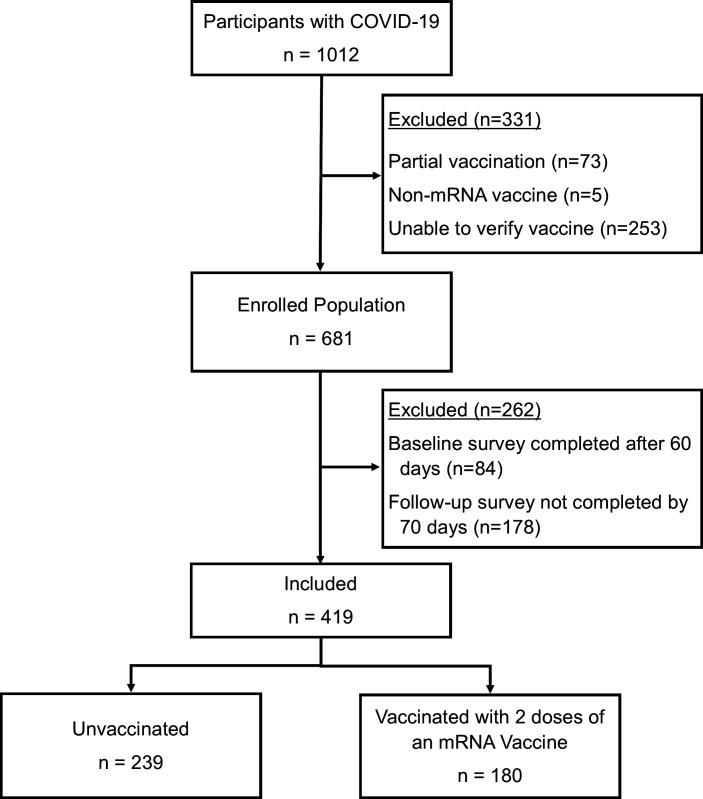
HCP participating in a vaccine effectiveness study were eligible for inclusion if they had laboratory-confirmed symptomatic SARS-CoV-2 with mRNA vaccination (symptom onset ≥14 days after two doses) or no prior vaccination. Among 681 eligible participants, 419 (61%) completed a follow-up survey to assess symptoms reported 6 weeks after illness onset.
EXPOSURES
Two doses of a COVID-19 mRNA vaccine compared with no COVID-19 vaccine.
MAIN OUTCOME MEASURES
Prevalence of symptoms 6 weeks after onset of COVID-19 illness and days to return to work.
RESULTS
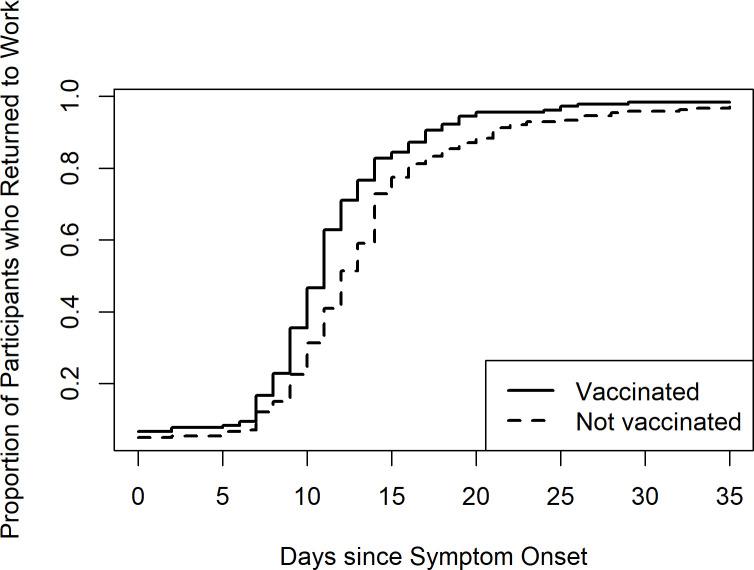
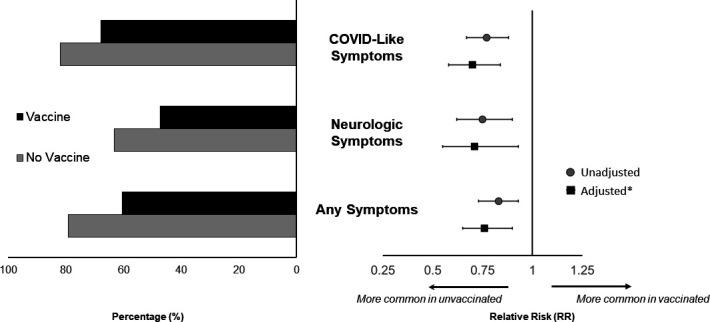
Among 419 HCP with COVID-19, 298 (71%) reported one or more COVID-like symptoms 6 weeks after illness onset, with a lower prevalence among vaccinated participants compared with unvaccinated participants (60.6% vs 79.1%; adjusted risk ratio 0.70, 95% CI 0.58 to 0.84). Following their illness, vaccinated HCP returned to work a median 2.0 days (95% CI 1.0 to 3.0) sooner than unvaccinated HCP (adjusted HR 1.37, 95% CI 1.04 to 1.79).
CONCLUSIONS
Receipt of two doses of a COVID-19 mRNA vaccine among HCP with COVID-19 illness was associated with decreased prevalence of COVID-like symptoms at 6 weeks and earlier return to work.
目的
尽管 COVID-19 疫苗可预防感染和重症疾病,但关于疫苗对 COVID-19 后长期症状的影响,信息有限。我们的目的是确定接种疫苗和未接种疫苗的 COVID-19 医护人员(HCP)在 COVID-19 发病后 6 周时长期症状的发生率差异,并评估其重返工作岗位的时间差异。
设计
对参加多中心疫苗有效性研究的 COVID-19 医护人员进行队列分析。在 2020 年 12 月至 2021 年 8 月期间,对 COVID-19 发病后 6 周的 HCP 进行随访。
地点
美国 12 个州的卫生系统。
参与者
如果 HCP 实验室确诊的 SARS-CoV-2 症状性感染且接种了 mRNA 疫苗(症状出现后≥14 天接种两剂)或无既往疫苗接种史,则有资格参加疫苗有效性研究。在 681 名合格参与者中,有 419 名(61%)完成了一项随访调查,以评估发病后 6 周报告的症状。
暴露
两剂 COVID-19 mRNA 疫苗与未接种 COVID-19 疫苗相比。
主要结局指标
COVID-19 发病后 6 周的症状发生率和重返工作岗位的天数。
结果
在 419 名 COVID-19 医护人员中,298 名(71%)在发病后 6 周报告了一种或多种 COVID 样症状,接种组的发生率低于未接种组(60.6%比 79.1%;调整风险比 0.70,95%CI 0.58 至 0.84)。发病后,接种疫苗的 HCP 重返工作岗位的中位时间比未接种疫苗的 HCP 早 2.0 天(95%CI 1.0 至 3.0)(调整后的 HR 1.37,95%CI 1.04 至 1.79)。
结论
COVID-19 发病的 HCP 接种两剂 COVID-19 mRNA 疫苗与 6 周时 COVID 样症状发生率降低和更早重返工作岗位有关。

 Zotero 插件