
ADAM17 定向抑制剂抗体 MEDI3622 拮抗放疗诱导的 VEGF 释放并增强非小细胞肺癌对放疗的敏感性。
The ADAM17-directed Inhibitory Antibody MEDI3622 Antagonizes Radiotherapy-induced VEGF Release and Sensitizes Non-Small Cell Lung Cancer for Radiotherapy.
机构信息
Laboratory for Applied Radiobiology, Department of Radiation Oncology, University Hospital Zurich, University of Zurich, Zurich, Switzerland.
Department of Infectious Diseases and Hospital Epidemiology, University Hospital Zurich, University of Zurich, Zurich, Switzerland.
出版信息
Cancer Res Commun. 2021 Dec 22;1(3):164-177. doi: 10.1158/2767-9764.CRC-21-0067. eCollection 2021 Dec.
UNLABELLED
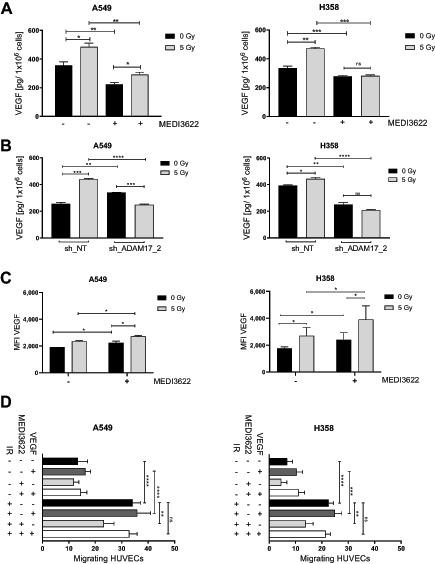
The cellular response to ionizing radiation (IR) depends on tumor cell and microenvironmental factors. Here, we investigated the role of IR-induced ADAM17 matrix metalloproteinase activity for the intercellular communication between tumor cells and the tumor vasculature in non-small cell lung cancer (NSCLC) tumor models. Factors shed by ADAM17 from NSCLC tumor cells (A549, H358) and relevant for endothelial cell migration were investigated using transwell migration assays, ELISA, and flow cytometry. Tumor angiogenesis-related endpoints were analyzed with the chorio-allantoic membrane assay and in murine NSCLC tumor models. Efficacy-oriented experiments were performed in a murine orthotopic NSCLC tumor model using irradiation with an image-guided small-animal radiotherapy platform alone and in combination with the novel ADAM17-directed antibody MEDI3622. , VEGF was identified as the major factor responsible for IR-induced and ADAM17-dependent endothelial cell migration toward attracting tumor cells. IR strongly enhanced tumor cell-associated ADAM17 activity, released VEGF in an ADAM17-dependent manner, and thereby coordinated the communication between tumor and endothelial cells. , tumor growth and microvessel size and density were strongly decreased in response to the combined treatment modality of IR and MEDI3622 but not by either treatment modality alone and thus suggest that the supra-additive effect of the combined treatment modality is in part due to abrogation of the ADAM17-mediated IR-induced protective effect on the tumor vasculature. Furthermore, we demonstrate that the novel ADAM17-inhibitory antibody MEDI3622 potently improves the radiotherapy response of NSCLC.
SIGNIFICANCE
The tumor response to radiotherapy is influenced by several factors of the tumor microenvironment. We demonstrate that inhibition of the sheddase ADAM17 by the novel antibody MEDI3622 reduces IR-induced VEGF release from tumor cells relevant for endothelial cell migration and vasculature protection, thereby enhancing radiotherapy treatment outcome of NSCLC.
未加标签
细胞对电离辐射 (IR) 的反应取决于肿瘤细胞和微环境因素。在这里,我们研究了 ADAM17 基质金属蛋白酶活性在非小细胞肺癌 (NSCLC) 肿瘤模型中肿瘤细胞与肿瘤血管之间细胞间通讯中的作用。使用 Transwell 迁移分析、ELISA 和流式细胞术研究了 ADAM17 从 NSCLC 肿瘤细胞 (A549、H358) 脱落的因子,这些因子与内皮细胞迁移有关。使用绒毛尿囊膜分析和在小鼠 NSCLC 肿瘤模型中分析了与肿瘤血管生成相关的终点。使用图像引导小动物放射治疗平台单独和与新型 ADAM17 定向抗体 MEDI3622 联合进行了以疗效为导向的实验,用于小鼠原位 NSCLC 肿瘤模型。结果表明,VEGF 是 IR 诱导和 ADAM17 依赖性内皮细胞迁移的主要因子,吸引肿瘤细胞。IR 强烈增强了肿瘤细胞相关的 ADAM17 活性,以 ADAM17 依赖的方式释放 VEGF,从而协调了肿瘤细胞和内皮细胞之间的通讯。结果表明,肿瘤生长和微血管大小和密度强烈减少,对 IR 和 MEDI3622 的联合治疗方式有反应,但不能对单独的治疗方式有反应,这表明联合治疗方式的超加性效应部分归因于 ADAM17 介导的 IR 诱导的对肿瘤血管的保护作用的消除。此外,我们证明了新型 ADAM17 抑制性抗体 MEDI3622 可有效增强 NSCLC 的放射治疗反应。意义:放疗的肿瘤反应受肿瘤微环境的几个因素的影响。我们证明,新型抗体 MEDI3622 抑制 ADAM17 可减少 IR 诱导的肿瘤细胞释放与内皮细胞迁移和血管保护有关的 VEGF,从而增强 NSCLC 的放射治疗效果。




 Zotero 插件