
美国自我报告口罩佩戴行为的时空趋势:一项大型横断面调查分析。
Spatiotemporal Trends in Self-Reported Mask-Wearing Behavior in the United States: Analysis of a Large Cross-sectional Survey.
机构信息
Department of Biology, Georgetown University, Washington, DC, United States.
出版信息
JMIR Public Health Surveill. 2023 Mar 6;9:e42128. doi: 10.2196/42128.
BACKGROUND
Face mask wearing has been identified as an effective strategy to prevent the transmission of SARS-CoV-2, yet mask mandates were never imposed nationally in the United States. This decision resulted in a patchwork of local policies and varying compliance, potentially generating heterogeneities in the local trajectories of COVID-19 in the United States. Although numerous studies have investigated the patterns and predictors of masking behavior nationally, most suffer from survey biases and none have been able to characterize mask wearing at fine spatial scales across the United States through different phases of the pandemic.
OBJECTIVE
Urgently needed is a debiased spatiotemporal characterization of mask-wearing behavior in the United States. This information is critical to further assess the effectiveness of masking, evaluate the drivers of transmission at different time points during the pandemic, and guide future public health decisions through, for example, forecasting disease surges.
METHODS
We analyzed spatiotemporal masking patterns in over 8 million behavioral survey responses from across the United States, starting in September 2020 through May 2021. We adjusted for sample size and representation using binomial regression models and survey raking, respectively, to produce county-level monthly estimates of masking behavior. We additionally debiased self-reported masking estimates using bias measures derived by comparing vaccination data from the same survey to official records at the county level. Lastly, we evaluated whether individuals' perceptions of their social environment can serve as a less biased form of behavioral surveillance than self-reported data.
RESULTS
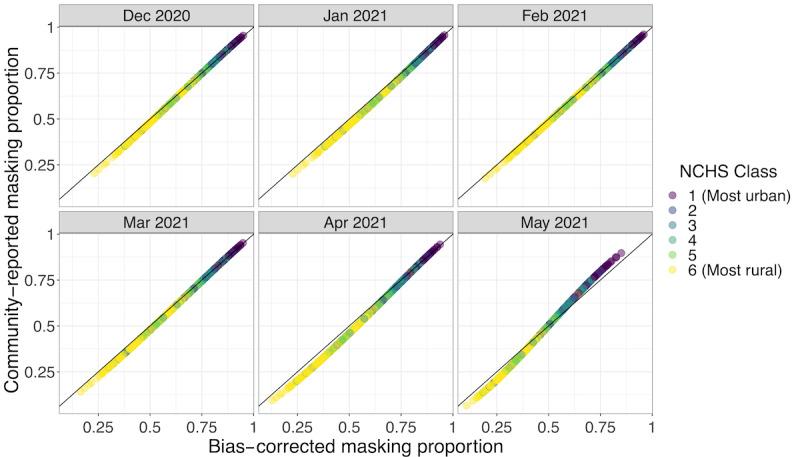
We found that county-level masking behavior was spatially heterogeneous along an urban-rural gradient, with mask wearing peaking in winter 2021 and declining sharply through May 2021. Our results identified regions where targeted public health efforts could have been most effective and suggest that individuals' frequency of mask wearing may be influenced by national guidance and disease prevalence. We validated our bias correction approach by comparing debiased self-reported mask-wearing estimates with community-reported estimates, after addressing issues of a small sample size and representation. Self-reported behavior estimates were especially prone to social desirability and nonresponse biases, and our findings demonstrated that these biases can be reduced if individuals are asked to report on community rather than self behaviors.
CONCLUSIONS
Our work highlights the importance of characterizing public health behaviors at fine spatiotemporal scales to capture heterogeneities that may drive outbreak trajectories. Our findings also emphasize the need for a standardized approach to incorporating behavioral big data into public health response efforts. Even large surveys are prone to bias; thus, we advocate for a social sensing approach to behavioral surveillance to enable more accurate estimates of health behaviors. Finally, we invite the public health and behavioral research communities to use our publicly available estimates to consider how bias-corrected behavioral estimates may improve our understanding of protective behaviors during crises and their impact on disease dynamics.
背景
佩戴口罩已被确定为防止 SARS-CoV-2 传播的有效策略,但在美国从未在全国范围内强制佩戴口罩。这一决定导致了当地政策的拼凑和执行情况的不同,这可能会导致美国 COVID-19 的当地轨迹出现差异。尽管许多研究已经调查了全国范围内的口罩佩戴行为模式和预测因素,但大多数研究都存在调查偏差,而且没有一项研究能够通过不同阶段的大流行来描述美国各地口罩佩戴的精细空间尺度。
目的
迫切需要对美国的口罩佩戴行为进行无偏的时空特征描述。这些信息对于进一步评估口罩的效果、评估大流行不同时间点的传播驱动因素以及通过预测疾病高峰等方式指导未来的公共卫生决策至关重要。
方法
我们分析了 2020 年 9 月至 2021 年 5 月期间,来自美国各地的超过 800 万项行为调查回复的时空口罩佩戴模式。我们使用二项式回归模型和调查排名分别调整了样本量和代表性,以生成县级月度口罩佩戴行为估计值。我们还使用从同一调查中获取的疫苗接种数据与县级官方记录进行比较,得出的偏差衡量标准来纠正自我报告的口罩佩戴估计值。最后,我们评估了个体对其社会环境的看法是否可以作为比自我报告数据更无偏的行为监测形式。
结果
我们发现,县级口罩佩戴行为在城乡梯度上存在空间异质性,2021 年冬季达到峰值,并在 2021 年 5 月急剧下降。我们的研究结果确定了可以采取最有效靶向公共卫生措施的区域,并表明个体的口罩佩戴频率可能受到国家指导和疾病流行率的影响。我们通过比较经偏差修正的自我报告口罩佩戴估计值与社区报告估计值,解决了样本量小和代表性不足的问题,验证了我们的偏差修正方法。自我报告的行为估计值特别容易受到社会期望和无反应偏差的影响,我们的研究结果表明,如果要求个人报告社区而不是自我行为,这些偏差可以减少。
结论
我们的工作强调了在精细时空尺度上描述公共卫生行为的重要性,以捕捉可能推动疫情轨迹的异质性。我们的研究结果还强调了需要采用标准化方法将行为大数据纳入公共卫生应对工作中。即使是大型调查也容易出现偏差;因此,我们提倡采用社会感知方法进行行为监测,以更准确地估计健康行为。最后,我们邀请公共卫生和行为研究界使用我们公开提供的估计值,以考虑在危机期间使用经偏差修正的行为估计值如何提高我们对保护行为的理解及其对疾病动态的影响。


 Zotero 插件